Review
. 2017 Jun 15;16(1):118.
doi: 10.1186/s12944-017-0514-6.

Docosahexaenoic acid regulates vascular endothelial cell function and prevents cardiovascular disease

Affiliations
Review

Docosahexaenoic acid regulates vascular endothelial cell function and prevents cardiovascular disease

Kazuo Yamagata. Lipids Health Dis. .

Abstract

Docosahexaenoic acid (DHA) is present in high concentrations in salmon, herring, and trout. Epidemiologic studies have shown that high dietary consumption of these and other oily fish is associated with reduced rates of myocardial infarction, atherosclerosis, and other ischemic pathologies. Atherosclerosis is induced by inflammation and can lead to acute cardiovascular events and extensive plaque. DHA inhibits the development of inflammation in endothelial cells, alters the function and regulation of vascular biomarkers, and reduces cardiovascular risk. It also affects vascular relaxation and constriction by controlling nitric oxide and endothelin 1 production in endothelial cells. DHA also contributes to the prevention of arteriosclerosis by regulating the expression of oxidized low density lipoprotein receptor 1, plasminogen activator inhibitor 1, thromboxane A2 receptor, and adhesion molecules such as vascular cell adhesion molecule-1, monocyte chemoattractant protein-1, and intercellular adhesion molecule 1 in endothelial cells. Recent research showed that DHA reduces the increase in adhesion factor expression induced by lipopolysaccharide by suppressing toll-like receptor 4. A new mechanism of action of DHA has been described that is mediated through endothelial free fatty acid receptor 4, associated with heme oxygenase 1 induction by Nrf2. However, the efficacy and mechanisms of action of DHA in cardiovascular disease prevention are not yet completely understood. The aim of this paper was to review the effects of DHA on vascular endothelial cells and recent findings on their potential for the prevention of circulatory diseases.

Keywords: Cardiovascular disease; DHA; Endothelial cells.


Figures
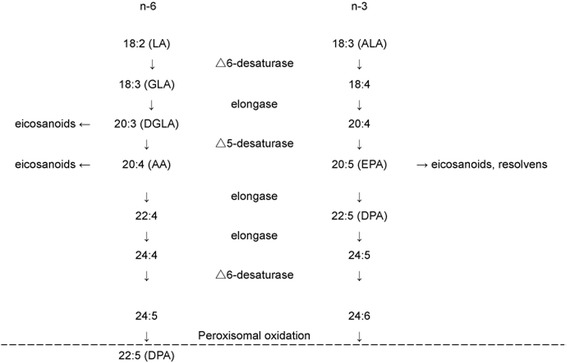
Fig. 1
Fig. 1
Enzymatic conversion of LA to longer-chain n–6 PUFAs and ALA to longer-chain n–3 PUFAs. The conversion of ALA to EPA and DHA is catalyzed by elongase and a desaturase enzyme. The desaturase shares ALA (18:3n-6) with elongase and the conversion ratio is affected by the quantity of substrate. As such, when n-6 PUFA levels are high, the amount that is converted to n-3 PUFA decreases. On the other hand, EPA can be converted to DHA or eicosanoids. Abbreviations: AA, arachidonic acid; ALA, Alpha-linolenic acid; DPA, docosapentaenoic acid; DGLA, dihomo-γ-linolenic acid; EPA, eicosapentaenoic acid; GLA, gamma-Linolenic acid; LA, Linolenic acid; PUFAs, polyunsaturated fatty acids
Fig. 2
Fig. 2
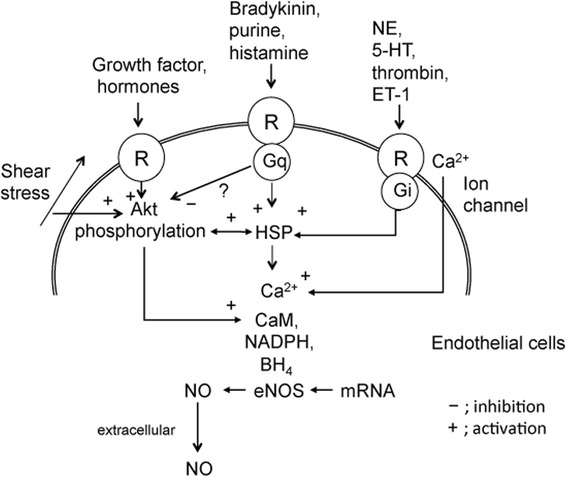
A possible mechanism of nitric oxide production in endothelial cells. Nitric oxide is released through enzymatic conversion of L-arginine by eNOS. eNOS transcription is induced by growth factors and hormones, whereas eNOS enzyme activity requires calcium, calmodulin, NADPH and BH4. The activity of eNOS is regulated by complex formation with these proteins in microdomains of endothelial cells. The L-arginine metabolite, ADMA, reduces production of nitric oxide by competitive binding to eNOS. Abbreviations: R, receptor; HSP, heat shock protein; NE; 5-HT, serotonin (5-hydroxytryptamine); ET-1, endothelin-1; CaM, calmodulin; NADPH, nicotinamide adenine dinucleotide phosphate; BH4, 5,6,7,8-tetra-hydrobiopterine; NO, nitric oxide; eNOS, nitric oxide synthase
Fig. 3
Fig. 3
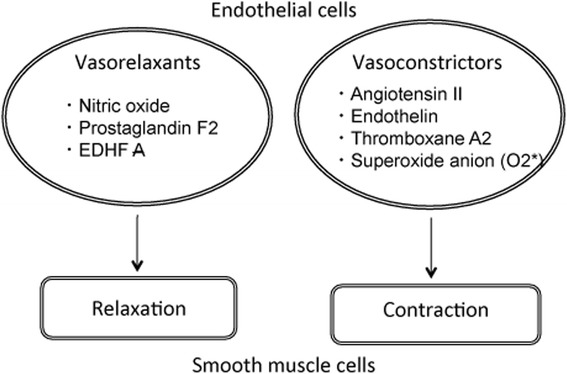
Regulation of relaxation and contraction of smooth muscle cells by vasoactive compounds. Vasoconstriction and vasorelaxation of vascular endothelial cells are controlled by vasoactive molecules such as NO, PGI2, and EDHF that act as vasorelaxants, or vasoconstrictors, which include AII, ET-1, TXA2 and superoxide anion. Abbreviations: AII, angiotensin II; ET-1, endothelin; EDHF, endothelium-derived hyperpolarizing factor. NO, nitric oxide; PGI2, prostaglandin F2; TXA2, thromboxane A2. Abbreviations: AII, angiotensin II; ET-1, endothelin; EDHF, endothelium-derived hyperpolarizing factor. NO, nitric oxide; PGI2, prostaglandin F2; TXA2, thromboxane A2
Fig. 4
Fig. 4
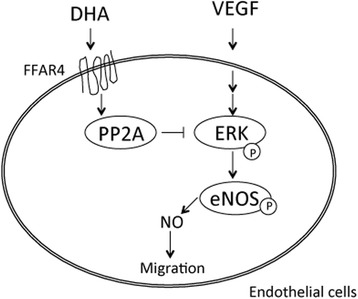
DHA inhibits VEGF-induced endothelial cell migration, which plays a role in angiogenesis and wound repair. The effects of DHA on wound repair and angiogenesis are due, at least in part, to a reduction in cell migration. DHA reduces VEGF-induced cell migration mediated by FFAR4 and the PP2A/ERK1/2/eNOS signaling pathway. Abbreviations: DHA, docosahexaenoic acid; FFAR4, Free fatty acid receptor 4; PP2A, protein phosphatase 2A; ERK, extracellular signal-regulated kinase; eNOS, eNOS, endothelial nitric oxide synthase; NO, nitric oxide
Fig. 5
Fig. 5
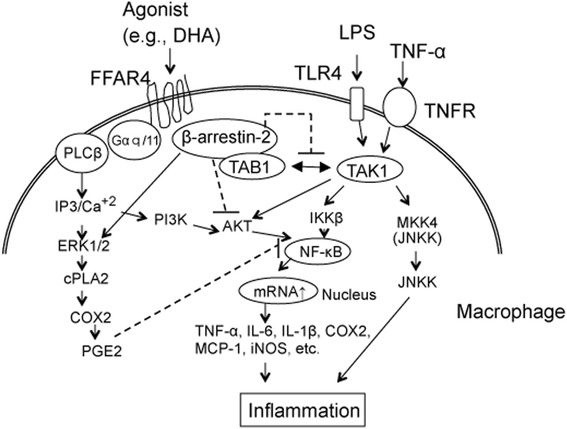
Anti-inflammatory FFA4 signaling pathways in macrophages and mechanisms of action of DHA. Macrophages have FFAR4 signaling pathways that can be affected by anti-inflammatory molecules. LPS and TNF-α induce inflammatory processes following activation of TLR4 and TNFR, which subsequently activate the TAK1 complex of TAK1 and the TAB1 binding protein. Activated TAK1 phosphorylates MKK4 and induces JNK phosphorylation. TAK1 also induces the phosphorylation of IKK-β and NF-κB. NF-κB and phospho-JNK enhance mRNA expression of inflammatory mediators such as TNF-α, IL-6, IL-1β, COX 2, MCP-1 and iNOS. In contrast, FFAR4 together with DHA inhibits TAB1 dissociation and blocks potential TAK1 interactions. Activation of FFAR4 can be induced by β-arrestin-2 enhancement to inhibit its interaction with TAK1. These actions of FFAR4 block downstream activation of NF-κB and JNK to induce anti-inflammatory effects. Abbreviations: DHA, docosahexaenoic acid; FFAR4, Free fatty acid receptor 4; ERK 1/2, extracellular signal-regulated kinase 1/2; COX2, cyclooxygenase 2; TAB1, TGF-β activated kinase 1; TAK1, Transforming growth factor beta-activated kinase 1; TLR4, toll-like receptor 4; LPS, lipopolysaccharide; TNFα, tumor necrosis factor-alpha; TNFR, tumor necrosis factor receptor; MKK4; JNKK, Jun-N-terminal kinase kinase; IL-6, interleukin-6; IL-1β, interleukin-1beta; MCP-1, monocyte chemoattractant protein-1; iNOS, inducible nitric oxide synthase

References

    1. Bang HO, Dyerberg J, Hjorne N. Composition of food consumed by greenland eskimos. Acta Med Scand. 1976;200:69–73. doi: 10.1111/j.0954-6820.1976.tb08198.x. - DOI - PubMed
    1. Bang HO, Dyerberg J, Nielsen AB. Plasma lipid and lipoprotein pattern in Greenlandic west-coast Eskimos. Lancet. 1971;1(7710):1143–1145. doi: 10.1016/S0140-6736(71)91658-8. - DOI - PubMed
    1. Dyerberg J, Bang HO. Haemostatic function and platelet polyunsaturated fatty acids in Eskimos. Lancet. 1979;2(8140):433–435. doi: 10.1016/S0140-6736(79)91490-9. - DOI - PubMed
    1. Dyerberg J, Bang HO, Stoffersen E, Moncada S, Vane JR. Eicosapentaenoic acid and prevention of thrombosis and atherosclerosis? Lancet. 1978;2(8081):117–119. doi: 10.1016/S0140-6736(78)91505-2. - DOI - PubMed
    1. Bjerregaard P, Young TK, Hegele RA. Low incidence of cardiovascular disease among the inuit-what is the evidence? Atherosclerosis. 2003;166:351–357. doi: 10.1016/S0021-9150(02)00364-7. - DOI - PubMed

MeSH terms