Review
. 2018 Feb 1;10(2):a028415.
doi: 10.1101/cshperspect.a028415.

Interleukin-6 Family Cytokines

Affiliations
Review

Interleukin-6 Family Cytokines

Stefan Rose-John. Cold Spring Harb Perspect Biol. .

Abstract

The interleukin (IL)-6 family cytokines is a group of cytokines consisting of IL-6, IL-11, ciliary neurotrophic factor (CNTF), leukemia inhibitory factor (LIF), oncostatin M (OSM), cardiotrophin 1 (CT-1), cardiotrophin-like cytokine (CLC), and IL-27. They are grouped into one family because the receptor complex of each cytokine contains two (IL-6 and IL-11) or one molecule (all others cytokines) of the signaling receptor subunit gp130. IL-6 family cytokines have overlapping but also distinct biologic activities and are involved among others in the regulation of the hepatic acute phase reaction, in B-cell stimulation, in the regulation of the balance between regulatory and effector T cells, in metabolic regulation, and in many neural functions. Blockade of IL-6 family cytokines has been shown to be beneficial in autoimmune diseases, but bacterial infections and metabolic side effects have been observed. Recent advances in cytokine blockade might help to minimize such side effects during therapeutic blockade.


Figures

Figure 1.
Figure 1.
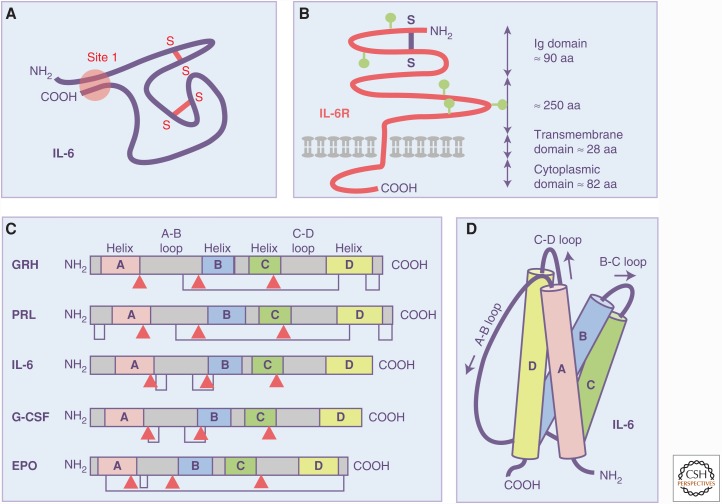
Recognition of interleukin-6 (IL-6) as a four-helical cytokine with up-up–down-down topology. (A) IL-6 was functionally characterized by sets of monoclonal antibodies and it was stated that the NH2 terminus and the COOH terminus must be in close proximity in the biologic active IL-6 protein (Brakenhoff et al. 1990). Hypothesized disulfide bridges are indicated in red. (B) When the complementary DNA (cDNA) coding for the IL-6 receptor (IL-6R) was cloned, no details about structure or function were available and only a schematic model of the IL-6R as a member of the immunoglobulin (Ig) superfamily could be envisioned (Hirano et al. 1989). A single hypothesized disulfide bridge is shown in blue. Postulated N-glycosylation sites are shown in green. (C) It was recognized by Bazan (1990) that, although growth hormone (GRH), prolactin (PRL), IL-6, granulocyte colony-stimulating factor (G-CSF), and erythropoietin (EPO) (Bazan 1990) display no (or at best fragmentary) similarities in amino acid sequence, they share exon–intron boundaries at predicted secondary structure elements (red arrowheads) and predicted disulfide bridges. Based on the known three-dimensional structure of G-CSF (Abdel-Meguid et al. 1987), Bazan postulated that GRH, PRL, IL-6, G-CSF, and EPO formed a structurally related family of cytokines. (D) Model of the IL-6 as a four-helical cytokine with up-up–down-down topology (Bazan 1990).
Figure 2.
Figure 2.
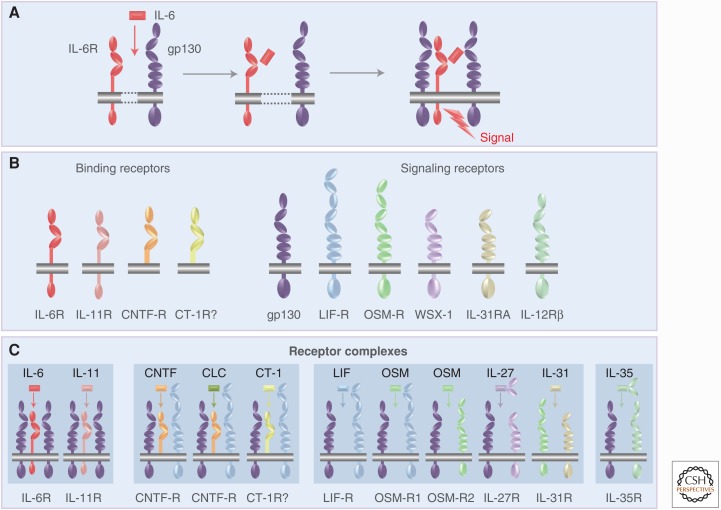
Molecular set-up of the interleukin-6 receptor (IL-6R) complex and comparison with other receptor complexes of IL-6 family cytokines. (A) IL-6 (red) binds to the membrane-bound IL-6R (red) and the complex of IL-6 and IL-6R associate with gp130 (lilac), which dimerizes and initiates signaling. (B) The IL-6 family cytokines act via four different ligand-binding receptors (left) and six different signaling receptors (right). (C) Assembly of the receptor complexes of the IL-6 family cytokines. CNTF, Ciliary neurotrophic factor; CLC, cardiotrophin-like cytokine; CT-1, cardiotrophin 1; LIF, leukemia inhibitory factor; OSM, oncostatin M.
Figure 3.
Figure 3.
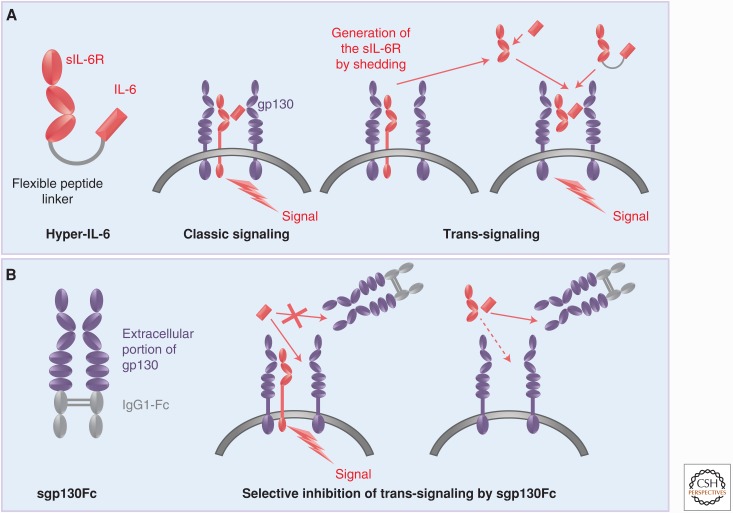
Molecular tools for the analysis of interleukin-6 (IL-6) trans-signaling. (A) IL-6 cannot only bind to the membrane-bound IL-6 receptor (IL-6R) (classic signaling) but also to a soluble IL-6R (sIL-6R), which can be generated by limited proteolysis via ADAM proteases. Cells, which express gp130 but no IL-6R, are not responsive to IL-6 but can be stimulated by the complex of IL-6 and sIL-6R (trans-signaling). IL-6 trans-signaling can be mimicked by the designer cytokine hyper-IL-6 (left) in which IL-6 and sIL-6R are covalently connected by a flexible peptide linker. (B) In the sgp130Fc protein, the extracellular portion of gp130 is fused to the constant portion of a human immunoglobulin G (IgG)1 antibody leading to dimerization by disulfide bridges. Since gp130 has no measurable affinity for IL-6 but binds the IL-6/sIL-6R complex with high affinity, sgp130Fc selectively blocks IL-6 trans-signaling without affecting IL-6 classic signaling via the membrane-bound IL-6R.
Figure 4.
Figure 4.
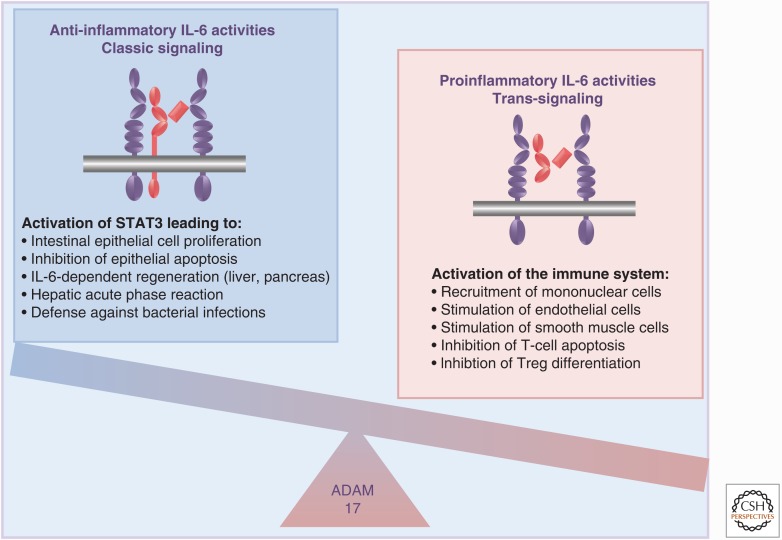
Pro- and anti-inflammatory activities of interleukin-6 (IL-6). IL-6 classic signaling (left) via signal transducer and activator of transcription 3 (STAT3) phosphorylation leads to protective and regenerative activities, whereas IL-6 trans-signaling (right) leads to an activation of the immune system resulting in proinflammatory IL-6 activities. Treg, Regulatory T cell.
Figure 5.
Figure 5.
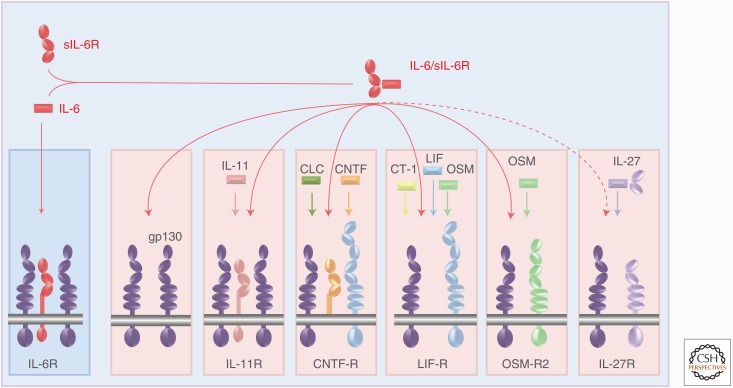
General gp130 activation by the interleukin-6 (IL-6)/soluble IL-6 receptor (sIL-6R) complex. Because all depicted receptor complexes of IL-6 family cytokines contain at least one molecule of gp130, the IL-6/sIL-6R complex can substitute for the activity of all depicted IL-6 family cytokines leading to signal transducer and activator of transcription 3 (STAT3) activation. CLC, Cardiotrophin-like cytokine; CNTF, ciliary neurotrophic factor; LIF, leukemia inhibitory factor; OSM, oncostatin M.

References

    1. Abdel-Meguid SS, Shieh HS, Smith WW, Dayringer HE, Violand BN, Bentle LA. 1987. Three-dimensional structure of a genetically engineered variant of porcine growth hormone. Proc Natl Acad Sci 84: 6434–6437. - PMC - PubMed
    1. Aparicio-Siegmund S, Garbers C. 2015. The biology of interleukin-27 reveals unique pro- and anti-inflammatory functions in immunity. Cytokine Growth Factor Rev 26: 579–586. - PubMed
    1. Atreya R, Mudter J, Finotto S, Mullberg J, Jostock T, Wirtz S, Schutz M, Bartsch B, Holtmann M, Becker C, et al. 2000. Blockade of interleukin 6 trans signaling suppresses T-cell resistance against apoptosis in chronic intestinal inflammation: Evidence in Crohn’s disease and experimental colitis in vivo. Nat Med 6: 583–588. - PubMed
    1. Audet J, Miller CL, Rose-John S, Piret JM, Eaves CJ. 2001. Distinct role of gp130 activation in promoting self-renewal divisions by mitogenically stimulated murine hematopoietic stem cells. Proc Natl Acad Sci 98: 1757–1762. - PMC - PubMed
    1. Barkhausen T, Tschernig T, Rosenstiel P, van Griensven M, Vonberg RP, Dorsch M, Mueller-Heine A, Chalaris A, Scheller J, Rose-John S, et al. 2011. Selective blockade of interleukin-6 trans-signaling improves survival in a murine polymicrobial sepsis model. Crit Care Med 39: 1407–1413. - PubMed

Publication types

LinkOut - more resources