Review
. 2017 May 16:6:F1000 Faculty Rev-683.
doi: 10.12688/f1000research.10342.2. eCollection 2017.

Metabolic reprogramming during the Trypanosoma brucei life cycle

Affiliations
Review

Metabolic reprogramming during the Trypanosoma brucei life cycle

Terry K Smith et al. F1000Res. .

Abstract

Cellular metabolic activity is a highly complex, dynamic, regulated process that is influenced by numerous factors, including extracellular environmental signals, nutrient availability and the physiological and developmental status of the cell. The causative agent of sleeping sickness, Trypanosoma brucei, is an exclusively extracellular protozoan parasite that encounters very different extracellular environments during its life cycle within the mammalian host and tsetse fly insect vector. In order to meet these challenges, there are significant alterations in the major energetic and metabolic pathways of these highly adaptable parasites. This review highlights some of these metabolic changes in this early divergent eukaryotic model organism.

Keywords: Trypanosoma brucei; adaptations; metabolism.


Conflict of interest statement

Competing interests: The authors declare that they have no competing interests.No competing interests were disclosed.No competing interests were disclosed.No competing interests were disclosed.No competing interests were disclosed.

Figures
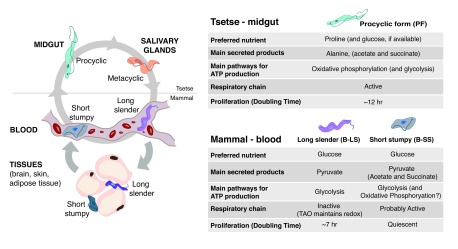
Figure 1.
Figure 1.. Changes in metabolism during the life cycle of Trypanosoma brucei.
T. brucei life cycle spans two hosts: a mammal (human, cattle, wild animals) and the tsetse fly. As this protozoan parasite is extracellular, it adapts its metabolism to the available extracellular nutrients. The two stages that have been better characterised in terms of metabolism are the bloodstream long slender and procyclic forms, which mainly catabolise glucose and proline, respectively. Fewer studies have studied bloodstream short stumpy forms. In the mammalian host, parasites accumulate in the interstitial spaces of several tissues, mainly the brain, skin and visceral adipose tissue (adipocytes are shown as an example). The metabolism of parasites in these tissues remains mostly unknown, except for the activation of fatty acid β-oxidation in parasites resident of the adipose tissue. Metabolism of metacyclic stage has not been characterised to date. TAO, trypanosome alternative oxidase.
Figure 2.
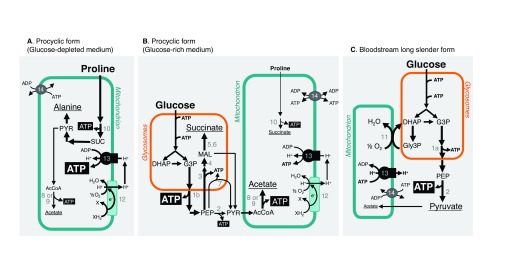
Figure 2.. Multiple pathways to produce ATP in trypanosomes.
Catabolism of the most abundant carbon sources in procyclic form grown in glucose-depleted ( A) or in glucose-containing ( B) conditions and in bloodstream long slender form ( C). Excreted end-products from glucose and proline degradation (pyruvate, acetate, succinate and alanine) are underlined. Arrows with different thicknesses tentatively represent the metabolic flux at each enzymatic step. In ( B), the direction of ADP/ATP exchange between the cytosol and the mitochondrion (step 14) is unknown and is represented by double arrows. Key enzymatic steps: 1a, glycosomal phosphoglycerate kinase; 1b, cytosolic phosphoglycerate kinase; 2, pyruvate kinase; 3, phosphoenolpyruvate carboxykinase; 4, glycosomal malate dehydrogenase; 5, cytosolic fumarase (for simplification this reaction is placed in the glycosome); 6, glycosomal NADH-dependent fumarate reductase; 7, pyruvate phosphate dikinase; 8, acetate:succinate coenzyme A-transferase, or ASCT; 9, acetyl-coenzyme A thioesterase; 10, succinyl-coenzyme A synthetase; 11, trypanosome alternative oxidase; 12, respiratory chain; 13, F 0F 1-ATP synthase; 14, mitochondrial ADP/ATP exchanger. AcCoA, acetyl-coenzyme A; DHAP, dihydroxyacetone phosphate; G3P, glyceraldehyde 3-phosphate; Gly3P, glycerol 3-phosphate; MAL, malate; PEP, phosphoenolpyruvate; PYR, pyruvate; SUC, succinate.

References

    1. Franco JR, Simarro PP, Diarra A, et al. : Epidemiology of human African trypanosomiasis. Clin Epidemiol. 2014;6:257–75. 10.2147/CLEP.S39728 - DOI - PMC - PubMed
    2. F1000 Recommendation

    1. Morrison LJ, Vezza L, Rowan T, et al. : Animal African Trypanosomiasis: Time to Increase Focus on Clinically Relevant Parasite and Host Species. Trends Parasitol. 2016;32(8):599–607. 10.1016/j.pt.2016.04.012 - DOI - PubMed
    1. Gualdrón-López M, Brennand A, Hannaert V, et al. : When, how and why glycolysis became compartmentalised in the Kinetoplastea. A new look at an ancient organelle. Int J Parasitol. 2012;42(1):1–20. 10.1016/j.ijpara.2011.10.007 - DOI - PubMed
    1. Caljon G, van Reet N, De Trez C, et al. : The Dermis as a Delivery Site of Trypanosoma brucei for Tsetse Flies. PLoS Pathog. 2016;12(7):e1005744. 10.1371/journal.ppat.1005744 - DOI - PMC - PubMed
    2. F1000 Recommendation

    1. Capewell P, Cren-Travaillé C, Marchesi F, et al. : The skin is a significant but overlooked anatomical reservoir for vector-borne African trypanosomes. eLife. 2016;5: pii: e17716. 10.7554/eLife.17716 - DOI - PMC - PubMed
    2. F1000 Recommendation

LinkOut - more resources