


Review
doi: 10.1007/s12028-017-0416-5.
The Role of Mast Cells in Intracerebral Hemorrhage
Affiliations
- PMID: 28620846
- PMCID: PMC5732094
- DOI: 10.1007/s12028-017-0416-5
Item in Clipboard
Review
The Role of Mast Cells in Intracerebral Hemorrhage
Neurocrit Care.
2018 Jun.
Abstract
Mast cells are first responders to intracerebral hemorrhage. They release potent mediators that can disrupt the blood-brain barrier promoting injury, vasogenic edema formation, and hematoma exacerbation. Also, mast cells recruit other inflammatory cells that maintain and amplify brain damage. Given their early role in the cascade of events in intracerebral hemorrhage, mast cells may offer an alternative target for antichemotactic interventions.
Keywords: Blood–brain barrier; Cytokines; Edema; Inflammation; Intracerebral hemorrhage; Mast cells.
Figures
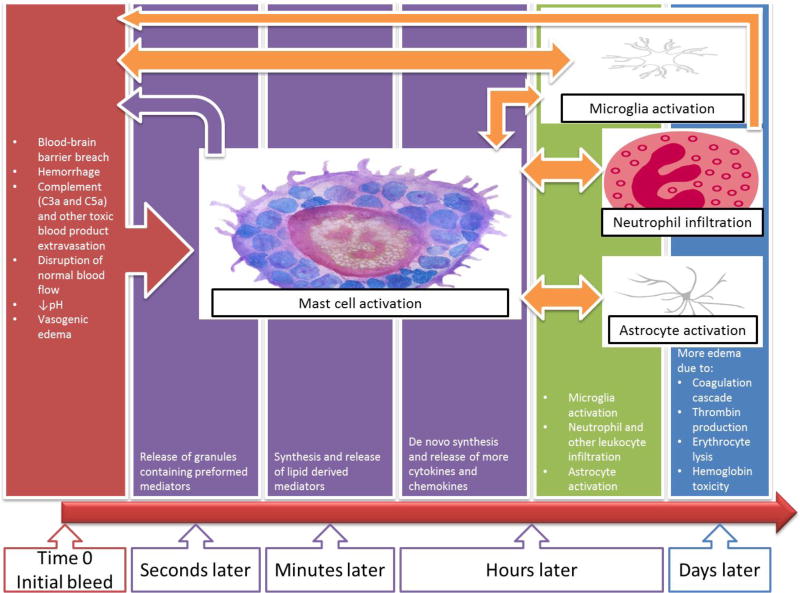
Graphical description of the time sensitive mast cell activation process and the inflammatory cascade after intracerebral hemorrhage.
References
-
- Ghably J, Saleh H, Vyas H, Peiris E, Misra N, Krishnaswamy G. Paul Ehrlich's mastzellen: a historical perspective of relevant developments in mast cell biology. Methods in molecular biology. 2015;1220:3–10. - PubMed
-
- Nelissen S, Lemmens E, Geurts N, Kramer P, Maurer M, Hendriks J, Hendrix S. The role of mast cells in neuroinflammation. Acta neuropathologica. 2013;125(5):637–650. - PubMed
-
- Collington SJ, Williams TJ, Weller CL. Mechanisms underlying the localisation of mast cells in tissues. Trends in Immunology. 2011;32(10):478–485. - PubMed
-
- Silver R, Curley JP. Mast cells on the mind: new insights and opportunities. Trends in neurosciences. 2013;36(9):513–521. - PubMed
-
- Ribatti D. The crucial role of mast cells in blood-brain barrier alterations. Experimental cell research. 2015;338(1):119–125. - PubMed
Publication types
MeSH terms
Grants and funding
LinkOut - more resources
Full Text Sources
Other Literature Sources
Medical
