. 2017 Sep;24(9):1588-1597.
doi: 10.1038/cdd.2017.85. Epub 2017 Jun 16.

Hepatocyte nuclear factor 1b is a novel negative regulator of white adipocyte differentiation

Affiliations

Hepatocyte nuclear factor 1b is a novel negative regulator of white adipocyte differentiation

Xin Wang et al. Cell Death Differ. 2017 Sep.

Abstract

Hepatocyte nuclear factor 1b (HNF1b) is a transcription factor belonging to the HNF family. We aimed to investigate the role of HNF1b in white adipocyte differentiation. The expression of HNF1b was reduced in white adipose tissue (WAT) of both diet-induced and genetic obese mice and decreased during the process of 3T3-L1 adipocyte differentiation. Downregulation of HNF1b enhanced 3T3-L1 adipocyte differentiation and upregulation of HNF1b inhibited this process. Upregulation of HNF1b inhibited peroxisome proliferator-activated receptor γ (PPARγ) and its target gene expression, while downregulation of HNF1b increased those genes expression. Overexpression of PPARγ suppressed HNF1b upregulation-induced inhibition of adipocyte differentiation. HNF1b can directly bind with the promoter of PPARγ in 3T3-L1 cells, which was decreased after adipogenic differentiation. HNF1b promoted apoptotic and autophagic cell death in early differentiated adipocytes through regulation of cell cycle progress and cell death-related factors, and thus inhibited the process of mitotic clonal expansion (MCE). HNF1b acted as an antioxidant regulator through regulating various antioxidant enzymes via binding with antioxidant response element. Oxidant treatment suppressed HNF1b upregulation-induced inhibition of adipocyte differentiation. Overall, our results suggest that HNF1b is a novel negative regulator of adipocyte differentiation through regulation of PPARγ signaling, MCE and redox state.


Conflict of interest statement

The authors declare no conflict of interest.

Figures
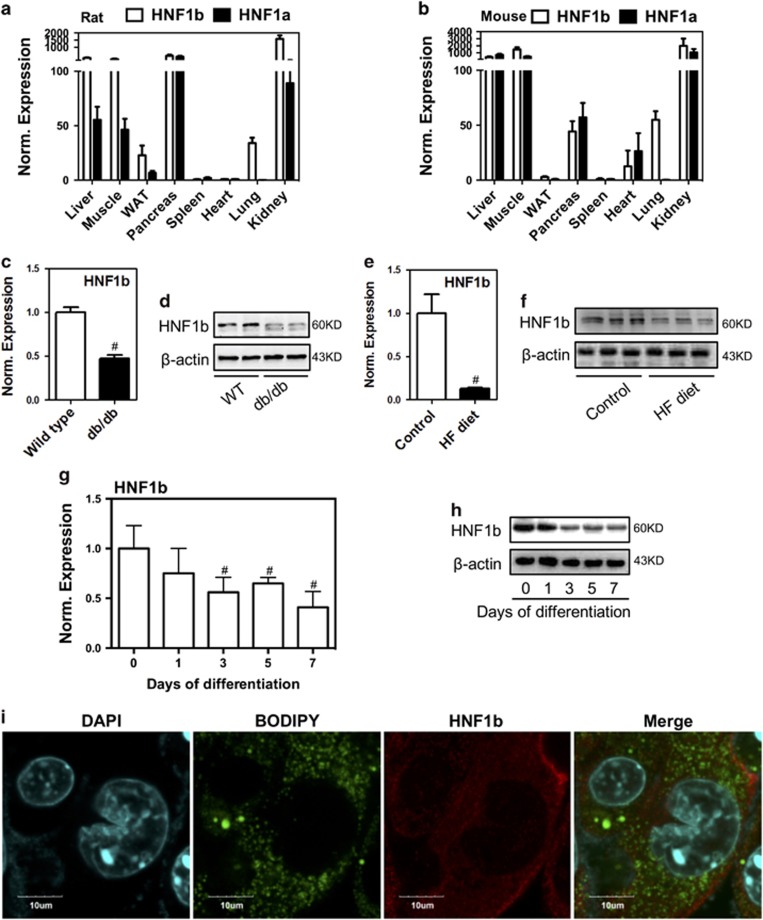
Figure 1
Figure 1
Expression pattern of HNF1b in adipose tissue of animals and during adipocyte differentiation. (a and b) mRNA expression of HNF1b in several tissues in rats and mice were determined. (c and d) mRNA and protein expression of HNF1b in WAT in wild-type and db/db mice were detected. (e and f) mRNA and protein expression of HNF1b in WAT in HF diet-fed mice were detected. (g and h) mRNA and protein expression of HNF1b during 3T3-L1 adipocyte differentiation. (i) Immunostaining of HNF1b and BODIPY staining in differentiated 3T3-L1 adipocytes. #P<0.05, compared with control
Figure 2
Figure 2
Effect of knockdown and knockup of HNF1b on 3T3-L1 adipocyte differentiation. 3T3-L1 cell lines with stable knockdown (KD) and knockup (KU) of HNF1b were established using lentivirus transfection. HNF1b KD and KU 3T3-L1 cells were induced to adipogenic differentiation. (a and b) BODIPY and Oil Red O staining in differentiated HNF1b KD 3T3-L1 cells with or without 1 μM RSG treatment. Statistical analysis of Oil Red O staining was shown (c). (d and e) BODIPY and Oil Red O staining in differentiated HNF1b KU 3T3-L1 cells with or without 1 μM RSG treatment. Statistical analysis of Oil Red O staining was shown (f). 3T3-L1 cells were transiently transfected with HNF1b plasmid and then induced to adipogenic differentiation. (g) Oil Red O staining in differentiated 3T3-L1 cells transfected with HNF1b plasmid with or without 1 μM RSG treatment. #P<0.05
Figure 3
Figure 3
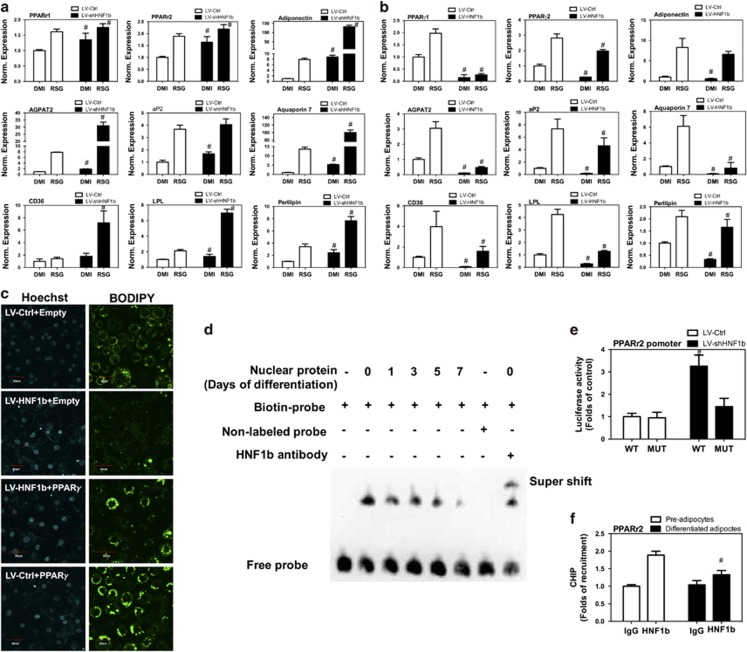
Effect of knockdown and knockup of HNF1b on PPARγ and its target gene expression in differentiated 3T3-L1 adipocytes. 3T3-L1 cell lines with stable KD and KU of HNF1b were established using lentivirus transfection. HNF1b KD and KU 3T3-L1 cells were induced to adipogenic differentiation. (a) mRNA expression of PPARγ1, PPARγ2, adiponectin, AGPAT2, aP2, aquaporin 7, CD36, LPL and perilipin in differentiated HNF1b KD 3T3-L1 cells. (b) mRNA expression of PPARγ1, PPARγ2, adiponectin, AGPAT2, aP2, aquaporin 7, CD36, LPL and perilipin in differentiated HNF1b KU 3T3-L1 cells. HNF1b KU 3T3-L1 cells were transfected with PPARγ plasmid and induced to adipogenic differentiation. (c) BODIPY staining in differentiated HNF1b KU 3T3-L1 cells transfected with PPARγ plasmid. (e) 3T3-L1 preadipocytes were induced to adipogenic differentiation. On days 0, 1, 3, 5 and 7, nuclear extracts were obtained and EMSA detection of HNF1b-binding in the putative binding sites in the PPARγ 2 promoter was performed. (d) 3T3-L1 cell lines with stable KD and KU of HNF1b were established using lentivirus transfection. The cells were transfected with wild-type promoter (WT) or its derivative containing site-direct mutagenesis of the putative HNF1b-binding site (MUT). Fold change of luciferase activity was calculated. (f) 3T3-L1 preadipocytes were induced to adipogenic differentiation and HNF1b-binding of PPARγ promoter in preadipocytes and differentiated adipocytes were determined. #P<0.05, compared with respective control
Figure 4
Figure 4
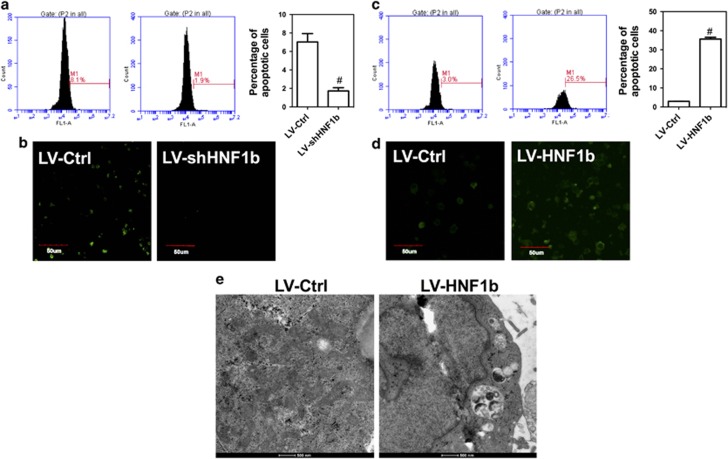
Effect of knockdown and knockup of HNF1b on apoptosis and autophagy in differentiated 3T3-L1 adipocytes. 3T3-L1 cell lines with stable KD and KU of HNF1b were established using lentivirus transfection. HNF1b KD and KU 3T3-L1 cells were induced to adipogenic differentiation. (a) Flow cytometry analysis of TUNEL-stained cells in differentiated HNF1b KD 3T3-L1 cells. (b) Confocal observation of TUNEL-stained cells in differentiated HNF1b KD 3T3-L1 cells. (c) Flow cytometry analysis of TUNEL-stained cells in differentiated HNF1b KU 3T3-L1 cells. (d) Confocal observation of TUNEL-stained cells in differentiated HNF1b KU 3T3-L1 cells. (e) Images of differentiated HNF1b KD 3T3-L1 cells under TEM. #P<0.05, compared with control
Figure 5
Figure 5
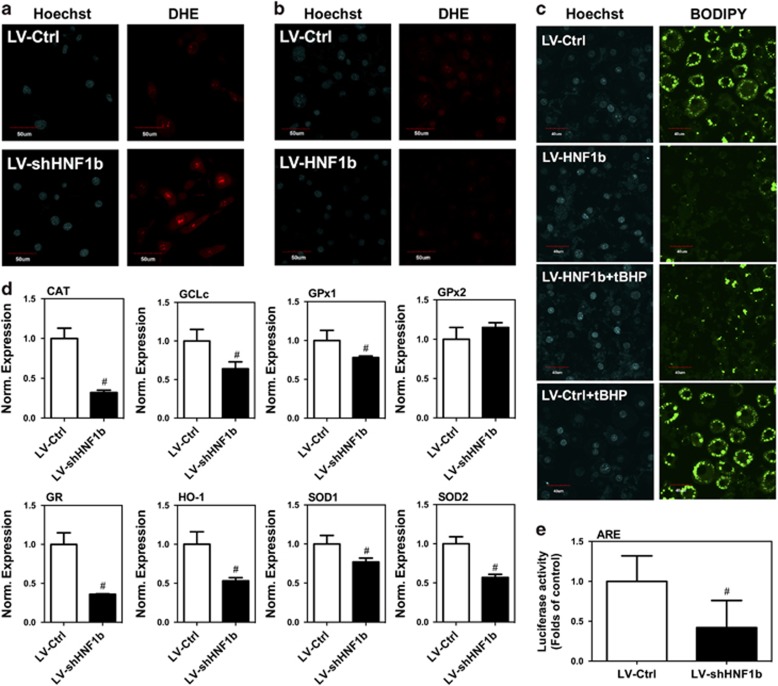
Effect of knockdown and knockup of HNF1b on redox state in differentiated 3T3-L1 adipocytes. 3T3-L1 cell lines with stable KD and KU of HNF1b were established using lentivirus transfection. HNF1b KD and KU 3T3-L1 cells were induced to adipogenic differentiation. (a) DHE staining in differentiated HNF1b KD 3T3-L1 cells. (b) DHE staining in differentiated HNF1b KU 3T3-L1 cells. HNF1b KU 3T3-L1 cells were treated by tBHP and induced to adipogenic differentiation. (c) BODIPY staining in differentiated HNF1b KU 3T3-L1 cells treated by tBHP. (d) mRNA expression of CAT, GCLc, GPx1, GPx2, GR, HO-1, SOD1 and SOD2 in differentiated HNF1b KD 3T3-L1 cells. HNF1b KD 3T3-L1 cells were transfected with pARE-luc and ARE luciferase activity was examined. #P<0.05, compared with control
Figure 6
Figure 6
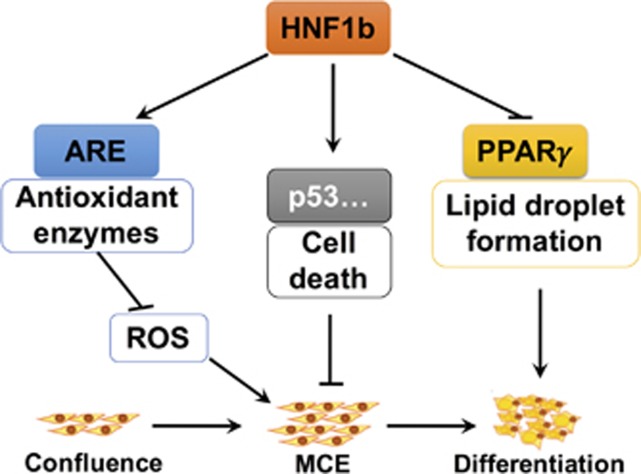
Schematic figure of the molecular mechanisms underlying inhibitory role of HNF1b in adipocyte differentiation. HNF1b has an inhibitory role in adipocyte differentiation and adipose formation. The mechanism involves downregulation of ROS level, promotion of cell death, and downregulation of PPARγ and its target gene expression, leading to inhibition of adipocyte differentiation

References

    1. Tronche F, Yaniv M. HNF1, a homeoprotein member of the hepatic transcription regulatory network. Bioessays 1992; 14: 579–587. - PubMed
    1. Cereghini S, Blumenfeld M, Yaniv M. A liver-specific factor essential for albumin transcription differs between differentiated and dedifferentiated rat hepatoma cells. Genes Dev 1988; 2: 957–974. - PubMed
    1. Rey-Campos J, Chouard T, Yaniv M, Cereghini S. vHNF1 is a homeoprotein that activates transcription and forms heterodimers with HNF1. EMBO J 1991; 10: 1445–1457. - PMC - PubMed
    1. Ulinski T, Bensman A, Lescure S. Abnormalities of hepatocyte nuclear factor (HNF)-1beta: biological mechanisms, phenotypes, and clinical consequences. Arch Pediatr 2009; 16: 1049–1056. - PubMed
    1. Bell GI, Xiang KS, Newman MV, Wu SH, Wright LG, Fajans SS et al. Gene for non-insulin-dependent diabetes mellitus (maturity-onset diabetes of the young subtype) is linked to DNA polymorphism on human chromosome 20q. Proc Natl Acad Sci USA 1991; 88: 1484–1488. - PMC - PubMed

LinkOut - more resources