. 2017 Jun 15;169(7):1249-1262.e13.
doi: 10.1016/j.cell.2017.05.036.

Microbial Genetic Composition Tunes Host Longevity

Affiliations

Microbial Genetic Composition Tunes Host Longevity

Bing Han et al. Cell. .

Erratum in

  • Microbial Genetic Composition Tunes Host Longevity.
    Han B, Sivaramakrishnan P, Lin CJ, Neve IAA, He J, Tay LWR, Sowa JN, Sizovs A, Du G, Wang J, Herman C, Wang MC. Han B, et al. Cell. 2018 May 3;173(4):1058. doi: 10.1016/j.cell.2018.04.026. Cell. 2018. PMID: 29727664 Free PMC article. No abstract available.

Abstract

Homeostasis of the gut microbiota critically influences host health and aging. Developing genetically engineered probiotics holds great promise as a new therapeutic paradigm to promote healthy aging. Here, through screening 3,983 Escherichia coli mutants, we discovered that 29 bacterial genes, when deleted, increase longevity in the host Caenorhabditis elegans. A dozen of these bacterial mutants also protect the host from age-related progression of tumor growth and amyloid-beta accumulation. Mechanistically, we discovered that five bacterial mutants promote longevity through increased secretion of the polysaccharide colanic acid (CA), which regulates mitochondrial dynamics and unfolded protein response (UPRmt) in the host. Purified CA polymers are sufficient to promote longevity via ATFS-1, the host UPRmt-responsive transcription factor. Furthermore, the mitochondrial changes and longevity effects induced by CA are conserved across different species. Together, our results identified molecular targets for developing pro-longevity microbes and a bacterial metabolite acting on host mitochondria to promote longevity.

Keywords: colanic acid; longevity; microbiota-host interaction; mitochondrial dynamics; mitochondrial unfolded protein response; probiotics.


Figures

Figure 1
Figure 1. Bacterial mutants promote host longevity
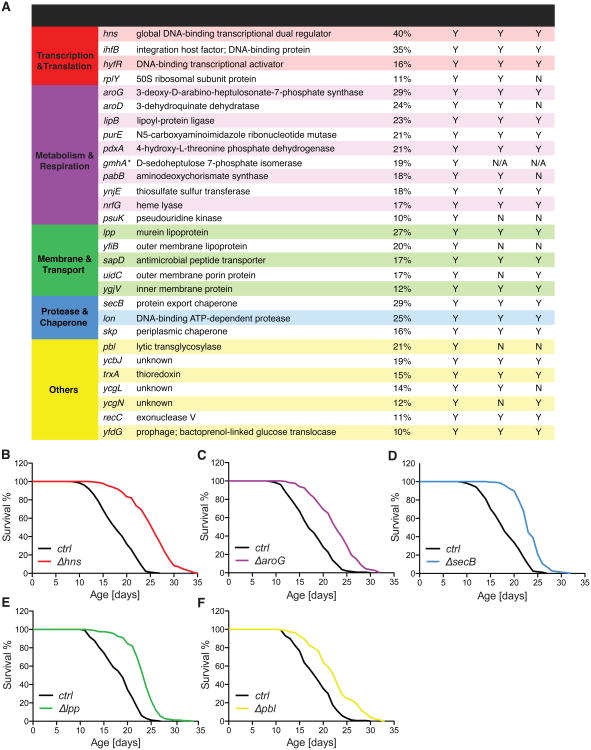
(A) A genome-wide screen of the E. coli BW25113 single-gene knockout library identified 29 mutants that prolong C. elegans lifespan by more than 10% (p<0.001, log-rank test). 21 of these mutants significantly prolong lifespan when provided only to C. elegans adults (p<0.05, log-rank test), and 23 of them also promote host longevity in the wild-type E. coli MG1655 strain background (p<0.05, log-rank test). These longevity-promoting bacterial mutants are classified into different functional categories, delineated by different colors. An asterisk marks the gmhA gene, when deleted, resulting in resistance to P1 phage. (B to F) Lifespan extensions by different functional categories of bacterial mutants are represented by Δhns (B), ΔaroG (C), ΔsecB (D), Δlpp (E), and Δpbl (F), respectively. See Figure S1 for information on the control bacteria and the design of the screen, Figure S2 for information of viability and colonization capacities of the mutants, Figure S7 for the enrichment of genes involved in chorismate metabolism, and Table S1 to S3 for lifespan data including animal numbers, mean and median lifespans, and statistics.
Figure 2
Figure 2. Bacterial mutants attenuate age-related pathologies in the host
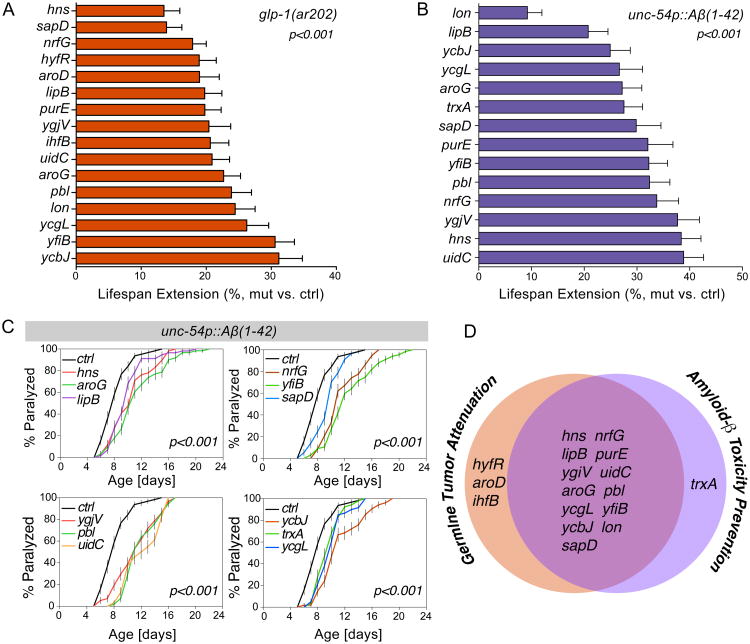
(A) 16 bacterial mutants significantly increase the survival of the C. elegans glp-1(ar202) mutants, which exhibit early death due to age-related progression of germline tumors (p<0.001, Log-rank test). (B) Ectopic expression of human amyloid-β (Aβ) in the C. elegans CL2006 transgenic strain dvIs2[unc-54p∷Aβ(1-42)] leads to a shortened lifespan. 14 bacterial mutants significantly increase the survival of this strain (p<0.001, Log-rank test). Survival analyses were conducted three times independently. The average percentage of lifespan extension by each bacterial mutant vs. the parental control is shown, and error bars represent standard error of the mean (SEM). (C) 12 of the bacterial mutants that increase the survival of the CL2006 strain also significantly delay the onset of paralysis caused by Aβ proteotoxicity (p<0.001, Log-rank test). Error bars represent SEM. (D) The sets of the bacterial mutants that protect C. elegans against the lethality of germline tumor and Aβ accumulation are largely overlapped. See Table S4 and S5 for survival data of three independent trails including animal numbers, mean lifespans and statistics.
Figure 3
Figure 3. Genetic interaction analyses with host longevity mechanisms
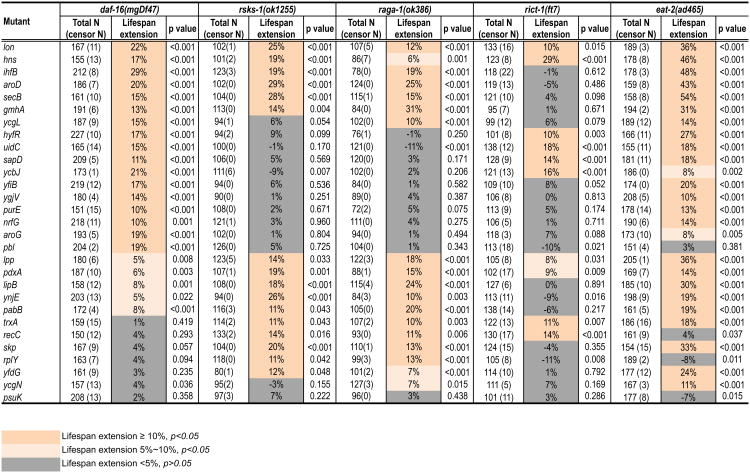
Bacterial mutants were examined for their effects on the lifespans of the daf-16(mgDf47), rsks-1(ok1255), raga-1(ok386), rict-1(ft7), and eat-2(ad465) C. elegans mutants. Grey colors mark the candidates showing dependence on these known host longevity regulatory pathways, and apricot colors mark the ones acting independently. Total N, the number of total animals; censor N, the number of censored animals; Lifespan extension, the percentage of lifespan extension in different C. elegans mutants on each bacterial mutant compared to those on parental control bacteria; p-values, bacterial mutant vs. parental control by Log-rank test. See Figure S3 for effects of bacterial mutants on C. elegans feeding and defecation behaviors.
Figure 4
Figure 4. Colanic acid-overproducing bacterial mutants promote host longevity
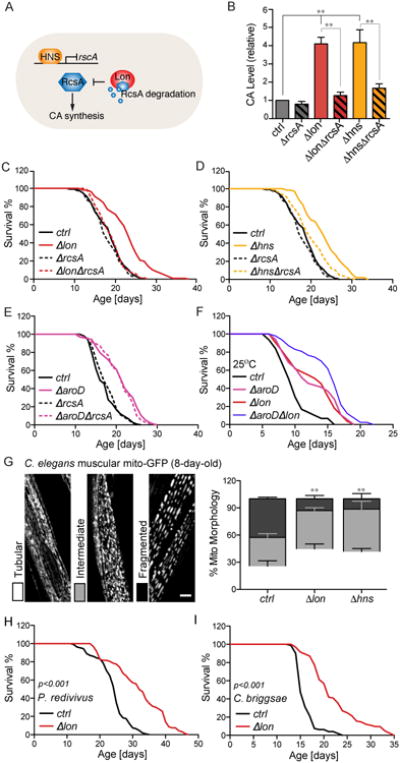
(A) Schematic depiction of biosynthesis of colanic acid (CA) in bacteria. RcsA, a positive activator required for CA biosynthesis, can be transcriptionally repressed by H-NS and degraded by the Lon protease. (B) Both Δlon and Δhns show increased CA secretion in the culture medium, which are completely suppressed by the deletion of rcsA (**p<0.01, one-way ANOVA followed by Bonferroni's multiple comparison test). Error bars represent SEM. (C and D) The ΔrcsA deletion suppresses the lifespan extension conferred by Δlon (C) and Δhns (D) (p<0.001, double mutants vs. corresponding single mutants, Log-rank test). Experiments were conducted in parallel with same parental controls and ΔrcsA mutants. (E) The ΔrcsA deletion does not affect the lifespan extension conferred by ΔaroD (p>0.05, ΔaroDΔrcsA vs. ΔaroD, Log-rank test). (F) Δlon further enhances the lifespan extension conferred by ΔaroD (p<0.05, ΔaroDΔlon vs. ΔaroD, Log-rank test). (G) Both Δlon and Δhns mutants significantly lower the levels of mitochondrial fragmentation in the transgenic C. elegans expressing mito-GFP in body wall muscles (raxIs[myo-3p∷mitoGFP]), visualized at day-8 adulthood. Different mitochondrial morphologies were classified as tubular, intermediate and fragmented (representative images are shown, scale bar = 10μm), and quantified double-blindly. Error bars represent SEM; **p<0.01 bacterial mutant vs. parental control by Student's t-test. (H and I) The Dlon bacterial mutant significantly prolongs the lifespan of P. redivivus (H) and C. briggsae (I) (p<0.001, Log-rank test). See Figure S4 for information on additional CA-overproducing mutants, and Table S6 for lifespan data including animal numbers, mean and median lifespans, and statistics.
Figure 5
Figure 5. Purified colanic acid promotes host longevity across species
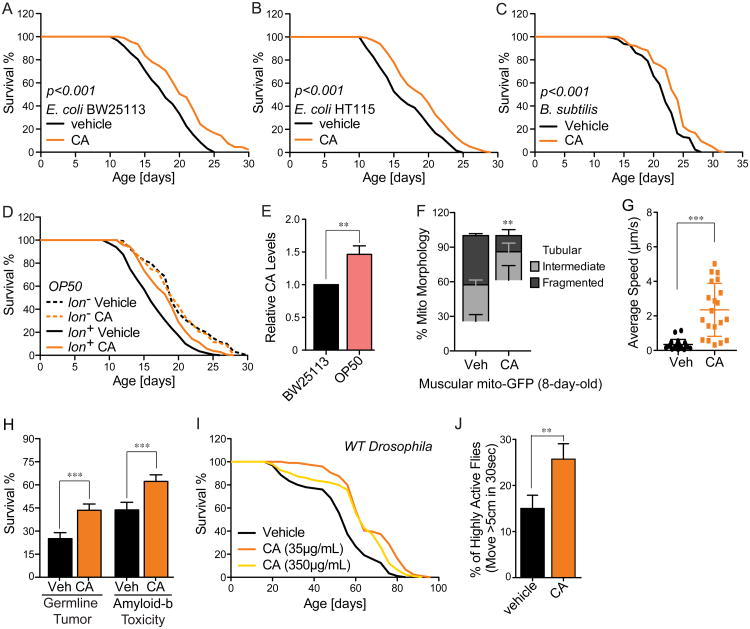
(A to C) CA significantly prolongs the lifespan of wild-type C. elegans when supplemented with gram-negative E. coli BW25113 (A) and HT115 (B), and with gram-positive B. subtilis (C) (p<0.001, CA vs. vehicle control (ddH2O), Log-rank test). (D) CA supplementation does not prolong the lifespan of C. elegans grown on lon-deficient E. coli B OP50 (p>0.5, Log-rank test), but resumes its effects when lon expression is restored in OP50 (p<0.001, Log-rank test). (E) E. coli OP50 produces 50% more CA than E. coli BW25113 (**p<0.01, Student's t-test). (F) Muscular cells of 8-day-old C. elegans with CA supplementation display significantly increased levels of tubular mitochondrial morphology, compared to those on parental control bacteria (**p<0.01, Student's t-test). (G) CA supplementation increases locomotion velocity of aged C. elegans, measured at day 15 of adulthood (***p<0.0001, non-parametric t-test). (H) CA supplementation increases the survival of the glp-1(ar202) tumorous mutants and the transgenic strains expressing human Aβ (***p<0.001, Log-rank test). (I) CA supplementation during adulthood at different concentrations significantly prolongs the lifespan of wild-type Drosophila OreR males (p<0.05, CA vs. vehicle control, Log-rank test). (J) 15 days old Drosophila adults supplemented with CA have increased mobility, compared to the vehicle controls (**p<0.01, non-parametric t-test). Error bars represent SEM. See Table S7 for detailed lifespan data including animal numbers, mean and median lifespans and statistics.
Figure 6
Figure 6. Polymer forms of CA act directly on the host to promote longevity
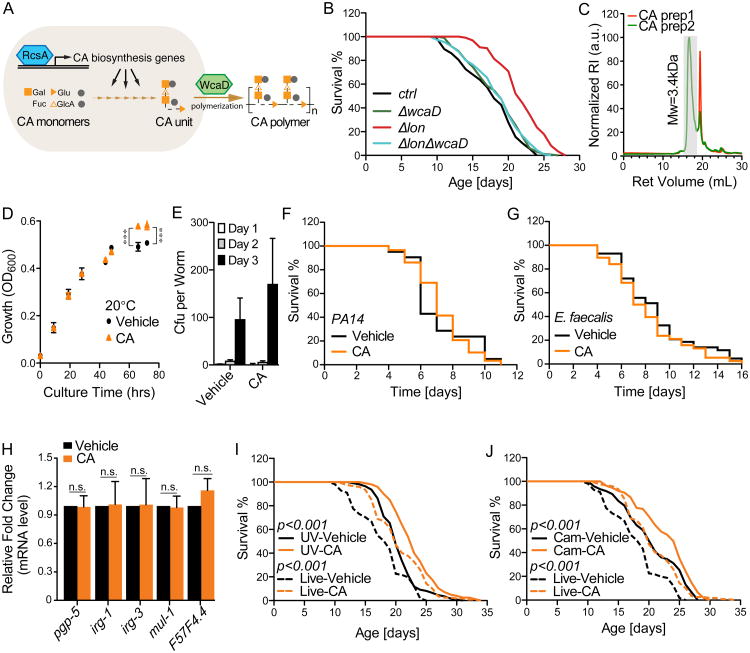
(A) Schematic depiction of CA polymerization in bacteria. RcsA activates the CA biosynthesis gene cluster. The CA unit contains 6 monomers, glucose (Glc), galactose (Gal), fucose (Fuc), glucuronic acid (GlcA), pyruvate (Pyr), and acetate (Ac), and is polymerized by WcaD in the periplasm. (B) Inhibition of CA polymerization by the bacterial ΔwcaD deletion fully suppresses the lifespan extension of C. elegans induced by the Δlon bacterial mutant (p>0.05, ΔwcaDΔlon vs. ΔwcaD, Log-rank test). (C) Gel permeation chromatography analysis determines the molecular weight of purified CA as ∼3.4kDa. Peaks after 19mL of retention volume are derived from the solvent. (D) CA does not reduce bacterial growth. The parental control E. coli BW25113 supplemented with water or CA were grown on worm standard plates at 20°C, and collected at designated time points to measure OD600 (*** p<0.001 CA vs. vehicle, Student's t-test). Error bars represent SEM. (E) The colonization of bacteria in the C. elegans gut is not affected by CA supplementation (p>0.5, Student's t-test). Error bars represent SEM. (F and G) CA supplementation does not affect the survival of C. elegans infected by Pseudomonas aeruginosa PA14 (F) or Enterococcus faecalis (G) (p>0.5, Log-rank test). (H) Expressions of five pathogenic response genes are not affected by CA supplementation (n.s. p>0.5, Student's t-test). Error bars represent standard deviation. (I and J) When supplemented to bacteria killed by UV (I) or inactivated by chloramphenicol (J), CA is still sufficient to prolong lifespan (p<0.001, CA vs. vehicle control, Log-rank test). Experiments were conducted in parallel with same live-bacteria controls (vehicle and CA treated). See Figure S5 for lifespan data on CA monomers/unit, other polysaccharides, and CA with endocytosis mutants, and Table S6 and Table S7 for lifespan data including animal numbers, mean and median lifespans, and statistics.
Figure 7
Figure 7. CA acts on host mitochondria to promote longevity
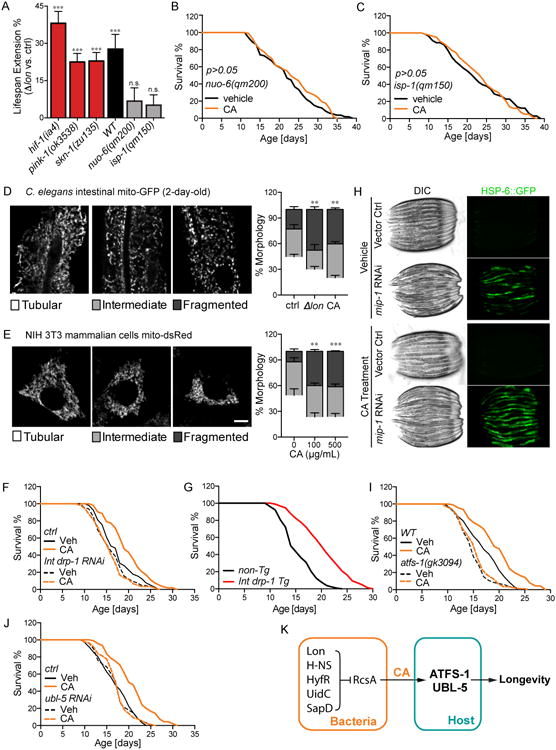
(A) The Δlon bacterial mutant extends the lifespan of C. elegans hif-1(ia4), skn-1(zu135), and pink-1(ok3538) mutants, but is not able to do so in the mutants of C. elegans ETC components, nuo-6(qm200) or isp-1(qm15) (***p<0.001, n.s. p>0.05, Δlon vs. parental control, Log-rank test). Error bars represent SEM. (B and C) CA supplementation cannot further increase the lifespan extension conferred by the mitochondrial ETC mutations, nuo-6(qm200) (B) and isp-1(qm150) (C) (p>0.05, CA vs. vehicle control, Log-rank test). (D) Both the Δlon mutant and CA supplementation increase mitochondrial fragmentation in C. elegans intestinal cells (**p<0.01, Student's t-test). The transgenic strain expressing mito-GFP in the intestine (raxIs[ges-1p∷mitoGFP]) was analyzed at day-2 adulthood. As shown in representative images, mitochondrial morphologies are categorized as either tubular, intermediate, or fragmented. Scale bar = 10μm. Error bars represent SEM. (E) CA increases mitochondrial fragmentation in mammalian cells (**p<0.01, ***p<0.001, Student's t-test). Mitochondrial morphologies were analyzed in the NIH/3T3 mammalian cells stably expressing dsRed2-mito, categorized as either tubular, intermediate, or fragmented. Representative images are shown, with scale bar = 10μm. Error bars represent SEM. (F) Intestinal-specific knockdown of drp-1 by RNAi fully suppresses the lifespan extension conferred by CA (p>0.05, CA vs. vehicle control (drp-1 RNAi), Log-rank test). (G) Intestinal-specific overexpression of drp-1 is sufficient to increase the lifespan of C. elegans (p<0.001 compared to non-transgenic siblings by Log-rank test). (H) The level of mitochondrial chaperone HSP-6∷GFP was used to measure UPRmt. Inactivation of mitochondrial intermediate peptidase, mip-1 (Y67H2A.7) by RNAi induces the HSP-6∷GFP level, which is further elevated by CA supplementation. (I) In the loss-of-function mutant of atfs-1(gk3094), the lifespan extension conferred by CA supplementation is fully suppressed (p>0.05, CA vs. vehicle control (atfs-1), Log-rank test). (J) RNAi knockdown of ubl-5 completely abrogates the lifespan-extending effect of CA (p>0.05, CA vs. vehicle control (ubl-5 RNAi), Log-rank test). (K) A diagram of CA-mediated bacteria-host communication in regulating host longevity. See Figure S6 for additional information of CA effects on mitochondria, lipid storage and proteasome, and Table S6 and Table S7 for lifespan data including animal numbers, mean and median lifespans, and statistics.

Comment in

References

    1. Andersson SG, Zomorodipour A, Andersson JO, Sicheritz-Ponten T, Alsmark UC, Podowski RM, Naslund AK, Eriksson AS, Winkler HH, Kurland CG. The genome sequence of Rickettsia prowazekii and the origin of mitochondria. Nature. 1998;396:133–140. - PubMed
    1. Andreux PA, Houtkooper RH, Auwerx J. Pharmacological approaches to restore mitochondrial function. Nat Rev Drug Discov. 2013;12:465–483. - PMC - PubMed
    1. Baba T, Ara T, Hasegawa M, Takai Y, Okumura Y, Baba M, Datsenko KA, Tomita M, Wanner BL, Mori H. Construction of Escherichia coli K-12 in-frame, single-gene knockout mutants: the Keio collection. Molecular systems biology. 2006;2:2006 0008. - PMC - PubMed
    1. Bentley R. The shikimate pathway--a metabolic tree with many branches. Critical reviews in biochemistry and molecular biology. 1990;25:307–384. - PubMed
    1. Breckenridge DG, Kang BH, Kokel D, Mitani S, Staehelin LA, Xue D. Caenorhabditis elegans drp-1 and fis-2 regulate distinct cell-death execution pathways downstream of ced-3 and independent of ced-9. Molecular cell. 2008;31:586–597. - PMC - PubMed