. 2017 Jun 16;17(1):141.
doi: 10.1186/s12862-017-0989-9.

Dated tribe-wide whole chloroplast genome phylogeny indicates recurrent hybridizations within Triticeae

Affiliations

Dated tribe-wide whole chloroplast genome phylogeny indicates recurrent hybridizations within Triticeae

Nadine Bernhardt et al. BMC Evol Biol. .

Abstract

Background: Triticeae, the tribe of wheat grasses, harbours the cereals barley, rye and wheat and their wild relatives. Although economically important, relationships within the tribe are still not understood. We analysed the phylogeny of chloroplast lineages among nearly all monogenomic Triticeae taxa and polyploid wheat species aiming at a deeper understanding of the tribe's evolution. We used on- and off-target reads of a target-enrichment experiment followed by Illumina sequencing.

Results: The read data was used to assemble the plastid locus ndhF for 194 individuals and the whole chloroplast genome for 183 individuals, representing 53 Triticeae species and 15 genera. We conducted Bayesian and multispecies coalescent analyses to infer relationships and estimate divergence times of the taxa. We present the most comprehensive dated Triticeae chloroplast phylogeny and review previous hypotheses in the framework of our results. Monophyly of Triticeae chloroplasts could not be confirmed, as either Bromus or Psathyrostachys captured a chloroplast from a lineage closely related to a Bromus-Triticeae ancestor. The most recent common ancestor of Triticeae occurred approximately between ten and 19 million years ago.

Conclusions: The comparison of the chloroplast phylogeny with available nuclear data in several cases revealed incongruences indicating past hybridizations. Recent events of chloroplast capture were detected as individuals grouped apart from con-specific accessions in otherwise monopyhletic groups.

Keywords: Aegilops; Divergence times; Hybridization; Next-generation sequencing; Phylogeny; Psathyrostachys; Triticeae; Triticum; Wheat; Whole chloroplast genome.


Figures
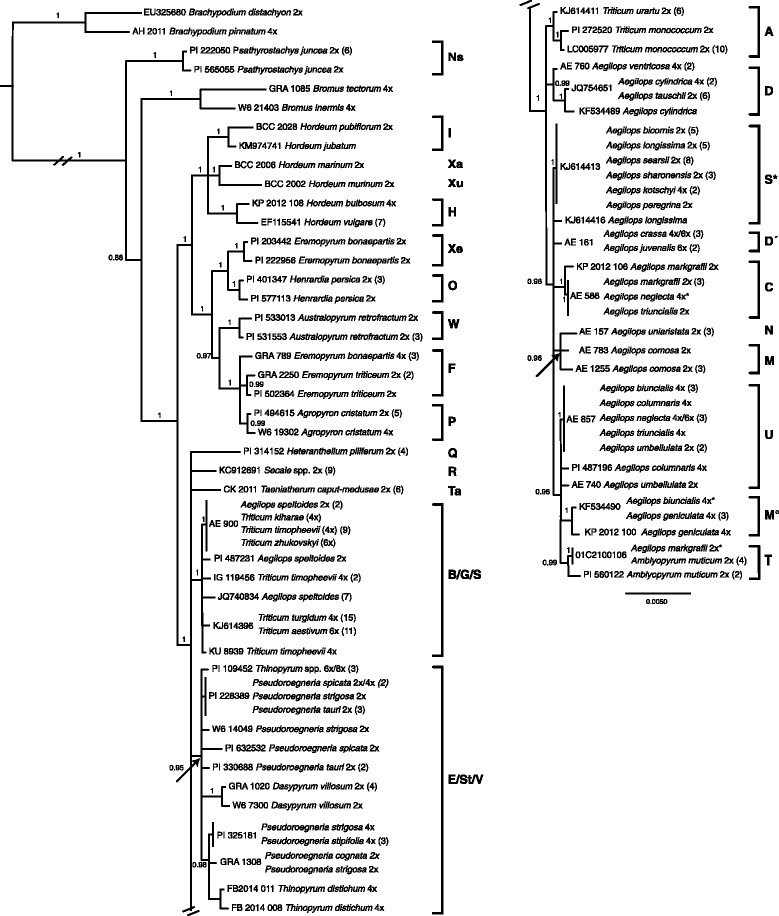
Fig. 1
Fig. 1
Phylogenetic tree derived from 2232 bp of the chloroplast locus ndhF and Bayesian inference. The multiple sequence alignment consisted of 64 unique haplotypes that originated from 194 accessions sequenced in the scope of this study and 41 sequences retrieved from GenBank. Brachypodium distachyon was set as outgroup taxon. Posterior probabilities (pp) for the main clades are depicted next to the nodes if they were higher then 0.75. Each unique haplotype is named with a distinctive identifier. For detailed information which accession possesses which haplotype and species synonyms see Additional file 1: Table S1. The ploidy level is indicated behind taxon labels. If there are multiple accessions per taxon sharing the same haplotype, the number of accessions is provided behind the taxon label. Single accessions grouping apart from other accessions of their taxon are marked with an asterisk. To the right the genomic groups are shown. Arrows with support values indicate the nodes they refer to
Fig. 2
Fig. 2
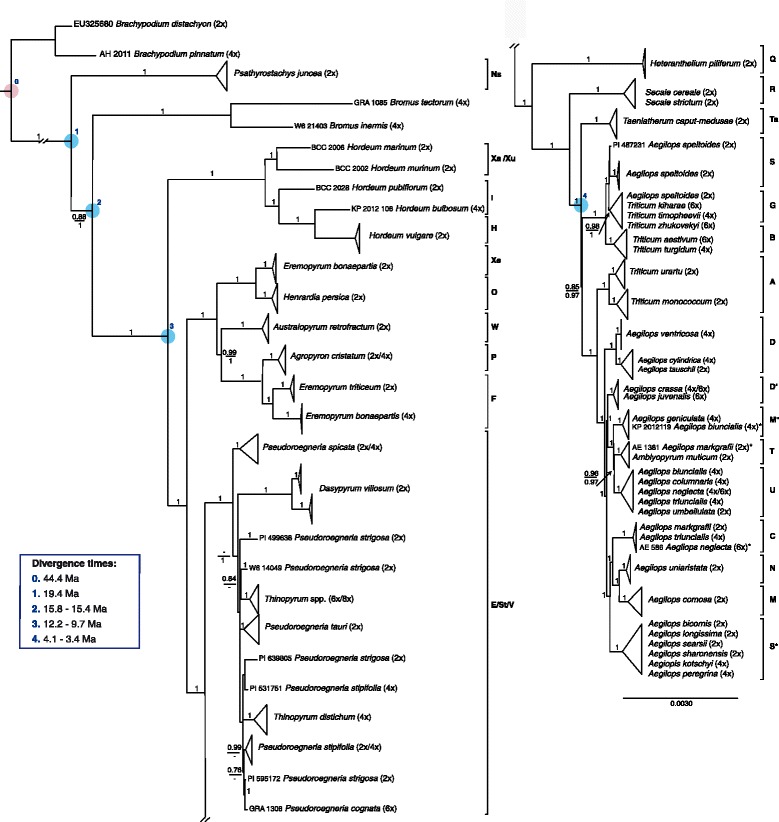
Phylogenetic tree derived from an alignment of whole genome chloroplast sequences via Bayesian phylogenetic inference. The multiple sequence alignment comprised 183 genomes assembled in the present study and 39 genomes that were downloaded from GenBank. Brachypodium distachyon was defined as outgroup taxon. The tree shown corresponds to an analysis based on the complete alignment of 123,531 base pairs (bp). Clades were collapsed into triangles to reflect the main groupings. The area of the triangles reflects the genetic variation contained in a certain clade. Posterior probabilities (pp) for the main clades are depicted next to the nodes if they were higher then 0.75. Support values of a second Bayesian phylogenetic analysis based on 114,788 bp of whole chloroplast genomes, where alignment positions with more than 50% of missing data were masked, are shown below the values of the corresponding nodes in the complete chloroplast analysis if the values differed between analyses. Ploidy levels are provided in brackets after the taxon labels. Single accessions grouping apart from other accessions of their taxon are highlighted with an asterisk. To the right the genomic groups are indicated. The red circle represents the secondary calibration point from Marcussen et al. [20] used for node calibrations in multispecies coalescent analyses (MSC). Major nodes are shown in blue and their estimated ages in million years are given in the box. Two age values for the same node correspond to the analysis with (first value) and without the inclusion of Psathyrostachys (second value). For more information on the results of the MSC analyses see Additional file 5: Figure S2 and Additional file 6: Figure S3. For the full representation of the tree showing the grouping of all single accessions see Additional file 4: Figure S1. For species synonyms see Additional file 1: Table S1. Arrows with support values indicate the nodes they refer to

References

    1. Barkworth ME, R von B. Scientific names in the Triticeae. In: Muehlbauer GJ, Feuillet C, editors. Genetics and Genomics of the Triticeae. US: Springer; 2009. pp. 3–30.
    1. Feldman M, Levy AA. Origin and evolution of wheat and related Triticeae species. In: Molnár-Láng M, Ceoloni C, Doležel J, editors. Alien Introgression in Wheat: Springer; 2015. p. 21–76.
    1. Hsiao C, Chatterton NJ, Asay KH, Jensen KB. Phylogenetic relationships of the monogenomic species of the wheat tribe, Triticeae (Poaceae), inferred from nuclear rDNA (internal transcribed spacer) sequences. Genome. 1995;38:211–223. doi: 10.1139/g95-026. - DOI - PubMed
    1. Kellogg EA, Appels R, Mason-Gamer RJ. When genes tell different stories: The diploid genera of Triticeae (Gramineae) Syst Bot. 1996;21:321–347. doi: 10.2307/2419662. - DOI
    1. de Bustos A, Jouve N. Phylogenetic relationships of the genus Secale based on the characterisation of rDNA ITS sequences. Plant Syst Evol. 2002;235:147–154. doi: 10.1007/s00606-002-0215-z. - DOI