


Association of Resistance Exercise, Independent of and Combined With Aerobic Exercise, With the Incidence of Metabolic Syndrome
- PMID: 28622914
- PMCID: PMC5546793
- DOI: 10.1016/j.mayocp.2017.02.018
Association of Resistance Exercise, Independent of and Combined With Aerobic Exercise, With the Incidence of Metabolic Syndrome
Abstract
Objective: To determine the association of resistance exercise, independent of and combined with aerobic exercise, with the risk of development of metabolic syndrome (MetS).
Patients and methods: The study cohort included adults (mean ± SD age, 46±9.5 years) who received comprehensive medical examinations at the Cooper Clinic in Dallas, Texas, between January 1, 1987, and December, 31, 2006. Exercise was assessed by self-reported frequency and minutes per week of resistance and aerobic exercise and meeting the US Physical Activity Guidelines (resistance exercise ≥2 d/wk; aerobic exercise ≥500 metabolic equivalent min/wk) at baseline. The incidence of MetS was based on the National Cholesterol Education Program Adult Treatment Panel III criteria. We used Cox regression to generate hazard ratios (HRs) and 95% CIs.
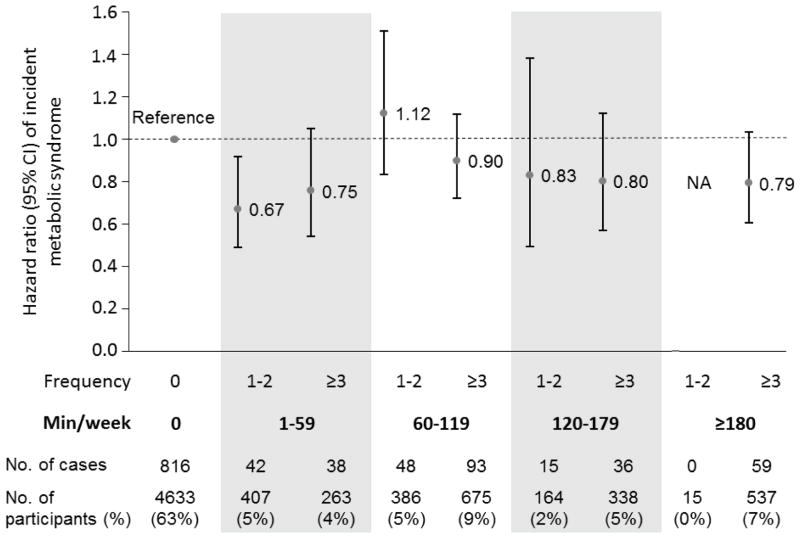
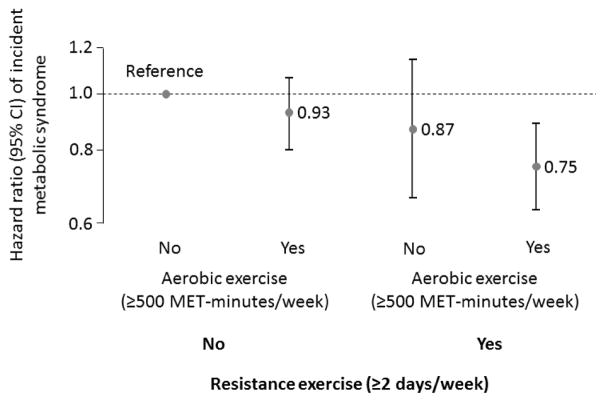
Results: Among 7418 participants, 1147 (15%) had development of MetS during a median follow-up of 4 years (maximum, 19 years; minimum, 0.1 year). Meeting the resistance exercise guidelines was associated with a 17% lower risk of MetS (HR, 0.83; 95% CI, 0.73-0.96; P=.009) after adjusting for potential confounders and aerobic exercise. Further, less than 1 hour of weekly resistance exercise was associated with 29% lower risk of development of MetS (HR, 0.71; 95% CI, 0.56-0.89; P=.003) compared with no resistance exercise. However, larger amounts of resistance exercise did not provide further benefits. Individuals meeting both recommended resistance and aerobic exercise guidelines had a 25% lower risk of development of MetS (HR, 0.75; 95% CI, 0.63-0.89; P<.001) compared with meeting neither guideline.
Conclusion: Participating in resistance exercise, even less than 1 hour per week, was associated with a lower risk of development of MetS, independent of aerobic exercise. Health professionals should recommend that patients perform resistance exercise along with aerobic exercise to reduce MetS.
Copyright © 2017 Mayo Foundation for Medical Education and Research. Published by Elsevier Inc. All rights reserved.
Figures
References
-
- Ford ES, Li C, Zhao G. Prevalence and correlates of metabolic syndrome based on a harmonious definition among adults in the US. J Diabetes. 2010;2(3):180–93. - PubMed
-
- Eckel RH, Grundy SM, Zimmet PZ. The metabolic syndrome. Lancet. 2005;365(9468):1415–28. - PubMed
-
- National Cholesterol Education Program Expert Panel on Detection E, Treatment of High Blood Cholesterol in A. Third Report of the National Cholesterol Education Program (NCEP) Expert Panel on Detection, Evaluation, and Treatment of High Blood Cholesterol in Adults (Adult Treatment Panel III) final report. Circulation. 2002;106(25):3143–421. - PubMed
-
- DeFina LF, Vega GL, Leonard D, Grundy SM. Fasting glucose, obesity, and metabolic syndrome as predictors of type 2 diabetes: the Cooper Center Longitudinal Study. J Investig Med. 2012;60(8):1164–8. - PubMed
Publication types
MeSH terms
Grants and funding
LinkOut - more resources
Full Text Sources
Other Literature Sources
Medical
