. 2017 Jun 16;7(1):3703.
doi: 10.1038/s41598-017-03804-8.

Dysbiosis in chronic periodontitis: Key microbial players and interactions with the human host

Affiliations

Dysbiosis in chronic periodontitis: Key microbial players and interactions with the human host

Zhi-Luo Deng et al. Sci Rep. .

Abstract

Periodontitis is an extremely prevalent disease worldwide and is driven by complex dysbiotic microbiota. Here we analyzed the transcriptional activity of the periodontal pocket microbiota from all domains of life as well as the human host in health and chronic periodontitis. Bacteria showed strong enrichment of 18 KEGG functional modules in chronic periodontitis, including bacterial chemotaxis, flagellar assembly, type III secretion system, type III CRISPR-Cas system, and two component system proteins. Upregulation of these functions was driven by the red-complex pathogens and candidate pathogens, e.g. Filifactor alocis, Prevotella intermedia, Fretibacterium fastidiosum and Selenomonas sputigena. Nine virulence factors were strongly up-regulated, among them the arginine deiminase arcA from Porphyromonas gingivalis and Mycoplasma arginini. Viruses and archaea accounted for about 0.1% and 0.22% of total putative mRNA reads, respectively, and a protozoan, Entamoeba gingivalis, was highly enriched in periodontitis. Fourteen human transcripts were enriched in periodontitis, including a gene for a ferric iron binding protein, indicating competition with the microbiota for iron, and genes associated with cancer, namely nucleolar phosphoprotein B23, ankyrin-repeat domain 30B-like protein and beta-enolase. The data provide evidence on the level of gene expression in vivo for the potentially severe impact of the dysbiotic microbiota on human health.


Conflict of interest statement

The authors declare that they have no competing interests.

Figures
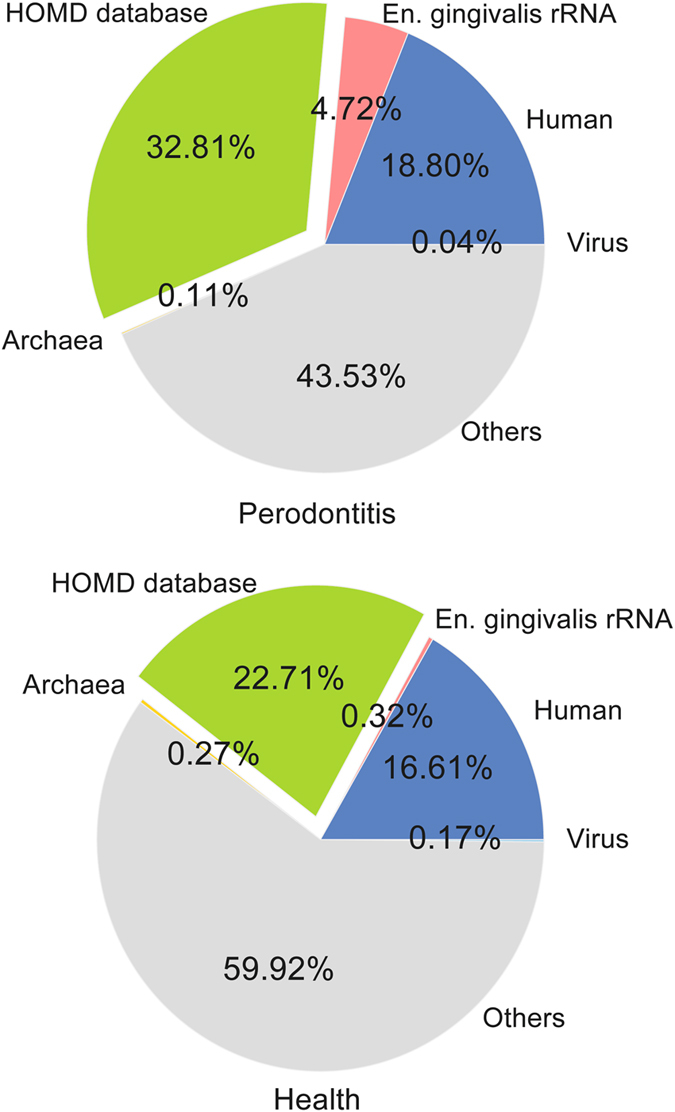
Figure 1
Figure 1
Mapping summary of periodontitis metatranscriptomes. The average proportion of cleaned putative mRNA reads mapped onto HOMD, En. gingivalis 18S  rRNA (after rRNA removal using SortMeRNA), human reference genome (ver. GRCh38), virus genomes from NCBI database, archaea genomes from NCBI database. The upper panel shows the periodontitis, whereas lower one is the health.
Figure 2
Figure 2
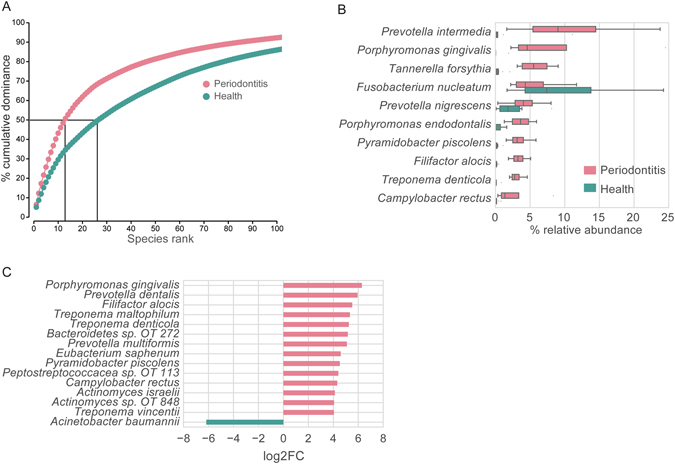
Taxonomic composition of transcripts in health and disease based on HOMD database. (A) Dominance plot showing the cumulative average contribution of individual genomes ranked according to transcript abundance of the total mapped reads. (B) The relative abundance of transcripts from the top 10 most abundant species in periodontitis in comparison with their abundance in health. (C) The differential activity of the microbial species based on the total mapped transcripts. The differential expression analysis was carried out by edgeR. Only species with FDR ≤ 0.05 and log2CPM ≥ 8 and absolute log2FC ≥ 4 are shown. If there were several strains for one species, those transcripts were pooled. Transcripts were mapped to the HOMD database. The bottom and top of the box show the first and third quartiles, the line inside the box indicates the median, and the ends of the whiskers represent the minimum and maximum, the dots on the outside of the whiskers represent outliers.
Figure 3
Figure 3
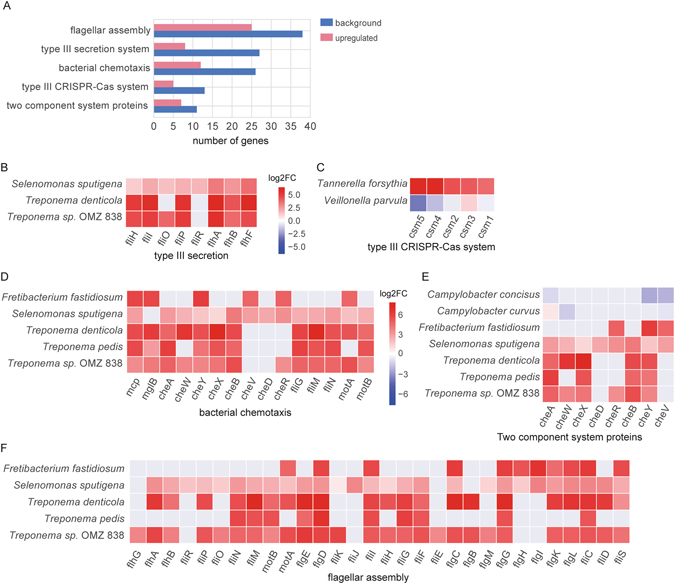
KEGG pathways and functional modules enriched in periodontitis and key microbial players driving the shifts. (A) Enrichment of the five most strongly up-regulated KEGG modules in periodontitis. The red bars indicate the number of up-regulated KEGG orthologous gene in the gene set, while dark blue bars show the number of total expressed genes of a given pathway or module. Only the enriched gene sets with FDR < 0.1 and (number of up-regulated genes)/(number of expressed) > 25% are shown here. The complete list of all enriched pathways and modules can be found in Table 1. (BF). Key microbial players driving the up-regulation of those functional pathways. Pathways consist of several KO genes (Supplementary Table 3), each of which contains several species specific genes. Only species specific genes with expression level count per million reads (CPM) ≥ 10 are shown. The horizontal axis shows the KEGG orthology genes in the pathway and vertical axis shows the microorganisms in which these KO genes were up- or down-regulated. Note different scales for B,C and DF.
Figure 4
Figure 4
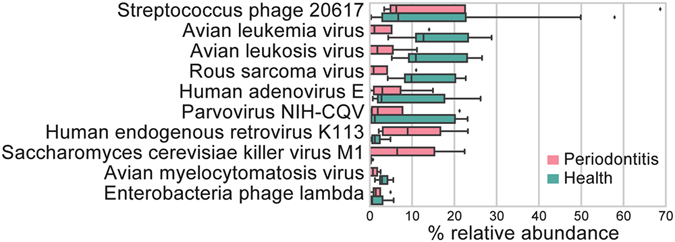
Virus transcripts in periodontal pockets. All virus genomes from NCBI database were used as mapping reference. Ten most abundant viruses are shown which accounted for about 80% of viral sequences. The bottom and top of the box show the first and third quartiles, the line inside the box indicates the median, and the ends of the whiskers represent the minimum and maximum, the dots on the outside of the whiskers represent outliers.
Figure 5
Figure 5
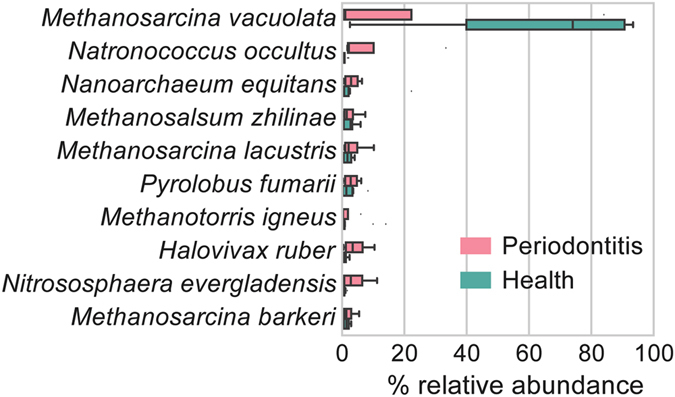
Transcriptional activity of archaea in the periodontal pocket microbiota. All archaea genomes from NCBI database were used as mapping reference. Top 10 most abundant archaea species across all subjects accounted for 72% of total archaeal reads. The bottom and top of the box show the first and third quartiles, the line inside the box indicates the median, and the ends of the whiskers represent the minimum and maximum, the dots on the outside of the whiskers represent outliers.
Figure 6
Figure 6
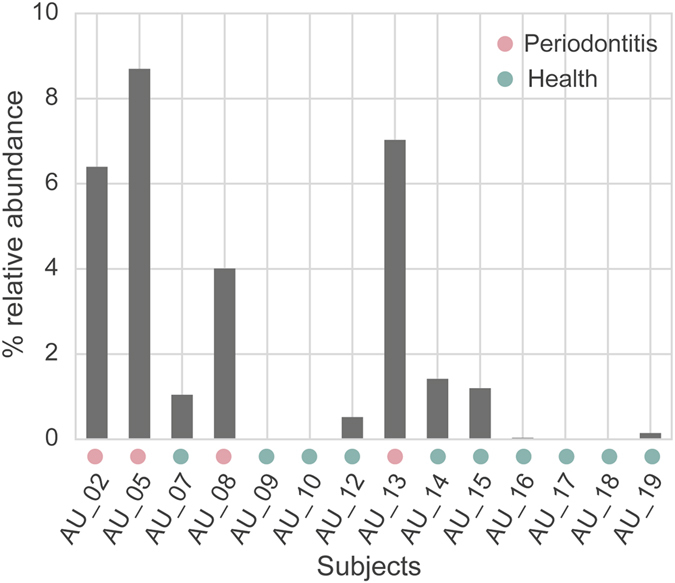
Abundant En. gingivalis in periodontitis. Total reads (without rRNA removal using SortMeRNA) from each sample were mapped against the 18S rRNA gene of En. gingivalis.

References

    1. Liu B, et al. Deep sequencing of the oral microbiome reveals signatures of periodontal disease. PLoS. One. 2012;7:e37919. doi: 10.1371/journal.pone.0037919. - DOI - PMC - PubMed
    1. Morgan XC, et al. Dysfunction of the intestinal microbiome in inflammatory bowel disease and treatment. Genome Biol. 2012;13:R79. doi: 10.1186/gb-2012-13-9-r79. - DOI - PMC - PubMed
    1. Qin J, et al. A metagenome-wide association study of gut microbiota in type 2 diabetes. Nature. 2012;490:55–60. doi: 10.1038/nature11450. - DOI - PubMed
    1. Scher JU, Abramson SB. The microbiome and rheumatoid arthritis. Nat. Rev. Rheumatol. 2011;7:569–578. - PMC - PubMed
    1. Turnbaugh PJ, et al. An obesity-associated gut microbiome with increased capacity for energy harvest. Nature. 2006;444:1027–1031. doi: 10.1038/nature05414. - DOI - PubMed

Publication types