. 2017 Jun 16;7(1):3700.
doi: 10.1038/s41598-017-03927-y.

Impact of Module-X2 and Carbohydrate Binding Module-3 on the catalytic activity of associated glycoside hydrolases towards plant biomass

Affiliations

Impact of Module-X2 and Carbohydrate Binding Module-3 on the catalytic activity of associated glycoside hydrolases towards plant biomass

Nandita Pasari et al. Sci Rep. .

Abstract

Cellulolytic enzymes capable of hydrolyzing plant biomass are secreted by microbial cells specifically in response to the carbon substrate present in the environment. These enzymes consist of a catalytic domain, generally appended to one or more non-catalytic Carbohydrate Binding Module (CBM), which enhances their activity towards recalcitrant biomass. In the present study, the genome of a cellulolytic microbe Paenibacillus polymyxa A18 was annotated for the presence of CBMs and analyzed their expression in response to the plant biomass and model polysaccharides Avicel, CMC and xylan using quantitative PCR. A gene that encodes X2-CBM3 was found to be maximally induced in response to the biomass and crystalline substrate Avicel. Association of X2-CBM3 with xyloglucanase and endoglucanase led to up to 4.6-fold increase in activity towards insoluble substrates. In the substrate binding study, module X2 showed a higher affinity towards biomass and phosphoric acid swollen cellulose, whereas CBM3 showed a higher affinity towards Avicel. Further structural modeling of X2 also indicated its potential role in substrate binding. Our findings highlighted the role of module X2 along with CBM3 in assisting the enzyme catalysis of agricultural residue and paved the way to engineer glycoside hydrolases for superior activity.


Conflict of interest statement

The authors declare that they have no competing interests.

Figures
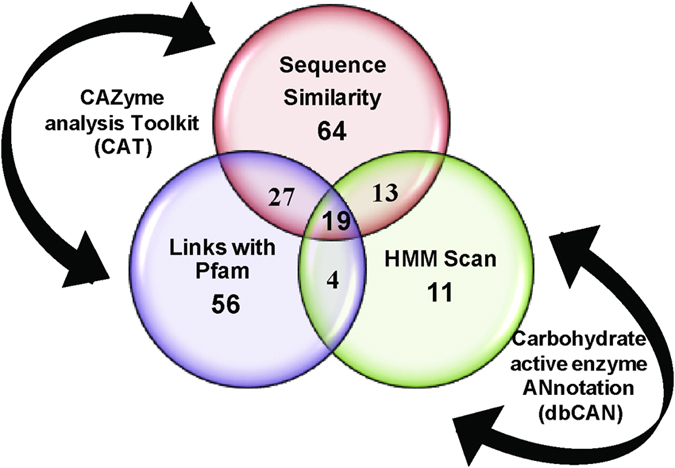
Figure 1
Figure 1
Venn diagram representing the number of CBMs predicted by different approaches in the genome of P. polymyxa A18. Detailed analysis is provided in Supplementary Table S1.
Figure 2
Figure 2
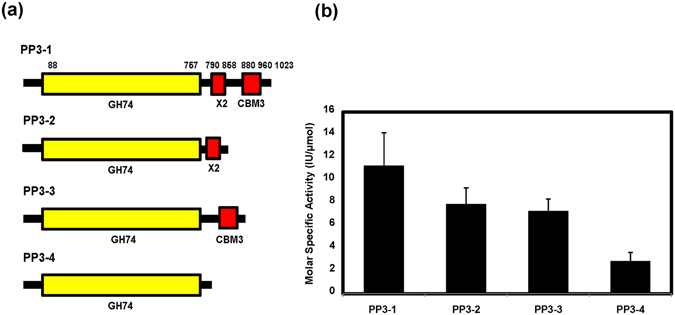
Domain architecture of CBM containing polypeptides identified in P. Polymyxa A18 genome. The numbering above the polypeptides shows the amino acid positions of the module boundaries as determined by HMM scan search. CBMs are color coded according to the previous knowledge on their binding affinity and categorized on the basis of (a) cellulose binding, (b) hemicellulose binding and (c) starch binding. Black and yellow boxes represent a potential signal sequence and the catalytic domain, respectively.
Figure 3
Figure 3
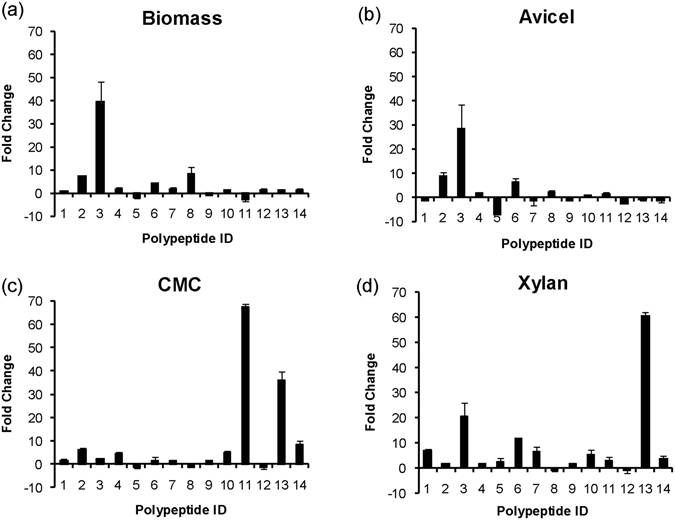
Relative transcript level of CBM containing polypeptides during growth on different carbon substrates. P. Polymyxa A18 was grown in presence of (a) ammonium hydroxide-treated biomass, (b) Avicel, (c) CMC and (d) xylan, and transcript levels of 14 CBM-containing polypeptides were estimated using qRT-PCR. Fold change was calculated with respect to P. Polymyxa A18 grown without the carbon substrate and normalized on 16S rRNA. Error bars represent standard error of mean calculated over four data obtained from two technical replicates of each of two biological replicates.
Figure 4
Figure 4
(a) Molecular organization of X2-CBM3 containing xyloglucanase and its truncated derivatives used in the study and (b) Specific activity of the derivatives against ammonia-treated biomass. Error bars represent the standard deviations of experiments performed in duplicate.
Figure 5
Figure 5
Binding of X2-CBM3 and its independent modules to insoluble polysaccharides. (a) 10 μg of purified protein was incubated with 4 mg of insoluble substrates, such as (A) biomass, (B) Avicel, (C) PASC, (D) starch and bound (1) and unbound* (2) proteins were analyzed on the SDS-PAGE gel. (E) The same amount of protein used in the binding assay in absence of the polysaccharide was included as a control to observe aggregation over the incubation period. Same amount of BSA was allowed to bind to the respective substrates and included as a control. Depletion isotherm of CBM3, X2 and X2-CBM3 proteins binding to (b) Avicel, (c) PASC and (d) biomass. X and Y axis are plotted on log2 scales for representation of data from 2-fold increasing protein concentration. Full-length gels are included as Supplementary Fig. S4. *Only 20 μl of 250 μl unbound fraction was loaded on the SDS-PAGE gel.
Figure 6
Figure 6
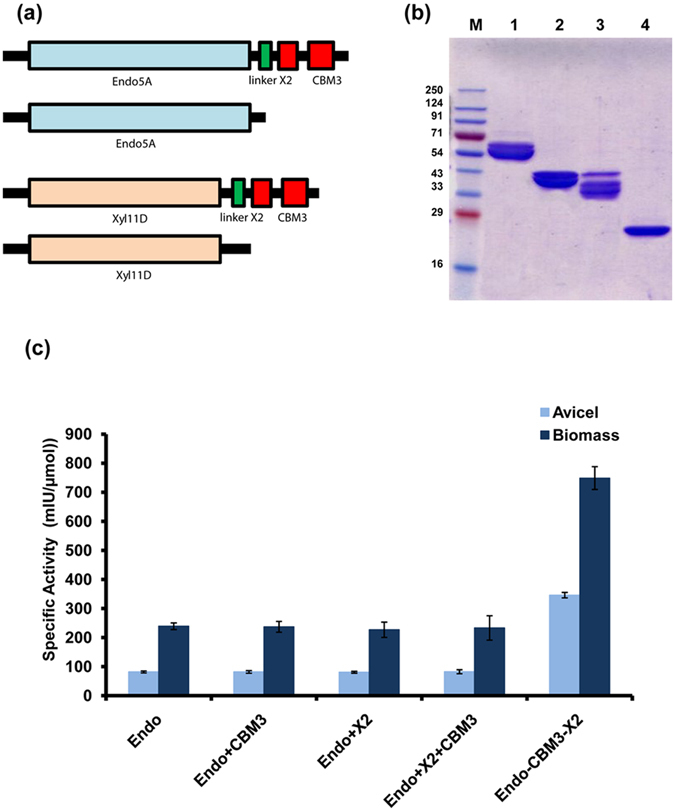
The impact of X2-CBM3 on the activity of endoglucanase (Endo5A) and xylanase (Xyl11D). (a) Domain organization of fusion construct containing Endo5A and Xyl11D along with X2-CBM3 linked through a Gly-Ser linker, (b) SDS-PAGE profile of fusion enzyme Endo5A-X2-CBM3 (Lane1), native endoglucanase Endo5A (Lane 2), fusion enzyme Xyl11D-X2-CBM3 (Lane 3), and native xylanase Xyl11D (Lane 4); M: molecular weight marker in kDa. (c) Enzyme activity of endoglucanase for native and fusion constructs measured towards insoluble substrates- Avicel and biomass. Enzyme activity for xylanase was not included as the activity of both of its constructs towards insoluble substrate was negligible (see text and Table 4 for details).
Figure 7
Figure 7
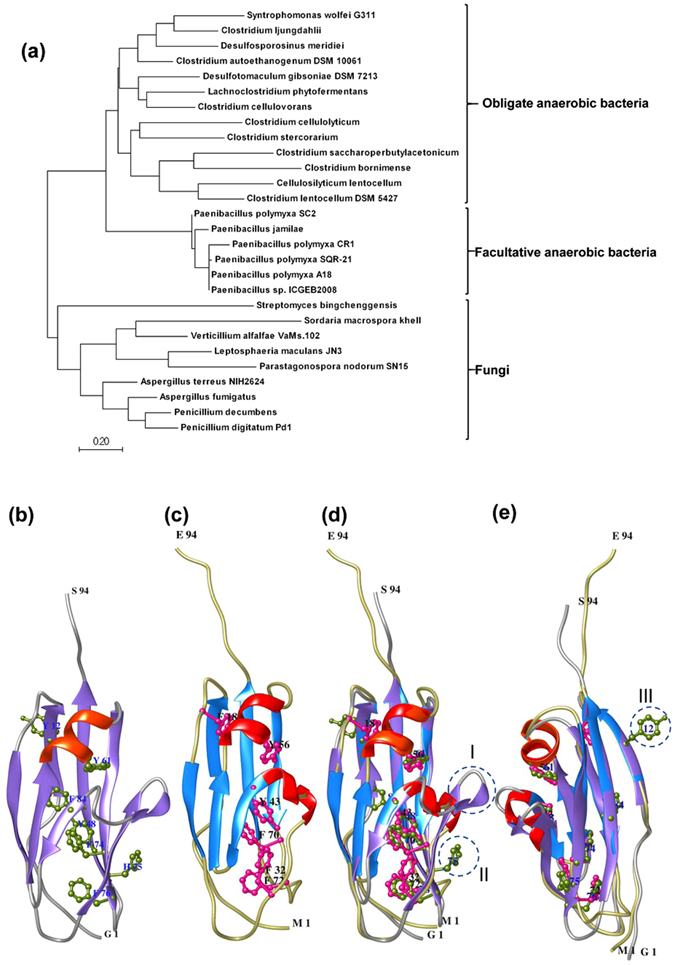
In silico analysis of module X2 of PP3 of P. polymyxa A18. (a) Molecular Phylogenetic analysis was performed by Maximum Likelihood method and the tree with the highest log likelihood is shown. Modelled structure of PP3-X2 (b), NMR-based structure of CipC-X2 (c) and superimposition of the two structures in two orientations (d,e) have been shown.

References

    1. Bayer EA, Chanzy H, Lamed R, Shoham Y. Cellulose, cellulases and cellulosomes. Current opinion in structural biology. 1998;8:548–557. doi: 10.1016/S0959-440X(98)80143-7. - DOI - PubMed
    1. Lynd LR, et al. How biotech can transform biofuels. Nature biotechnology. 2008;26:169–172. doi: 10.1038/nbt0208-169. - DOI - PubMed
    1. Pérez J, Munoz-Dorado J, de la Rubia T, Martinez J. Biodegradation and biological treatments of cellulose, hemicellulose and lignin: an overview. International Microbiology. 2002;5:53–63. doi: 10.1007/s10123-002-0062-3. - DOI - PubMed
    1. Bork P, Downing AK, Kieffer B, Campbell ID. Structure and distribution of modules in extracellular proteins. Quarterly reviews of biophysics. 1996;29:119–167. doi: 10.1017/S0033583500005783. - DOI - PubMed
    1. Gilkes N, Henrissat B, Kilburn D, Miller R, Warren R. Domains in microbial beta-1,4-glycanases: sequence conservation, function, and enzyme families. Microbiological reviews. 1991;55:303–315. - PMC - PubMed

Publication types