


Preclinical progenitor cell therapy in traumatic brain injury: a meta-analysis
- PMID: 28624058
- PMCID: PMC6275127
- DOI: 10.1016/j.jss.2017.02.078
Preclinical progenitor cell therapy in traumatic brain injury: a meta-analysis
Abstract
Background: No treatment is available to reverse injury associated with traumatic brain injury (TBI). Progenitor cell therapies show promise in both preclinical and clinical studies. We conducted a meta-analysis of preclinical studies using progenitor cells to treat TBI.
Methods: EMBASE, MEDLINE, Cochrane Review, Biosis, and Google Scholar were searched for articles using prespecified search strategies. Studies meeting inclusion criteria underwent data extraction. Analysis was performed using Review Manager 5.3 according to a fixed-effects model, and all studies underwent quality scoring.
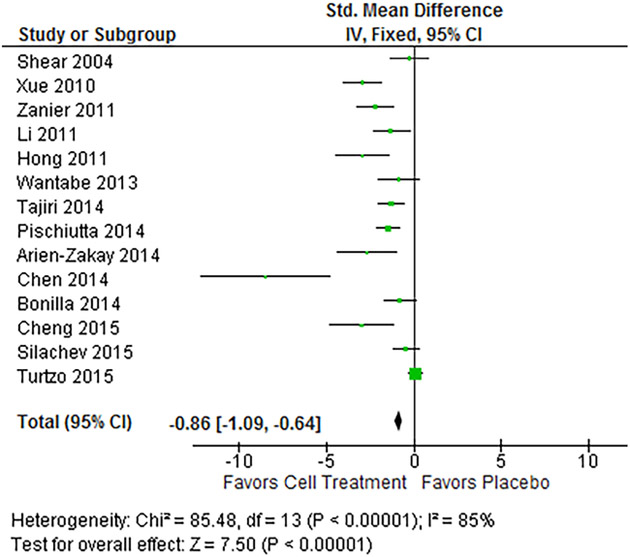
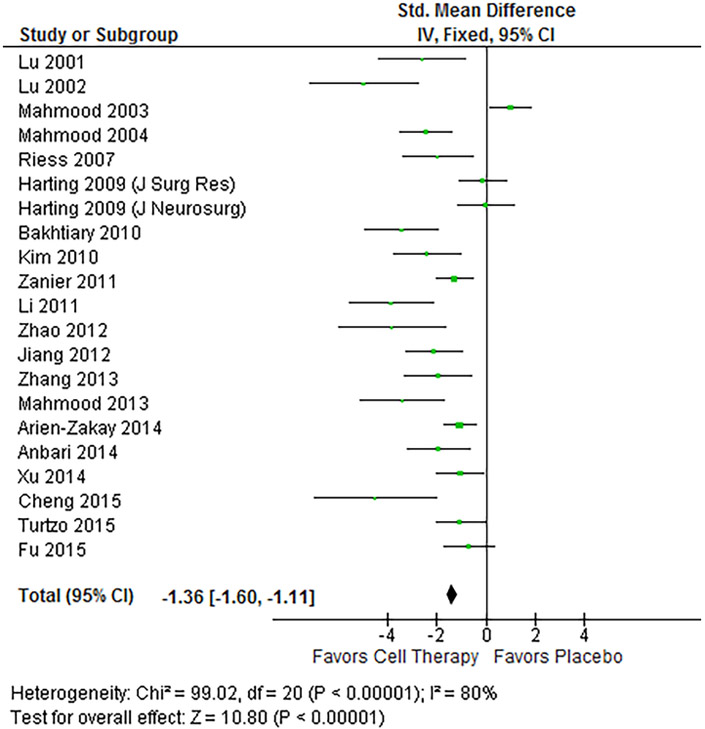
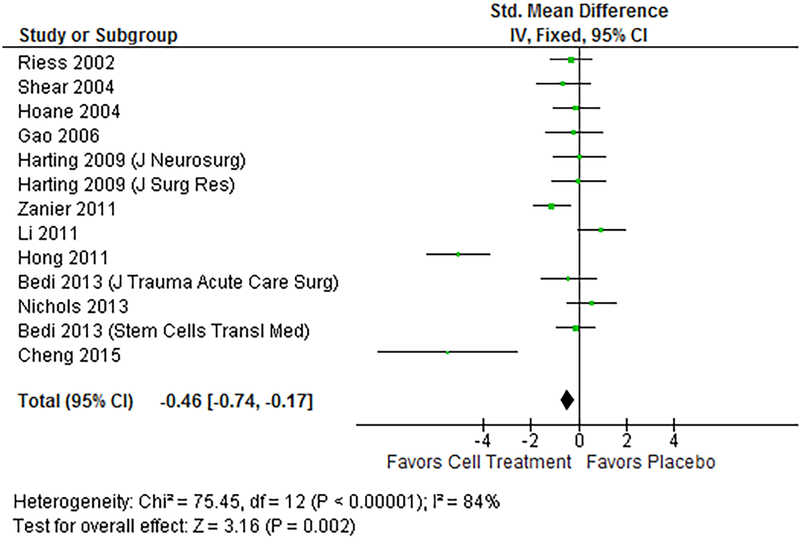
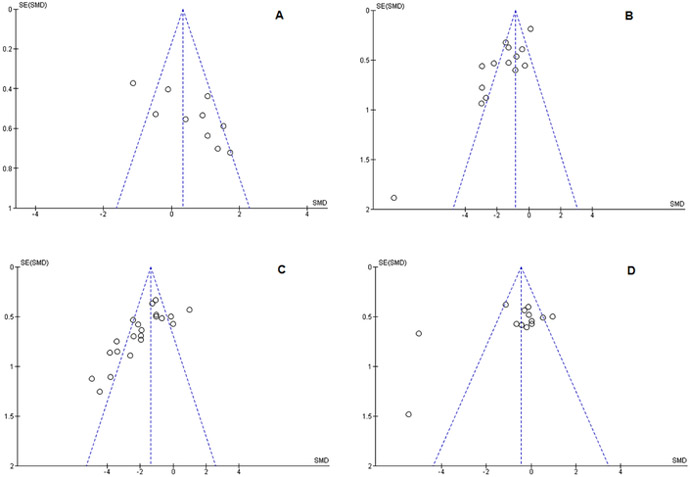
Results: Of 430 abstracts identified, 38 met inclusion criteria and underwent analysis. Average quality score was 4.32 of 8 possible points. No study achieved a perfect score. Lesion volume (LV) and neurologic severity score (NSS) outcomes favored cell treatment with standard mean difference (SMD) of 0.86 (95% CI: 0.64-1.09) and 1.36 (95% CI: 1.11-1.60), respectively. Rotarod and Morris water maze outcomes also favored treatment with improvements in SMD of 0.34 (95% CI: 0.02-0.65) and 0.46 (95% CI: 0.17-74), respectively. Although LV and NSS were robust to publication bias assessments, rotarod and Morris water maze tests were not. Heterogeneity (I2) ranged from 74%-85% among the analyses, indicating a high amount of heterogeneity among studies. Precision as a function of quality score showed a statistically significant increase in the size of the confidence interval as quality improved.
Conclusions: Our meta-analysis study reveals an overall positive effect of progenitor cell therapies on LV and NSS with a trend toward improved motor function and spatial learning in different TBI animal models.
Keywords: Animal TBI model; Meta-analysis; Preclinical studies; Progenitor cells; Traumatic brain injury.
Copyright © 2017 Elsevier Inc. All rights reserved.
Conflict of interest statement
Disclosures/Conflict of Interest:
CSC: equity interest in Cellvation, Inc., a company which seeks to develop cellular therapies for neurological injuries.
MLJ and AKS: The authors report no proprietary or commercial interest in any product mentioned or concept discussed in this article.
Figures


References
-
- Maas AI, Stocchetti N, Bullock R Moderate and severe traumatic brain injury in adults. Lancet Neurol 2008:7:728–741. - PubMed
-
- Cole TB Global road safety crisis remedy sought: 1.2 million killed, 50 million injured annually. JAMA 2004:291:2531–2532. - PubMed
-
- Werner C, Engelhard K Pathophysiology of traumatic brain injury. Br J Anaesth 2007:99:4–9. - PubMed
Publication types
MeSH terms
Grants and funding
LinkOut - more resources
Full Text Sources
Other Literature Sources
Medical
Miscellaneous
