


Obesity results with smaller oocyte in in vitro fertilization/intracytoplasmic sperm injection cycles-a prospective study
- PMID: 28624860
- PMCID: PMC5581790
- DOI: 10.1007/s10815-017-0975-6
Obesity results with smaller oocyte in in vitro fertilization/intracytoplasmic sperm injection cycles-a prospective study
Abstract
Background: Obesity is associated with several fertility disorders. This prospective cohort study was designed to evaluate the effect of body mass index (BMI) (kg/m2) on oocyte diameter and treatment.
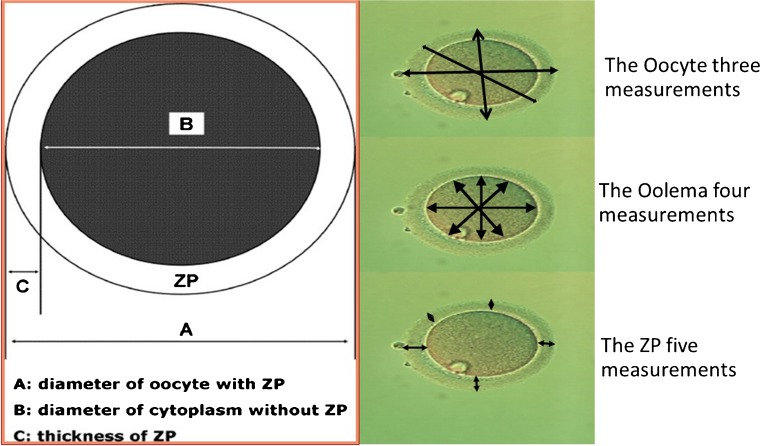
Methods: Women undergoing in vitro fertilization (IVF) with intracytoplasmic sperm injection (ICSI) were enrolled in the study. They were divided into two groups according to BMI: obese (BMI > 30) and normal weight (BMI < 25). Mature oocytes were evaluated according to total diameter, zona pellucida, and oolema diameters.
Results: A total of 387 oocytes were obtained from the 46 women who participated. Significantly more mature oocytes (M2) were retrieved from normal weight patients compare to obese women (15.1 ± 6.8 vs. 9.7 ± 3.9, respectively, P < 0.001). Oocytes from women in the obese group were significantly smaller than those in the normal weight group, including oocyte diameter (157.9 ± 7.9 vs. 164.3 ± 5.1 μm, P < 0.0001), oolema diameter (110.3 ± 4.5 vs. 113.5 ± 3.5 μm, P < 0.0001), and zona pellucida thickness (17.9 ± 2.6 vs. 19.0 ± 2.4 μm, P < 0.000), respectively. Multivariate logistic regression analysis, including oolema diameter, female age, BMI, number of M2 oocytes, and zona pellucida, was conducted to predict pregnancy. Small oolema diameter in obese patient adversely correlated with pregnancy. Larger oolema diameter was positively associated with the probability of pregnancy in the obese group as well as thinner zona pellucida.
Conclusion: Obesity is associated with smaller oocytes, which adversely affect fertility outcomes.
Trial registration: NIH number NCT01672931.
Keywords: IVF; Obesity; Oocyte; Oolema diameter; Zona pellucida.
Figures
References
-
- Losing weight, body mass index [Internet]. Available from: https://www.nhlbi.nih.gov/health/educational/lose_wt/BMI/bmi_dis.htm
-
- WHO | Obesity and overweight. WHO. World Health Organization; 2016.
-
- Practice Committee of American Society for Reproductive Medicine Obesity and reproduction: an educational bulletin. Fertil Steril. 2008;90:S21–S29. - PubMed
MeSH terms
Associated data
LinkOut - more resources
Full Text Sources
Other Literature Sources
Medical
