


Pathogen reduction/inactivation of products for the treatment of bleeding disorders: what are the processes and what should we say to patients?
- PMID: 28624906
- PMCID: PMC5486800
- DOI: 10.1007/s00277-017-3028-4
Pathogen reduction/inactivation of products for the treatment of bleeding disorders: what are the processes and what should we say to patients?
Abstract
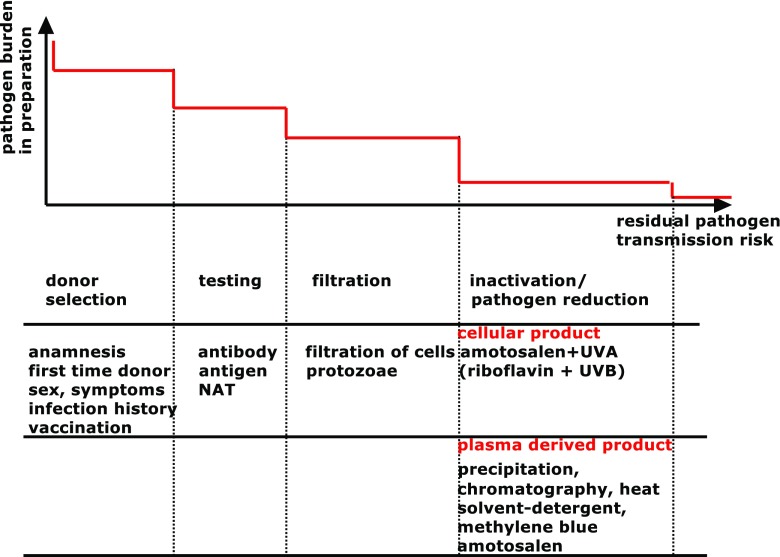
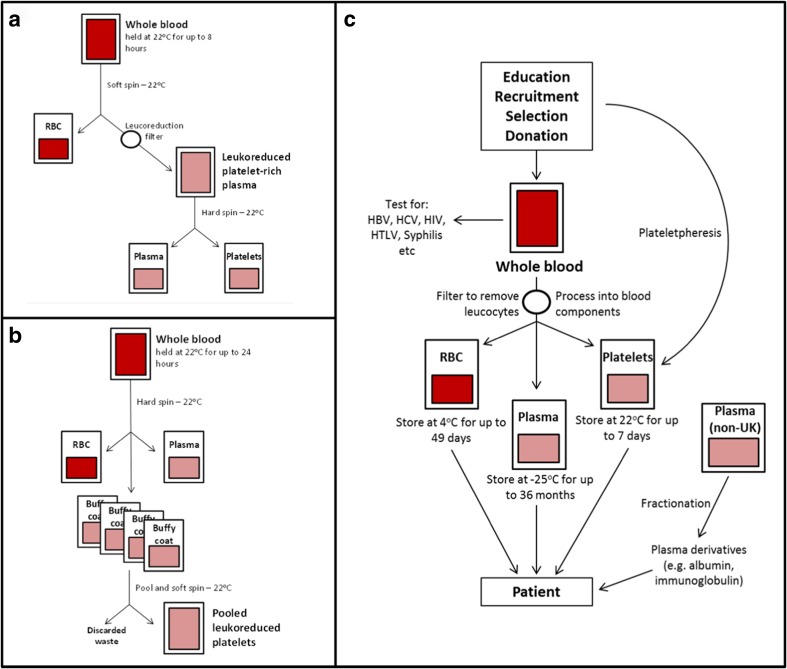
Patients with blood disorders (including leukaemia, platelet function disorders and coagulation factor deficiencies) or acute bleeding receive blood-derived products, such as red blood cells, platelet concentrates and plasma-derived products. Although the risk of pathogen contamination of blood products has fallen considerably over the past three decades, contamination is still a topic of concern. In order to counsel patients and obtain informed consent before transfusion, physicians are required to keep up to date with current knowledge on residual risk of pathogen transmission and methods of pathogen removal/inactivation. Here, we describe pathogens relevant to transfusion of blood products and discuss contemporary pathogen removal/inactivation procedures, as well as the potential risks associated with these products: the risk of contamination by infectious agents varies according to blood product/region, and there is a fine line between adequate inactivation and functional impairment of the product. The cost implications of implementing pathogen inactivation technology are also considered.
Keywords: Bleeding disorder; Blood; Clotting; Inactivation; Infection risk; Pathogen; Patient information; Removal; Virus.
Conflict of interest statement
Conflict of interest
AT has received grants and personal fees from Bayer, grants and personal fees from Baxter, grants and personal fees from Biotest, grants and personal fees from CSL Behring, grants and personal fees from Novo Nordisk, grants and personal fees from Pfizer and grants and personal fees from Octapharma, during the conduct of the study.
CFP has received grants as bureau speaker, consultant, or advisor, from Gilead, Merck Sharp and Dohme, Roche, Pfizer, Abbott, Bristol-Myers Squibb, VIIV and Boehringer Ingelheim. None of these personal activities is in conflict with the opinions he expressed in this manuscript.
DN has received honoraria for conferences from Pfizer, Roche Pharma, Roche Diagnostics, Abbott, MSD and Astellas.
GDM has disclosed the following financial relationships: speaker or a member of a speaker bureau for Boehringer Ingelheim, Sanofi-Aventis, Bayer, Novo Nordisk, Pfizer, Biotest, and Grifols. Consultant or ad hoc speaker/consultant for Boehringer Ingelheim, Eli-Lilly, Sanofi-Aventis, Bayer, CSL Behring, Novo Nordisk, Pfizer, Biotest and Grifols.
HE has received grants, honoraria for conferences and consultancy from Bayer; grants and personal fees from Baxter; grants, honoraria for conferences and consultancy from Biotest; grants, honoraria for conferences and consultancy from CSL Behring and honoraria for conferences and consultancy from Novo Nordisk.
JWI has received personal fees from Piramal, grants from the Department of Health and the Medical Research Council, UK, outside the submitted work.
MC has received research grants, lecture fees and honoraria for consultancy from Baxter, Bayer and Pfizer.
LG reports no potential conflicts of interest.
Funding information
Medical writing assistance was provided by Hanna Mourad-Agha of inScience Communications, Springer Healthcare. This assistance was funded by Pfizer.
Figures
References
-
- Darby SC, Kan SW, Spooner RJ, Giangrande PL, Hill FG, Hay CR, Lee CA, Ludlam CA, Williams M. Mortality rates, life expectancy, and causes of death in people with hemophilia A or B in the United Kingdom who were not infected with HIV. Blood. 2007;110(3):815–825. doi: 10.1182/blood-2006-10-050435. - DOI - PubMed
Publication types
MeSH terms
LinkOut - more resources
Full Text Sources
Other Literature Sources
Medical
Miscellaneous
