


Parenting cognitions → parenting practices → child adjustment? The standard model
- PMID: 28625208
- PMCID: PMC5823787
- DOI: 10.1017/S0954579417000931
Parenting cognitions → parenting practices → child adjustment? The standard model
Abstract
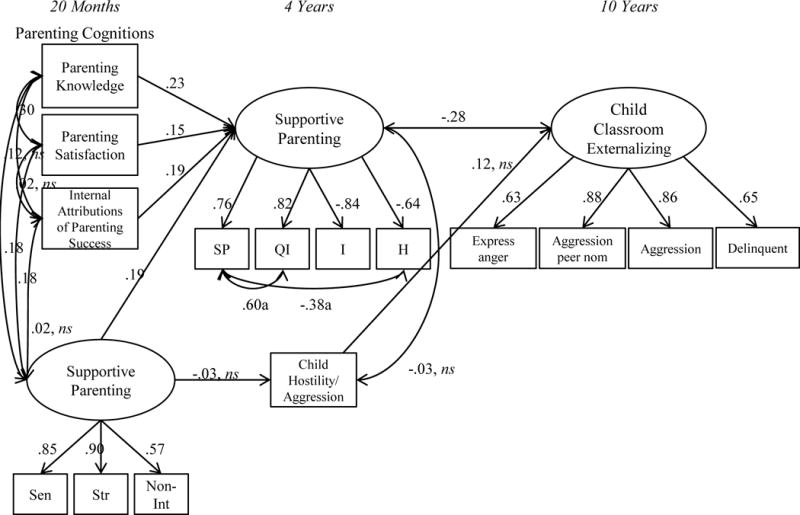
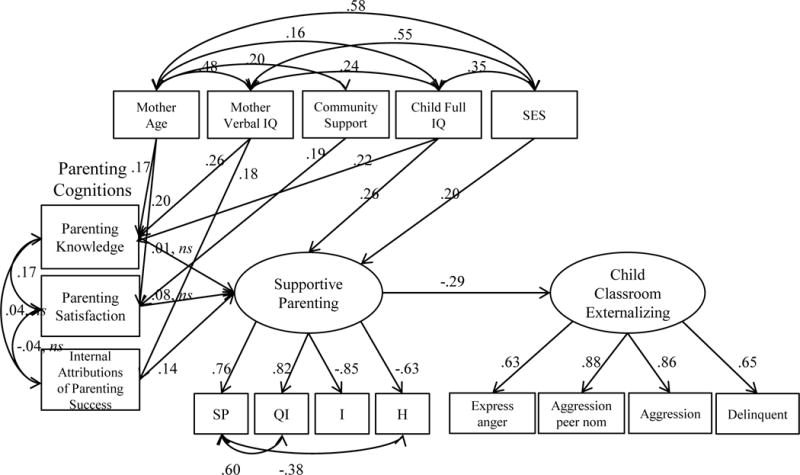
In a large-scale (N = 317) prospective 8-year longitudinal multiage, multidomain, multivariate, multisource study, we tested a conservative three-term model linking parenting cognitions in toddlerhood to parenting practices in preschool to classroom externalizing behavior in middle childhood, controlling for earlier parenting practices and child externalizing behavior. Mothers who were more knowledgeable, satisfied, and attributed successes in their parenting to themselves when their toddlers were 20 months of age engaged in increased supportive parenting during joint activity tasks 2 years later when their children were 4 years of age, and 6 years after that their 10-year-olds were rated by teachers as having fewer classroom externalizing behavior problems. This developmental cascade of a "standard model" of parenting applied equally to families with girls and boys, and the cascade from parenting attributions to supportive parenting to child externalizing behavior obtained independent of 12 child, parent, and family covariates. Conceptualizing socialization in terms of cascades helps to identify points of effective intervention.
Figures
References
-
- Abelson RP. A variance explanation paradox: When a little is a lot. Psychological Bulletin. 1985;97:129–133. doi: 10.1037/0033-2909.97.1.129. - DOI
-
- Achenbach TM. Integrative guide for the 1991 CBCL/4-18 YSR, and TRF profiles. Burlington, VT: University of Vermont Department of Psychiatry; 1991.
-
- Ajzen I, Fishbein M. Understanding attitudes and predicting social behavior. Englewood Cliffs, NJ: Prentice-Hall; 1980.
-
- Arbuckle JL. Full information estimation in the presence of incomplete data. In: Marcoulides GA, Schumacker RE, editors. Advanced structural equation modeling: Issues and techniques. Mahwah, NJ: Erlbaum; 1996. pp. 243–277.
-
- Bandura A. Regulation of cognitive processes through perceived self-efficacy. Developmental Psychology. 1989;25:729–735. doi: 10.1037/0012-1649.25.5.729. - DOI
Publication types
MeSH terms
Grants and funding
LinkOut - more resources
Full Text Sources
Other Literature Sources
Medical
