


Modification of a bi-functional diguanylate cyclase-phosphodiesterase to efficiently produce cyclic diguanylate monophosphate
- PMID: 28626712
- PMCID: PMC5466042
- DOI: 10.1016/j.btre.2015.04.008
Modification of a bi-functional diguanylate cyclase-phosphodiesterase to efficiently produce cyclic diguanylate monophosphate
Abstract
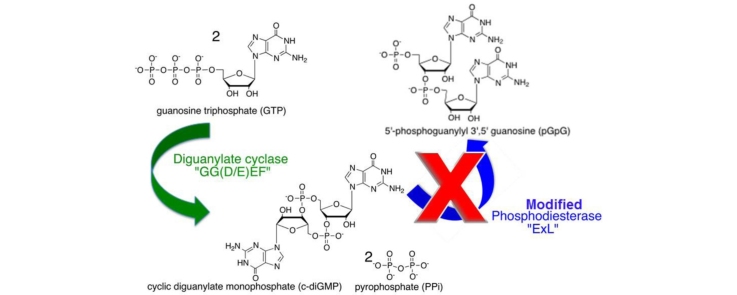
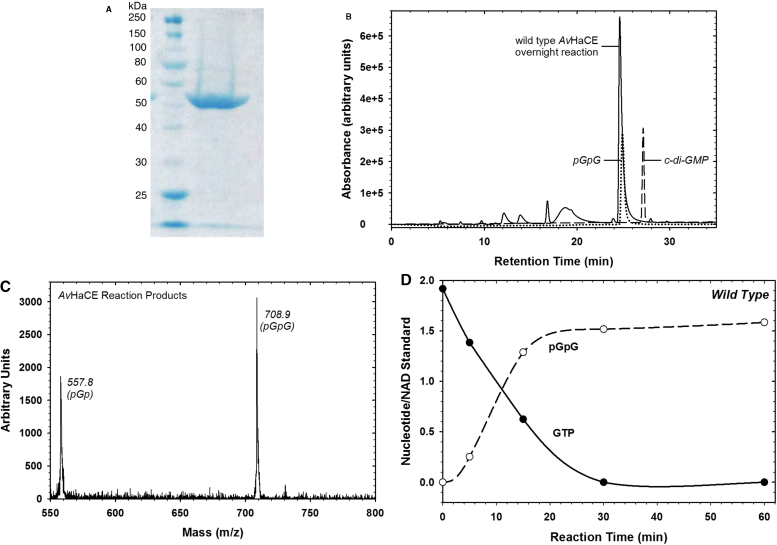
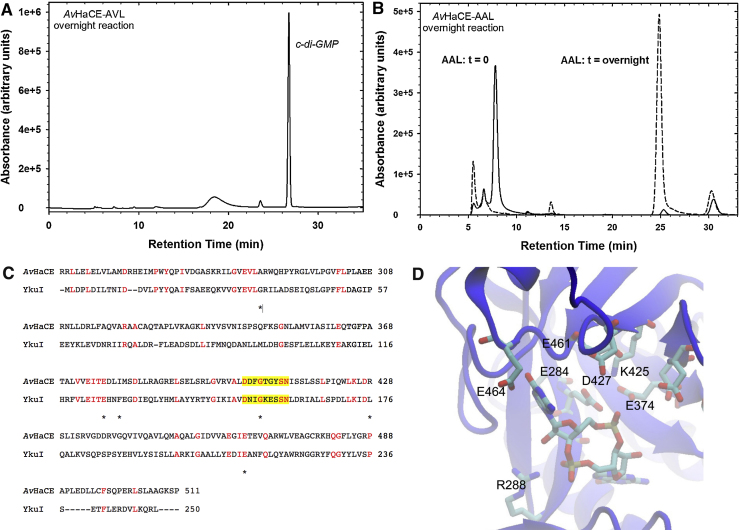
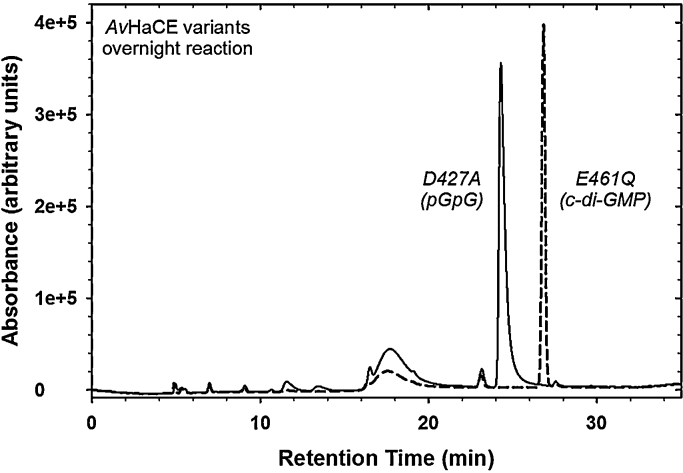
Cyclic-diGMP is a bacterial messenger that regulates many physiological processes, including many attributed to pathogenicity. Bacteria synthesize cyclic-diGMP from GTP using diguanylate cyclases; its hydrolysis is catalyzed by phosphodiesterases. Here we report the over-expression and purification of a bi-functional diguanylate cyclase-phosphodiesterase from Agrobacterium vitis S4. Using homology modeling and primary structure alignment, we identify several amino acids predicted to participate in the phosphodiesterase reaction. Upon altering selected residues, we obtain variants of the enzyme that efficiently and quantitatively catalyze the synthesis of cyclic-diGMP from GTP without hydrolysis to pGpG. Additionally, we identify a variant that produces cyclic-diGMP while immobilized to NiNTA beads and can catalyze the conversion of [α-32P]-GTP to [32P]-cyclic-diGMP. In short, we characterize a novel cyclic-diGMP processing enzyme and demonstrate its utility for efficient and cost-effective production of cyclic-diGMP, as well as modified cyclic-diGMP molecules, for use as probes in studying the many important biological processes mediated by cyclic-diGMP.
Keywords: AvHaCE, Agrobacterium vitis H-NOX associated cyclic-diGMP processing enzyme; Cyclic-diGMP; Cyclic-diGMP, bis-3′-5′-cyclic dimeric guanosine monophosphate; DGC, diguanylate cyclase; Diguanylate cyclase; GTP, guanosine-5′-triphosphate; H-NOX associated cyclic-diGMP processing enzyme; PDE, phosphodiesterase; Phosphodiesterase; [32P]-cyclic-diGMP; pGpG, 5′-phosphoguanylyl-(3′,5′)-guanosine).
Figures
References
-
- Ausmees N., Mayer R., Weinhouse H., Volman G., Amikam D., Benziman M., Lindberg M. Genetic data indicate that proteins containing the GGDEF domain possess diguanylate cyclase activity. FEMS Microbiol. Lett. 2001;204:163–167. - PubMed
-
- Bradford M.M. A rapid and sensitive method for the quantitation of microgram quantities of protein utilizing the principle of protein-dye binding. Anal. Biochem. 1976;72:248–254. - PubMed
LinkOut - more resources
Full Text Sources
Other Literature Sources
Miscellaneous