. 2017 Apr 28;2(10):eaam8929.
doi: 10.1126/sciimmunol.aam8929.

The Lung is a Host Defense Niche for Immediate Neutrophil-Mediated Vascular Protection

Affiliations

The Lung is a Host Defense Niche for Immediate Neutrophil-Mediated Vascular Protection

Bryan G Yipp et al. Sci Immunol. .

Abstract

Bloodstream infection is a hallmark of sepsis, a medically emergent condition requiring rapid treatment. However, upregulation of host defense proteins through toll-like receptors and NFκB requires hours after endotoxin detection. Using confocal pulmonary intravital microscopy, we identified that the lung provides a TLR4-Myd88-and abl tyrosine kinase-dependent niche for immediate CD11b-dependent neutrophil responses to endotoxin and Gram-negative bloodstream pathogens. In an in vivo model of bacteremia, neutrophils crawled to and rapidly phagocytosed Escherichia coli sequestered to the lung endothelium. Therefore, the lung capillaries provide a vascular defensive niche whereby endothelium and neutrophils cooperate for immediate detection and capture of disseminating pathogens.


Conflict of interest statement

Competing interests: The authors declare no competing interests

Figures

Fig. 1
Fig. 1. LPS induces rapid cell surface increases in neutrophil CD11b in mouse neutrophils and in neutrophils from humans treated with intravenous LPS
Peripheral blood leukocytes from wildtype mice were treated with either saline, fMLP (1μM) or LPS (5μg/ml) for 4, 15, and 30 min and flow cytometry was performed to assess levels of cell surface expression of (A) CD11b and (B) L-selectin on Ly6G+ cells (n = 3). Five healthy human volunteers received intravenous LPS and peripheral blood was obtained over time. (C) Flow cytometry was performed to assess the level of cell surface CD11b pre-and post LPS and the gate demonstrates CD11b high expressing neutrophils. (D) The total number of peripheral neutrophils from five individuals treated with LPS (left axis, mean ± SEM, ** P = 0.022, n = 5, one way ANOVA with Dunnett’s correction) is graphed along with the percentage of CD11b high cells from these individuals (right axis, mean ± SEM, * p = 0.02, n = 5, one way ANOVA with Dunnett’s correction). (E) Human peripheral blood leukocytes were treated with LPS (100 ng/ml, 15 minutes) and adhesion was assessed using a flow chamber lined with primary human pulmonary endothelium (n = 3, mean ± SD, ** p = 0.002, unpaired two tailed T test).
Fig. 2
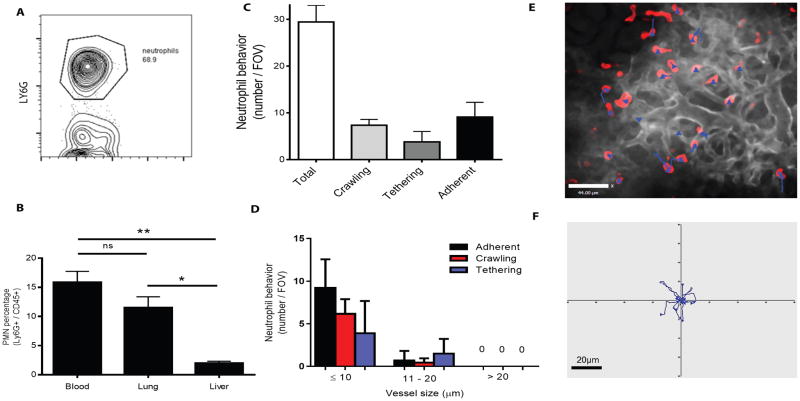
Fig. 2. Defining neutrophil behavior within the pulmonary circulation in vivo using intravital microscopy
(A) Ly6G+ cells were quantified using flow cytometry of exsanguinated untreated C57BL/6J whole lungs. (B) Ly6G+ cells were compared in blood, lung and liver of untreated C57BL/6J mice (mean ± SD, ** p = 0.0017, * p = 0.011, n=3, one way ANOVA). (C) Three neutrophil phenotypes, crawling, tethering and adhesion, were identified in vivo using pulmonary intravital microscopy (n=3). (D) Quantification of lung neutrophil behaviors during untreated conditions in vivo in relation to vessel diameter (n = 3). (E) Manually tracked pulmonary neutrophils in an unstimulated mouse. Neutrophils (red, intravenous fluorescently conjugated anti-Ly6G, clone 1A8), vasculature (greyscale, intravenous fluorescently conjugated anti-CD31, clone 390) and blue tracks displaying 10 minutes of tracking time. (F) Individual tracks displayed from a representative mouse over 10 minutes, compared from a central origin point.
Fig. 3
Fig. 3. Lung neutrophils rapidly begin crawling throughout the vasculature following LPS exposure
Lung neutrophils were tracked for 10 minutes prior to stimulation to quantify baseline neutrophil characteristics. (A) LPS (10μg i.v.) was administered and neutrophils were tracked over time. Each symbol represents an individual neutrophil combined from three separate experiments. Statistical testing was performed by averaging crawling distance of all neutrophils tracked from each mouse and using this as a single n value (mean ± SD, * p= 0.0169, ** p = 0.0014, one way ANOVA, n = 3). (B) Total neutrophil accumulation was quantified per field of view prior to and 30 minutes following LPS intravenous administration (mean ± SD, *** p = 0.0001, n = 5, unpaired two tailed T test). (C) A representative pulmonary intravital image with neutrophils tracked between 20–30min post-LPS. Neutrophils (red, i.v. fluorescently conjugated anti-Ly6G, clone 1A8, 3.5μg/mouse), vasculature (greyscale, i.v. fluorescently conjugated anti-CD31, clone 390, 5μg/mouse) and blue tracks displaying 10 minutes of tracking time. (D) Individual tracks displayed from the experiment depicted in panel C. Tracks are plotted from a central common origin point.
Fig. 4
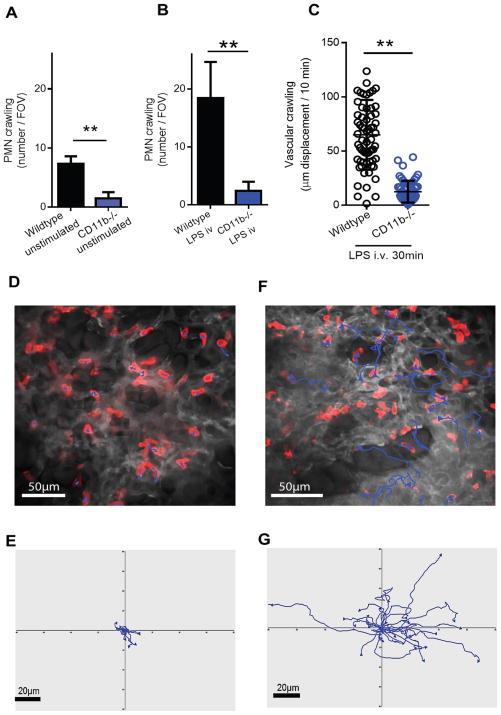
Fig. 4. CD11b mediates baseline and LPS induced rapid pulmonary crawling in vivo
Neutrophil crawling was compared between wildtype C57BL/6 and Cd11b-deficient mice under (A) control (saline i.v. 30 min, mean ± SD, ** p = 0.0013, n = 4 C57BL/6 and n = 3 for Cd11b-deficient, unpaired two tailed T test) and (B) LPS (10μg i.v. 30 min, mean ± SD, ** p = 0.0025, n = 4, unpaired two tailed T test) treated conditions. (C) Neutrophil crawling distance was compared between wildtype and Cd11b-deficient mice following stimulation (LPS 10μg i.v. 30min, mean ± SD, * p = 0.01, n = 3, unpaired two tailed T test). Neutrophil tracks from LPS (10μg i.v. 30 min) treated Cd11b-deficient mice are depicted in (D) and (E) from a representative intravital experiment. Neutrophil tracks from LPS (10μg i.v. 30 min) treated wildtype mice are depicted in (F) and (G) from a representative intravital experiment.
Fig. 5
Fig. 5. Rapid neutrophil crawling is TLR4 and Myd88 dependent
Pulmonary intravital microscopy was used to directly assess the molecular requirement of rapid neutrophil crawling following LPS stimulation. Tlr4-deficient mice were imaged and (A) neutrophil crawling was quantified pre-and post LPS (10μg i.v. mean ± SD, n = 3, one way ANOVA, not significant). (B) Neutrophil tracking is displayed from a representative experiment between 20–30 min post LPS. Myd88-deficient mice were imaged and (C) neutrophil crawling was quantified pre-and post LPS (10μg i.v. mean ± SD, n = 3, one way ANOVA, not significant). (D) Neutrophil tracking is displayed from a representative experiment between 20–30 min post LPS.
Fig. 6
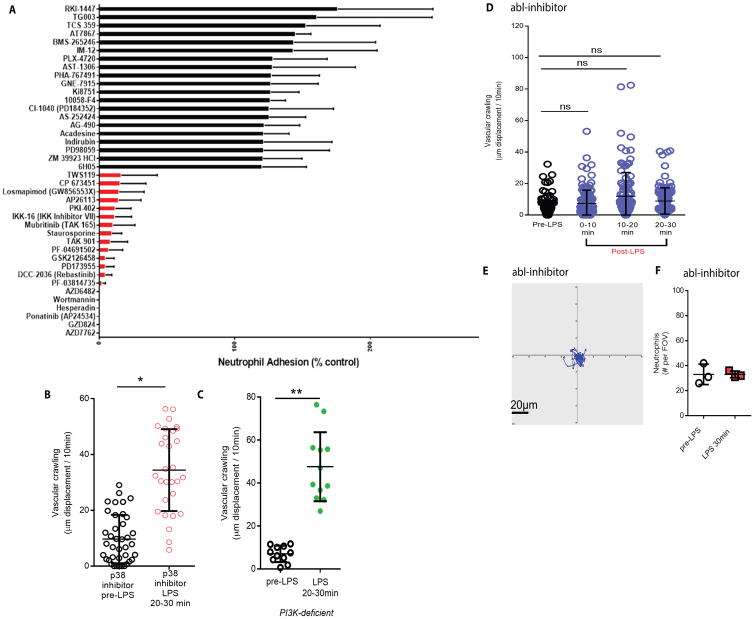
Fig. 6. The abl-tyrosine kinase mediates rapid vascular crawling in vivo following LPS stimulation
(A) A pharmacological inhibitor screen (1 μM) was performed to assess molecules involved in rapid neutrophil adhesion following 30 minutes of LPS stimulation in vitro. Adhesion levels were rank ordered and only the 20 least effective (black) and 20 most effective inhibitors (red or absent bars) are displayed. (B) A specific and potent p38-MAP kinase inhibitor (SB 239063, 10 μg/gram) was administered intravenously prior to LPS and vascular crawling was quantified (mean ± SD, * p = 0.018, n = 3, unpaired two tailed T test). (C) Mice deficient in PI3K underwent pulmonary intravital prior to and following intravenous LPS. Vascular crawling displacement was quantified (mean ± SD, ** p = 0.066, n = 3, unpaired two tailed T test). (D) Wildtype mice received GZD824, a specific abl-kinase inhibitor (5 μg/gram i.v.) 30 minutes prior to baseline pulmonary intravital imaging. Treated mice were imaged and neutrophil crawling was quantified (mean ± SD, n = 3, one way ANOVA, not significant) and (E) tracking determined. (F) Neutrophil accumulation was quantified in mice pretreated with abl-inhibitor before and after LPS administration (mean ± SD, n = 3, unpaired two tailed T test, not significant).
Fig. 7
Fig. 7. Abl-kinase mediates rapid CD11b dependent hunting during endotoxemia in vivo
Pulmonary intravital microscopy compared LPS induced CD11b upregulation in abl-inhibitor treated versus saline treated mice. (A) LPS enhanced CD11b expression (intravenous fluorescently conjugated monoclonal antibody clone M1/70, 2.5 μg, green) on lung neutrophils (intravenous fluorescently conjugated monoclonal antibody clone 1A8, 3.5 μg, red), which appear yellow when overlapped (n = 3). Image displayed is following 20 minutes of LPS. (B) Abl-inhibitor pre-treatment (GZD824, 5 μg/gram i.v.) attenuated CD11b-bright neutrophils after 20 minutes of LPS (n = 3). (C) Abl-inhibitor pre-treated or control mice were quantified over twenty minutes of imaging between 20–40 min. post LPS. The area, averaged over 20 minutes of video, of CD11b bright/Ly6G+ overlap is displayed (mean ± SD, n = 3, one way ANOVA, * p = 0.039 and # p = 0.022). (D) Additionally, the number of CD11b bright neutrophils was averaged over twenty minutes of video between 20–40 min. post LPS (mean ± SD, n = 3, one way ANOVA, ** p = 0.008 and ## p = 0.0043).
Fig. 8
Fig. 8. The lung provides a niche for rapid neutrophil surveillance and capture of bloodstream bacteria in vivo
(A) Crawling neutrophil behavior was directly examined during a model of E. coli gram-negative bacteremia. Fluorescently labelled transgenic E. coli was administered (1 × 10 7 CFU i.v.) at the time of imaging using the lymEGFP mouse. The sequence of images demonstrates endothelial capture of E. coli and subsequently two separate neutrophil capture events. Arrows highlight bacteria, while the corresponding neutrophil is marked with color-coded asterisks. (B) Bacteria trapped along the vasculature of lysmEGFP during the first-pass are compared to the total number of bacteria visualized during the first-pass (mean ± SD, n = 3, unpaired two tailed T test, not significant). (C) E. coli vascular sequestration was observed in macrophage depleted C57/BL6 or control mice (mean ± SD, n = 5, unpaired two tailed T test, not significant). (D) Bacteria trapped along the vasculature of CRIg-deficient mice during the first-pass are compared to the total number of bacteria visualized during the first-pass (mean ± SD, n = 5, unpaired two tailed T test, not significant). (E) E. coli sequestration in neutrophil depleted versus control C57BL/6 (mean ± SD, n = 5, unpaired two tailed T test, *** p = 0.001). E. coli captured by lung neutrophils compared to the total bacteria per FOV was quantified after 60 minutes of bacteria administration in either (F) lysmEGFP (mean ± SD, n = 3, unpaired two tailed T test, not significant) or (G) CRIg-deficient mice (mean ± SD, n = 3, unpaired two tailed T test, not significant). Following 60 minutes of bacteria administration, the number of E. coli remaining adhered to the vessel wall versus phagocytosed by neutrophils is demonstrated in (H) lysmEGFP (mean ± SD, n = 3, unpaired two tailed T test, ** p = 0.0049) and (I) CD11b-deficient mice (mean ± SD, n = 3, unpaired two tailed T test, not significant). (J) Neutrophil crawling was quantified as vascular distance between 20–30min following intravenous E. coli in control C57BL/6 mice versus mice pretreated with the abl-inhibitor (GZD824, 5 μg/gram i.v. mean ± SD, n = 3, unpaired two tailed T test, * p = 0.032). (K) The number of freely circulating uncaptured bacteria was quantified in control and abl inhibitor treated mice after 30 min of bacteremia (mean ± SD, n = 3, unpaired two tailed T test, * p = 0.018). (L) Bacteria capture by neutrophils was determined following 60 minutes of E. coli administration in control mice versus macrophage depleted mice (mean ± SD, n = 3, unpaired two tailed T test, ** p = 0.009).

References

    1. Liu V, Escobar GJ, Greene JD, Soule J, Whippy A, Angus DC, Iwashyna TJ. Hospital deaths in patients with sepsis from 2 independent cohorts. JAMA. 2014;312:90–92. - PubMed
    1. Mansur A, Klee Y, Popov AF, Erlenwein J, Ghadimi M, Beissbarth T, Bauer M, Hinz J. Primary bacteraemia is associated with a higher mortality risk compared with pulmonary and intra-abdominal infections in patients with sepsis: a prospective observational cohort study. BMJ Open. 2015;5 - PMC - PubMed
    1. Laupland KB. Incidence of bloodstream infection: a review of population-based studies. Clin Microbiol Infect. 2013;19:492–500. - PubMed
    1. Biondi E, Evans R, Mischler M, Bendel-Stenzel M, Horstmann S, Lee V, Aldag J, Gigliotti F. Epidemiology of bacteremia in febrile infants in the United States. Pediatrics. 2013;132:990–996. - PubMed
    1. Deen J, von Seidlein L, Andersen F, Elle N, White NJ, Lubell Y. Community-acquired bacterial bloodstream infections in developing countries in south and southeast Asia: a systematic review. Lancet Infect Dis. 2012;12:480–487. - PubMed