doi: 10.3201/eid2307.170163.
Novel Pestivirus Species in Pigs, Austria, 2015
- PMID: 28628456
- PMCID: PMC5512468
- DOI: 10.3201/eid2307.170163
Item in Clipboard
Novel Pestivirus Species in Pigs, Austria, 2015
Emerg Infect Dis.
2017 Jul.
Abstract
A novel pestivirus species was discovered in a piglet-producing farm in Austria during virologic examinations of congenital tremor cases. The emergence of this novel pestivirus species, provisionally termed Linda virus, in domestic pigs may have implications for classical swine fever virus surveillance and porcine health management.
Keywords: Austria; Bungowannah virus; Flaviviridae; Linda virus; atypical porcine pestivirus; classical swine fever virus; congenital tremor; livestock; pestivirus; pigs; viruses.
Figures
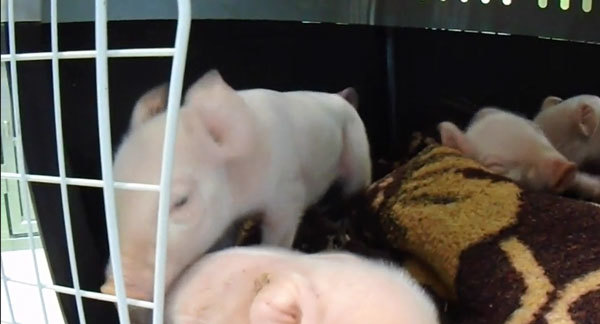
Congenital tremor visible in piglets that were affected by a novel pestivirus
provisionally termed Linda virus, Austria, 2015.
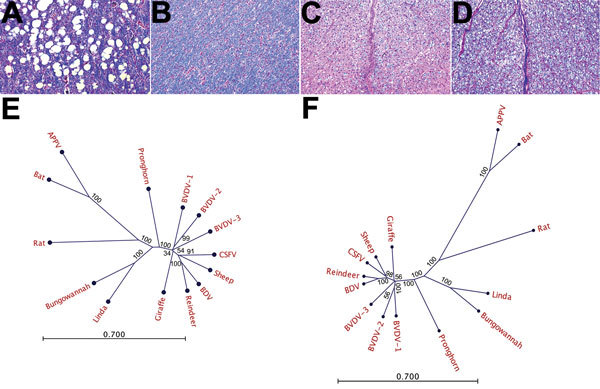
Histologic and phylogenetic examination in investigation of piglets with
congenital tremor (CT) on a farm in southeastern Austria, 2015. A)
Cerebellar white matter of CT-affected piglet showing multiple sharply
bordered vacuoles but normal myelination (stained in blue; luxol fast
blue/hematoxylin-eosin staining; original magnification ×10). B)
Control piglet with normal cerebellar white matter (original magnification
×10). C) Spinal cord white matter in CT-affected piglet shows a
severely reduced amount of myelin (original magnification ×10). D)
Control piglet with normal myelination of the spinal cord white matter
(original magnification ×10). E, F) Phylogenetic neighbor-joining
analysis using the nucleotide (E) and polyprotein (F) sequences of the novel
virus isolated from piglets, provisionally termed Linda virus (GenBank
accession no. KY436034); approved pestivirus species BVDV-1 NADL (accession
no. M31182.1), BVDV-2 890 (accession no. U18059.1), CSFV Alfort_187
(accession no. X87939.1), and BDV X818 (accession no. AF037405.1); and
tentative species Bungowannah virus (accession no. EF100713.2), sheep
pestivirus Aydin (accession no. NC_018713.1), pronghorn pestivirus
(accession no. NC_024018.2), reindeer pestivirus (accession no. AF144618.2),
giraffe pestivirus (accession no. NC_003678.1), BVDV-3 D32_00_HoBi
(accession no. AB871953.1), APPV NL1 (accession no. KX929062.1),
Rhinolophus affinis pestivirus (accession no.
JQ814854.1), and Norway rat pestivirus (accession no. KJ950914.1). Assumed
relationships between the species are shown in a radial branching diagram
with numbers indicating the bootstrap values of 1,000 replicates in
percentages. Scale bars indicate number of substitutions per site. BDV,
border disease virus; BVDV, bovine viral diarrhea virus; CSFV, classical
swine fever virus.
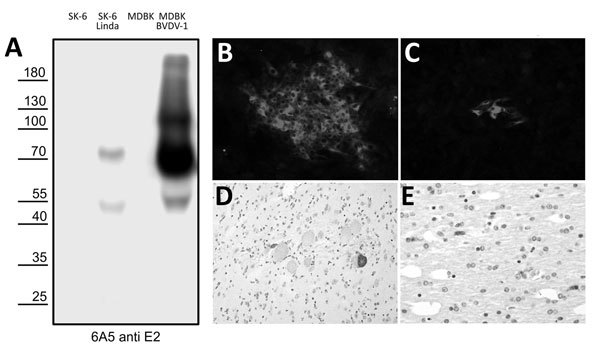
Detection of pestivirus E2 protein with monoclonal antibody 6A5 in
investigation of piglets with congenital tremor (CT) on a farm in
southeastern Austria, 2015. A) Western blot analysis of cells infected with
novel virus provisionally termed Linda virus. Total protein of SK-6 cells
infected with Linda virus and MDBK cells infected with BVDV-1 (strain NADL)
was probed with the pestivirus E2-specific antibody 6A5. The apparent
molecular mass of monomeric E2 (LV 50 kDa and BVDV-1 55 kDa) shows that
Linda virus E2 has a lower molecular weight than BVDV-1 E2 as a result of
fewer N-linked glycosylation sites. In contrast, the mass of E1-E2
heterodimers is comparable (≈70 kDa in Linda virus and BVDV-1),
because Linda virus E1 has an additional N-linked glycosylation site. B, C)
Focus size of Linda virus 48 hours after infection of SK-6 cells (B) and
MDBK cells (C) (original magnification ×20). D, E) Detection of
pestiviral E2 within neuronal tissue of Linda virus–positive,
congenital tremor–affected piglets showing positive signals in
neurons of the nucleus of the trigeminal nerve (D) (original magnification
×10) and within glial cells in the cerebellar white matter (E)
(original magnification ×20). BVDV, bovine viral diarrhea virus.
References
-
- King AMQ, Adams MJ, Carstens EB, Lefkowitz EJ; International Union of Microbiological Societies, Virology Division. Virus taxonomy: classification and nomenclature of viruses. Ninth report of the International Committee on Taxonomy of Viruses. Amsterdam: Elsevier/Academic Press; 2012.
-
- Arruda BL, Arruda PH, Magstadt DR, Schwartz KJ, Dohlman T, Schleining JA, et al. Identification of a divergent lineage porcine pestivirus in nursing piglets with congenital tremors and reproduction of disease following experimental inoculation. PLoS One. 2016;11:e0150104. 10.1371/journal.pone.0150104 - DOI - PMC - PubMed
Publication types
MeSH terms
Substances
LinkOut - more resources
Full Text Sources
Other Literature Sources