


Outcome of cardiac surgery in patients with congenital heart disease in England between 1997 and 2015
- PMID: 28628610
- PMCID: PMC5476245
- DOI: 10.1371/journal.pone.0178963
Outcome of cardiac surgery in patients with congenital heart disease in England between 1997 and 2015
Abstract
Background: The number of patients with congenital heart disease (CHD) is increasing worldwide and most of them will require cardiac surgery, once or more, during their lifetime. The total volume of cardiac surgery in CHD patients at a national level and the associated mortality and predictors of death associated with surgery are not known. We aimed to investigate the surgical volume and associated mortality in CHD patients in England.
Methods: Using a national hospital episode statistics database, we identified all CHD patients undergoing cardiac surgery in England between 1997 and 2015.
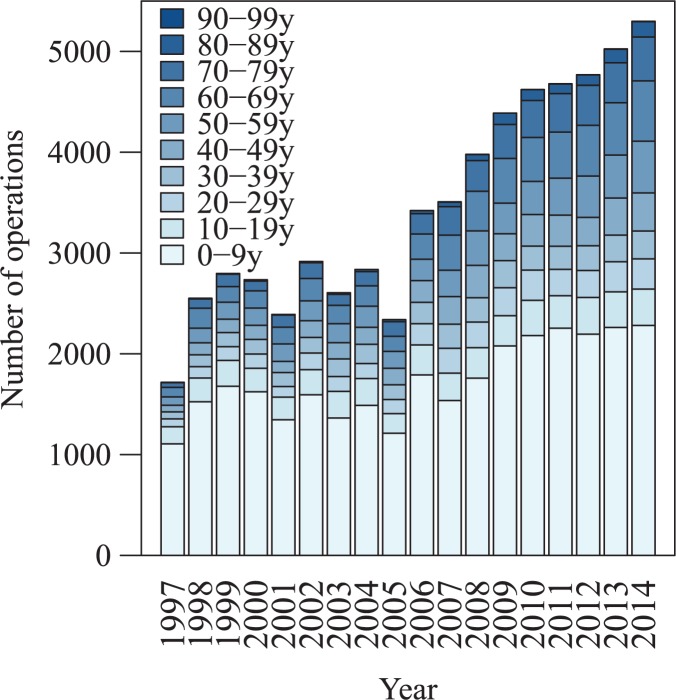
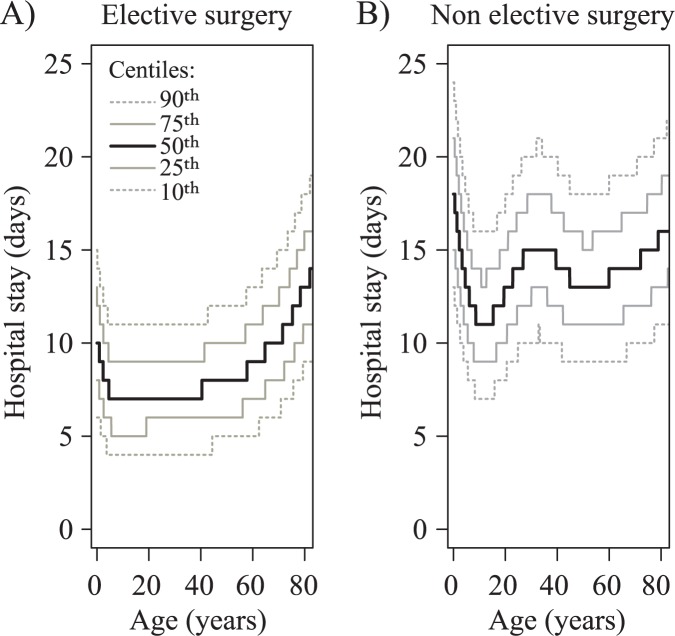
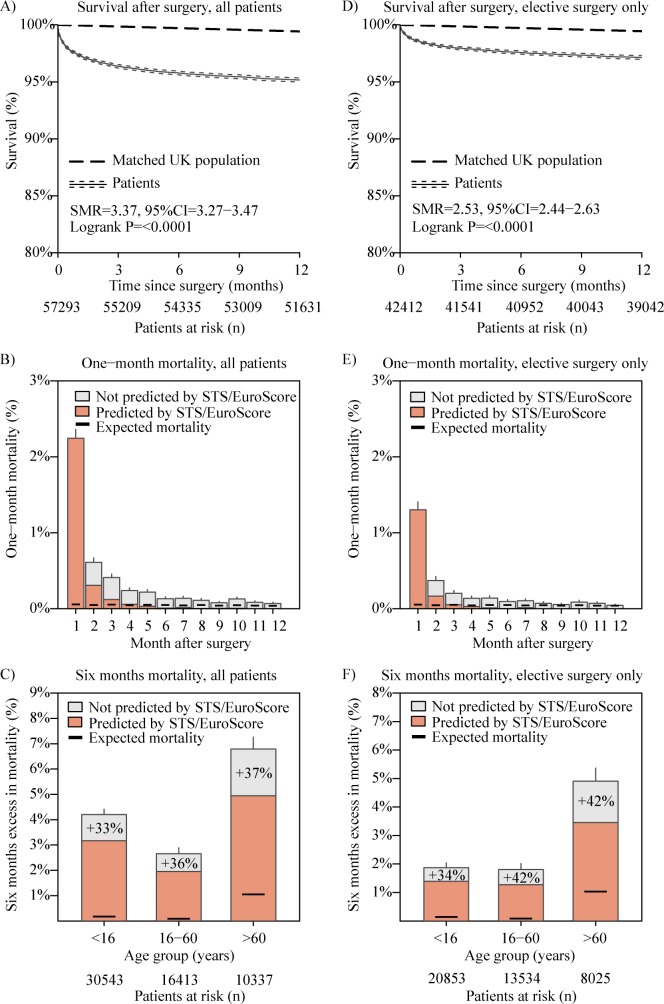
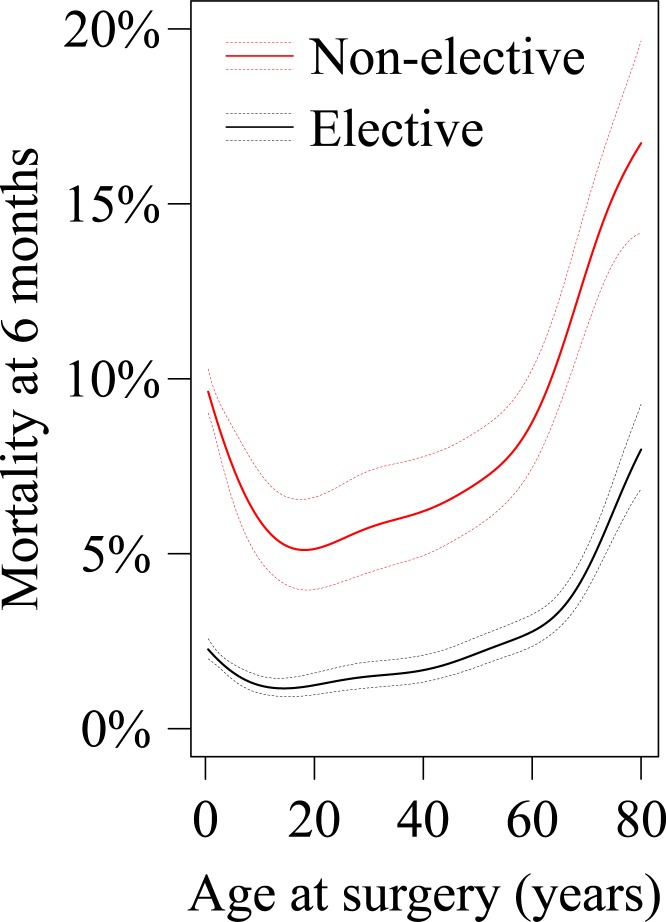
Results: We evaluated 57,293 patients (median age 11.9years, 46.7% being adult, 56.7% female). There was a linear increase in the number of operations performed per year from 1,717 in 1997 to 5,299 performed in 2014. The most common intervention at the last surgical event was an aortic valve procedure (9,276; 16.2%), followed by repair of atrial septal defect (9,154; 16.0%), ventricular septal defect (7,746; 13.5%), tetralogy of Fallot (3,523; 6.1%) and atrioventricular septal defect (3,330; 5.8%) repair. Associated mortality remained raised up to six months following cardiac surgery. Several parameters were predictive of post-operative mortality, including age, complexity of surgery, need for emergency surgery and socioeconomic status. The relationship of age with mortality was "U"-shaped, and mortality was highest amongst youngest children and adults above 60 years of age.
Conclusions: The number of cardiac operations performed in CHD patients in England has been increasing, particularly in adults. Mortality remains raised up to 6-months after surgery and was highest amongst young children and seniors.
Conflict of interest statement
Figures
References
-
- Diller G-P, Kempny A, Alonso-Gonzalez R, Swan L, Uebing A, et al. (2015) Survival Prospects and Circumstances of Death in Contemporary Adult Congenital Heart Disease Patients Under Follow-Up at a Large Tertiary Centre. Circulation 132: 2118–2125. doi: 10.1161/CIRCULATIONAHA.115.017202 - DOI - PubMed
-
- Kogon B, Oster M (2014) Assessing surgical risk for adults with congenital heart disease: are pediatric scoring systems appropriate? J Thorac Cardiovasc Surg 147: 666–671. doi: 10.1016/j.jtcvs.2013.09.053 - DOI - PubMed
-
- Lacour-Gayet F, Clarke D, Jacobs J, Comas J, Daebritz S, et al. (2004) The Aristotle score: a complexity-adjusted method to evaluate surgical results. Eur J Cardiothorac Surg 25: 911–924. doi: 10.1016/j.ejcts.2004.03.027 - DOI - PubMed
-
- Jacobs ML, O'Brien SM, Jacobs JP, Mavroudis C, Lacour-Gayet F, et al. (2013) An empirically based tool for analyzing morbidity associated with operations for congenital heart disease. J Thorac Cardiovasc Surg 145: 1046–1057.e1041. doi: 10.1016/j.jtcvs.2012.06.029 - DOI - PMC - PubMed
-
- Jenkins KJ, Gauvreau K, Newburger JW, Spray TL, Moller JH, et al. (2002) Consensus-based method for risk adjustment for surgery for congenital heart disease. J Thorac Cardiovasc Surg 123: 110–118. - PubMed
MeSH terms
Supplementary concepts
LinkOut - more resources
Full Text Sources
Other Literature Sources
Medical
