


Targeting multiple pro-apoptotic signaling pathways with curcumin in prostate cancer cells
- PMID: 28628644
- PMCID: PMC5476315
- DOI: 10.1371/journal.pone.0179587
Targeting multiple pro-apoptotic signaling pathways with curcumin in prostate cancer cells
Abstract
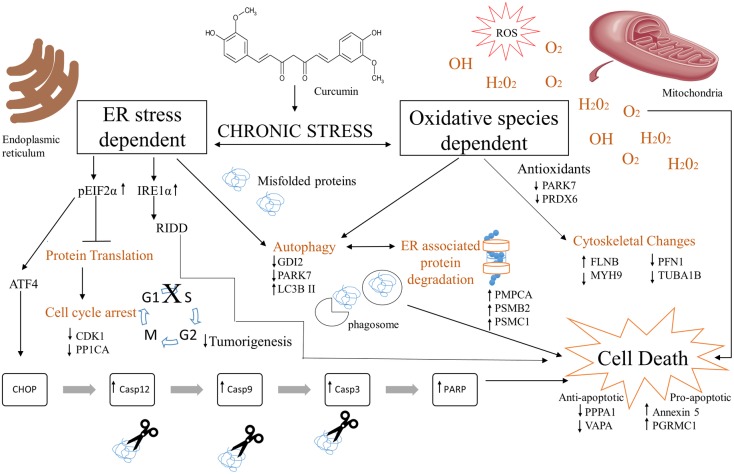
Curcumin, an extract from the turmeric rhizome (Curcuma longa), is known to exhibit anti-inflammatory, antioxidant, chemopreventive and antitumoral activities against aggressive and recurrent cancers. Accumulative data indicate that curcumin may induce cancer cell death. However, the detailed mechanism underlying its pro-apoptotic and anti-cancer effects remains to be elucidated. In the present study, we examined the signaling pathways triggered by curcumin, specifically, the exact molecular mechanisms of curcumin-induced apoptosis in highly metastatic human prostate cancer cells. The effect of curcumin was evaluated using for the first time in prostate cancer, a gel-free shotgun quantitative proteomic analysis coupled with Tandem Mass Tag isobaric labeling-based-signaling networks. Results were confirmed at the gene expression level by qRT-PCR and at the protein expression level by western blot and flow cytometry. Our findings revealed that curcumin induced an Endoplasmic Reticulum stress-mediated apoptosis in PC3. The mechanisms by which curcumin promoted cell death in these cells were associated with cell cycle arrest, increased reactive oxygen species, autophagy and the Unfolded Protein Response. Furthermore, the upregulation of ER stress was measured using key indicators of ER stress: Glucose-Regulated Protein 78, Inositol-Requiring Enzyme 1 alpha, Protein Disulfide isomerase and Calreticulin. Chronic ER stress induction was concomitant with the upregulation of pro-apoptotic markers (caspases 3,9,12) and Poly (ADP-ribose) polymerase. The downregulated proteins include anti-apoptotic and anti-tumor markers, supporting their curcumin-induced pro-apoptotic role in prostate cancer cells. Taken together, these data suggest that curcumin may serve as a promising anticancer agent by inducing a chronic ER stress mediated cell death and activation of cell cycle arrest, UPR, autophagy and oxidative stress responses.
Conflict of interest statement
Figures
References
-
- Siegel RL, Miller KD, Jemal A. Cancer statistics, 2016. CA: a cancer journal for clinicians. 2016;66(1):7–30. Epub 01/09. doi: 10.3322/caac.21332 - DOI - PubMed
-
- Wu SH, Hang LW, Yang JS, Chen HY, Lin HY, Chiang JH, et al. Curcumin induces apoptosis in human non-small cell lung cancer NCI-H460 cells through ER stress and caspase cascade- and mitochondria-dependent pathways. Anticancer Res. 2010;30(6):2125–33. . - PubMed
-
- Zheng R, Deng Q, Liu Y, Zhao P. Curcumin Inhibits Gastric Carcinoma Cell Growth and Induces Apoptosis by Suppressing the Wnt/beta-Catenin Signaling Pathway. Med Sci Monit. 2017;23:163–71. doi: 10.12659/MSM.902711 - DOI - PMC - PubMed
-
- Senft C, Polacin M, Priester M, Seifert V, Kogel D, Weissenberger J. The nontoxic natural compound Curcumin exerts anti-proliferative, anti-migratory, and anti-invasive properties against malignant gliomas. BMC Cancer. 2010;10:491 ; PubMed Central PMCID: PMCPMC2949804. doi: 10.1186/1471-2407-10-491 - DOI - PMC - PubMed
MeSH terms
Substances
Grants and funding
LinkOut - more resources
Full Text Sources
Other Literature Sources
Research Materials
