. 2017 Jun 19;13(1):187.
doi: 10.1186/s12917-017-1112-6.

Geospatial and temporal associations of Getah virus circulation among pigs and horses around the perimeter of outbreaks in Japanese racehorses in 2014 and 2015

Affiliations

Geospatial and temporal associations of Getah virus circulation among pigs and horses around the perimeter of outbreaks in Japanese racehorses in 2014 and 2015

Hiroshi Bannai et al. BMC Vet Res. .

Abstract

Background: We studied a recent epizootic of Getah virus infection among pigs in the southern part of Ibaraki Prefecture and the northern part of Chiba Prefecture, Japan, focusing on its possible association with outbreaks in racehorses in 2014 and 2015. The genomic sequence of a Getah virus strain from an infected pig was analyzed to evaluate the degree of identity with the strains from horses.

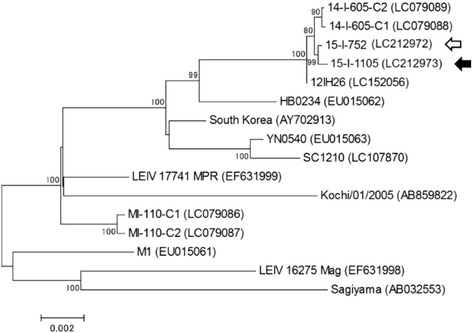
Results: Sera were collected from pigs from September to December 2012 to 2015 in south Ibaraki (380 pigs in 29 batches), and from September to December 2010 to 2015 in north Chiba (538 pigs in 104 batches). They were examined by using a virus-neutralizing test for Getah virus. Seropositivity rates in 2012-2013 in south Ibaraki and 2010-2012 in north Chiba ranged from 0% to 1.6%. In south Ibaraki, seropositivity rates in 2014 (28.8%) and 2015 (65.0%) were significantly higher than those in the previous years (P < 0.01); 4/5 batches had positive sera in 2014 and 7/7 in 2015. In north Chiba, seropositivity rates in 2013 (14.1%), 2014 (17.8%), and 2015 (48.0%) were significantly higher than those in the previous years (P < 0.01); 6/27 batches had positive sera in 2013, 3/9 in 2014, and 5/5 in 2015. Complete genome analysis revealed that the virus isolated from an infected pig had 99.89% to 99.94% nucleotide identity to the strains isolated from horses during the outbreaks in 2014 and 2015.

Conclusions: Serological surveillance of Getah virus in pigs revealed that the virus was circulating in south Ibaraki and north Chiba in 2014 and 2015; this was concomitant with the outbreaks in racehorses. The Getah virus strain isolated from a pig was closely related to the ones from horses during the 2014 and 2015 outbreaks. To our knowledge, this is the first convincing case of simultaneous circulation of Getah virus both among pigs and horses in specific areas.

Keywords: Getah virus; Horses; Japan; Pigs; Virus circulation.


Figures
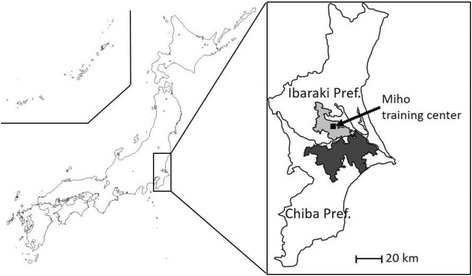
Fig. 1
Fig. 1
Locations of the study areas. The area in the southern part of Ibaraki Prefecture (south Ibaraki, gray) includes the village of Miho and the cities of Inashiki, Ushiku, and Tsuchiura and covers an area of 454 km2. There are 27 pig farms rearing about 32,000 pigs. The area in the northern part of Chiba Prefecture (north Chiba, black) includes the towns of Tako and Tohnosho and the cities of Inzai, Katori, Sakura, Narita, Shiroi, Yachimata, and Tomisato and covers an area of 988 km2. There are 158 pig farms rearing about 230,000 pigs. The location of the Miho training center—the site of the outbreak of Getah virus in racehorses in 2014 and 2015—is indicated by the black square
Fig. 2
Fig. 2
Phylogenetic analysis of complete Getah virus genome sequences. The Getah virus strain isolated from a pig (15-I-1105) is indicated by the black arrow. The strain isolated from a horse during the 2015 outbreak (15-I-752) is indicated by the white arrow. The percent bootstrap support is indicated by the values at each node; values less than 70% were omitted. MI-110-C1, MI-110-C2, 14-I-605-C1, and 14-I-605-C2 are Getah virus isolates from horses; 12IH26, HB0234, YN0540, SC1210, LEIV17741 MPR, M1, LEIV16275 Mag, and Sagiyama are isolates from mosquitoes; South Korea and Kochi/01/2005 are isolates from pigs
Fig. 3
Fig. 3
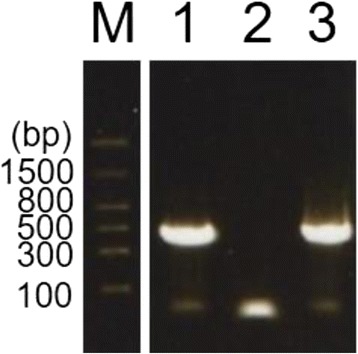
Detection of viral RNA by RT-PCR for Getah virus from the supernatant of Vero cells inoculated with a pig serum. After virus isolation in Vero cells, one serum collected on 28 September 2015 in Tsuchiura city (Ibaraki Pref.) showed cytopathic effects; the nucleic acid was extracted from the culture supernatant, and RT-PCR for the nsP1 gene was performed. M, marker; lane 1, supernatant of the cytopathic effects-positive culture; lane 2, negative control; lane 3, positive control

References

    1. Fukunaga Y, Kumanomido T, Kamada M. Getah virus as an equine pathogen. Vet Clin North Am Pract. 2000;16:605–617. doi: 10.1016/S0749-0739(17)30099-8. - DOI - PubMed
    1. Yago K, Hagiwara S, Kawamura H, Narita M. A fatal case in newborn piglets with Getah virus infection: isolation of the virus. Jpn J Vet Sci. 1987;49:989–994. doi: 10.1292/jvms1939.49.989. - DOI - PubMed
    1. Izumida A, Takuma H, Inagaki S, Kubota M, Hirahara T, Kodama K, et al. Experimental infection of Getah virus in swine. Jpn J Vet Sci. 1988;50:679–684. doi: 10.1292/jvms1939.50.679. - DOI - PubMed
    1. Kumanomido T, Wada R, Kanemaru T, Kamada M, Hirasawa K, Akiyama Y. Clinical and virological observations on swine experimentally infected with Getah virus. Vet Microbiol. 1988;16:295–301. doi: 10.1016/0378-1135(88)90033-8. - DOI - PubMed
    1. Kamada M, Wada R, Kumanomido T, Imagawa H, Sugiura T, Fukunaga Y. Effect of viral inoculum size on appearance of clinical signs in equine Getah virus infection. J Vet Med Sci. 1991;53:803–806. doi: 10.1292/jvms.53.803. - DOI - PubMed

MeSH terms

LinkOut - more resources