


Eating down or simply eating less? The diet and health implications of these practices during pregnancy and postpartum in rural Bangladesh
- PMID: 28629489
- PMCID: PMC10261490
- DOI: 10.1017/S1368980017000672
Eating down or simply eating less? The diet and health implications of these practices during pregnancy and postpartum in rural Bangladesh
Abstract
Objective: To: (i) determine the prevalence of self-reported eating less and eating down during early and late pregnancy and postpartum, and explore risk factors associated with eating less; (ii) examine the association between eating less and diet quality; and (iii) determine the association between eating less and weight gain during pregnancy.
Design: Data were collected longitudinally from a cohort of women participating in a community health programme. Diet was assessed at three time points (≤20 weeks' gestation, 36 weeks' gestation, 6 months' postpartum), body weight was measured during study enrolment (≤20 weeks' gestation) and at 36 weeks' gestation, and information about the woman and her household was collected at enrolment.
Setting: The Rang-Din Nutrition Study in the Rangpur and Dinajpur districts of Bangladesh.
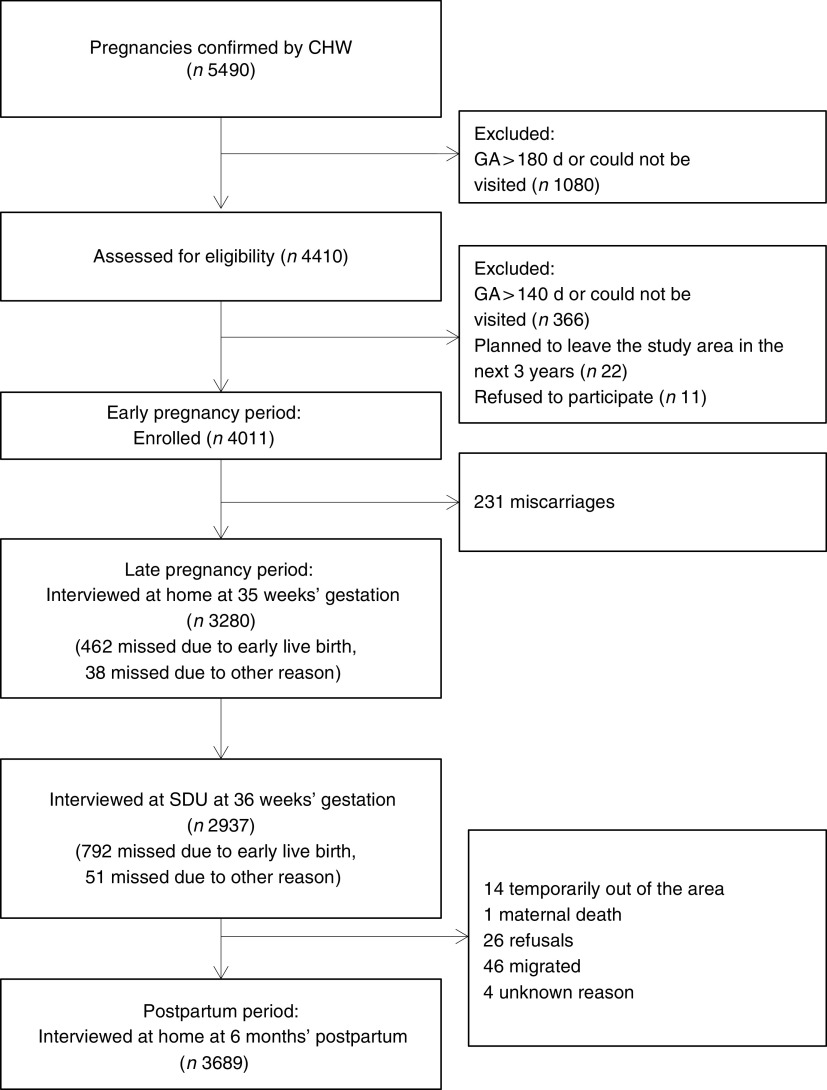
Subjects: Women (n 4011).
Results: The prevalence of self-reported eating less differed by time point (75·9 % in early pregnancy, 38·8 % in late pregnancy, 7·4 % postpartum; P<0·001). The most common reason for eating less across all time periods was food aversion or loss of appetite. Women who reported eating less in late pregnancy had consumed animal-source foods less frequently in the preceding week than women who reported eating more (mean (sd): 11·7 (7·4) v. 14·8 (9·2) times/week; P<0·001) and had lower weekly weight gain than women who reported eating more (mean (se): 0·27 (0·004) v. 0·33 (0·004) kg/week; P<0·001).
Conclusions: Eating less has negative implications with respect to diet quality and pregnancy weight gain in this context.
Keywords: Bangladesh; Diet; Eating down; Postpartum; Pregnancy.
Figures
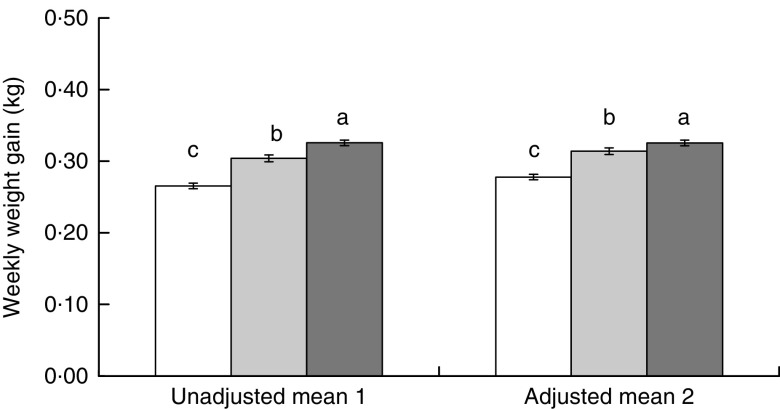
 ), the same (
 ) or more (
 ) food relative to their pre-pregnancy pattern, Rang-Din Nutrition Study, September 2011–August 2012. Means in model 1 were calculated using mixed-model ANOVA including the random effect of cluster and adjusted for multiple comparisons. Model 2 further adjusted for maternal age, BMI and gestational age at enrolment, parity, and season of interview at 36 weeks’ gestation. a,b,cMean values with unlike superscript letters were significantly different (P<0·05)
References
-
- Ramakrishnan U (2004) Nutrition and low birth weight: from research to practice. Am J Clin Nutr 79, 17–21. - PubMed
-
- Black RE, Allen LH, Bhutta ZA et al. (2008) Maternal and child undernutrition: global and regional exposures and health consequences. Lancet 371, 243–260. - PubMed
-
- Black RE, Victora CG, Walker SP et al. (2013) Maternal and child undernutrition and overweight in low-income and middle-income countries. Lancet 382, 427–451. - PubMed
-
- National Institute of Population Research and Training, Mitra and Associates, & ICF International (2013) Bangladesh Demographic and Health Survey 2011. Dhaka and Calverton, MD: NIPORT, Mitra and Associates, and ICF International.
-
- Arsenault JE, Yakes EA, Islam MM et al. (2013) Very low adequacy of micronutrient intakes by young children and women in rural Bangladesh is primarily explained by low food intake and limited diversity. J Nutr 143, 197–203. - PubMed
Publication types
MeSH terms
Grants and funding
LinkOut - more resources
Full Text Sources
Other Literature Sources
Medical
