


Trust and Credibility in Web-Based Health Information: A Review and Agenda for Future Research
- PMID: 28630033
- PMCID: PMC5495972
- DOI: 10.2196/jmir.7579
Trust and Credibility in Web-Based Health Information: A Review and Agenda for Future Research
Abstract
Background: Internet sources are becoming increasingly important in seeking health information, such that they may have a significant effect on health care decisions and outcomes. Hence, given the wide range of different sources of Web-based health information (WHI) from different organizations and individuals, it is important to understand how information seekers evaluate and select the sources that they use, and more specifically, how they assess their credibility and trustworthiness.
Objective: The aim of this study was to review empirical studies on trust and credibility in the use of WHI. The article seeks to present a profile of the research conducted on trust and credibility in WHI seeking, to identify the factors that impact judgments of trustworthiness and credibility, and to explore the role of demographic factors affecting trust formation. On this basis, it aimed to identify the gaps in current knowledge and to propose an agenda for future research.
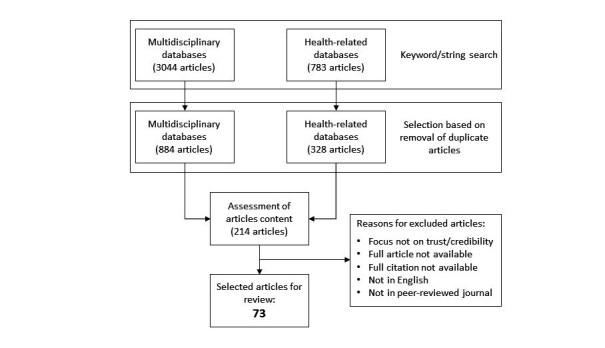
Methods: A systematic literature review was conducted. Searches were conducted using a variety of combinations of the terms WHI, trust, credibility, and their variants in four multi-disciplinary and four health-oriented databases. Articles selected were published in English from 2000 onwards; this process generated 3827 unique records. After the application of the exclusion criteria, 73 were analyzed fully.
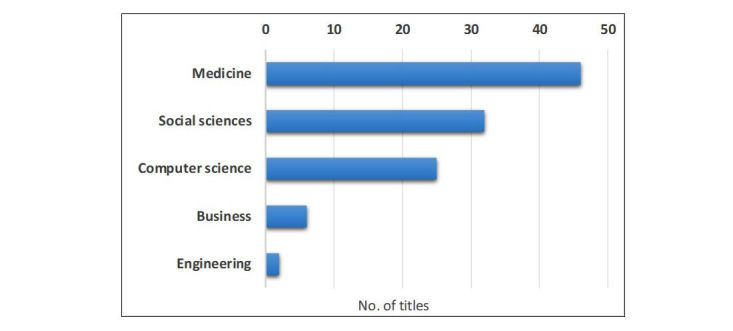
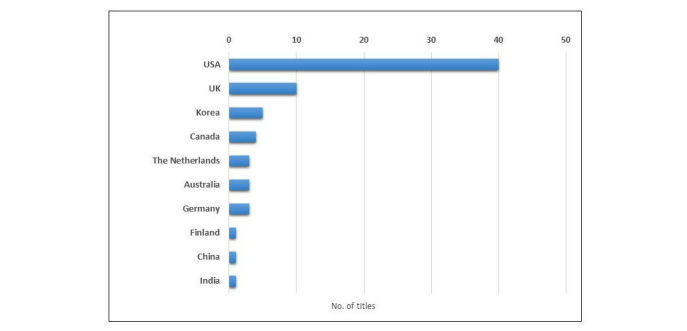
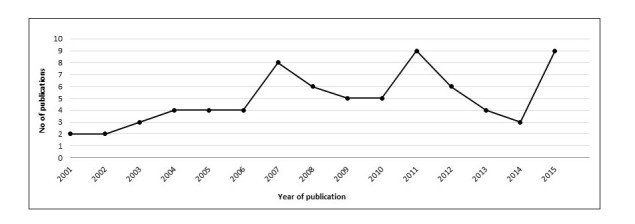
Results: Interest in this topic has persisted over the last 15 years, with articles being published in medicine, social science, and computer science and originating mostly from the United States and the United Kingdom. Documents in the final dataset fell into 3 categories: (1) those using trust or credibility as a dependent variable, (2) those using trust or credibility as an independent variable, and (3) studies of the demographic factors that influence the role of trust or credibility in WHI seeking. There is a consensus that website design, clear layout, interactive features, and the authority of the owner have a positive effect on trust or credibility, whereas advertising has a negative effect. With regard to content features, authority of the author, ease of use, and content have a positive effect on trust or credibility formation. Demographic factors influencing trust formation are age, gender, and perceived health status.
Conclusions: There is considerable scope for further research. This includes increased clarity of the interaction between the variables associated with health information seeking, increased consistency on the measurement of trust and credibility, a greater focus on specific WHI sources, and enhanced understanding of the impact of demographic variables on trust and credibility judgments.
Keywords: health information; information retrieval; literature review; trust; web.
©Laura Sbaffi, Jennifer Rowley. Originally published in the Journal of Medical Internet Research (http://www.jmir.org), 19.06.2017.
Conflict of interest statement
Conflicts of Interest: None declared.
Figures
References
-
- Fox S, Duggan M. Pew Research Center. 2013. Jan 15, [2017-06-03]. Health Online 2013 http://www.pewinternet.org/2013/01/15/health-online-2013/
-
- Dutton W, Blank G. Worldinternetproject. 2013. [2017-06-03]. Cultures of the Internet: The Internet in Britain http://www.worldinternetproject.net/_files/_Published/23/820_oxis2011_re... .
-
- Fox S. Pew Research Center. 2011. May 12, [2017-06-12]. The Social Life of Health Information, 2011 http://www.pewinternet.org/2011/05/12/the-social-life-of-health-informat...
-
- Xiao N, Sharman R, Rao HR, Upadhyaya S. Factors influencing online health information search: an empirical analysis of a national cancer-related survey. Decis Support Syst. 2014;57:417–427. doi: 10.1016/j.dss.2012.10.047. - DOI
-
- Powell J, Inglis N, Ronnie J, Large S. The characteristics and motivations of online health information seekers: cross-sectional survey and qualitative interview study. J Med Internet Res. 2011 Feb;13(1):e20. doi: 10.2196/jmir.1600. http://www.jmir.org/2011/1/e20/ - DOI - PMC - PubMed
Publication types
MeSH terms
LinkOut - more resources
Full Text Sources
Other Literature Sources
