


Cumulative Effect of an Antimicrobial Stewardship and Rapid Diagnostic Testing Bundle on Early Streamlining of Antimicrobial Therapy in Gram-Negative Bloodstream Infections
- PMID: 28630187
- PMCID: PMC5571292
- DOI: 10.1128/AAC.00189-17
Cumulative Effect of an Antimicrobial Stewardship and Rapid Diagnostic Testing Bundle on Early Streamlining of Antimicrobial Therapy in Gram-Negative Bloodstream Infections
Abstract
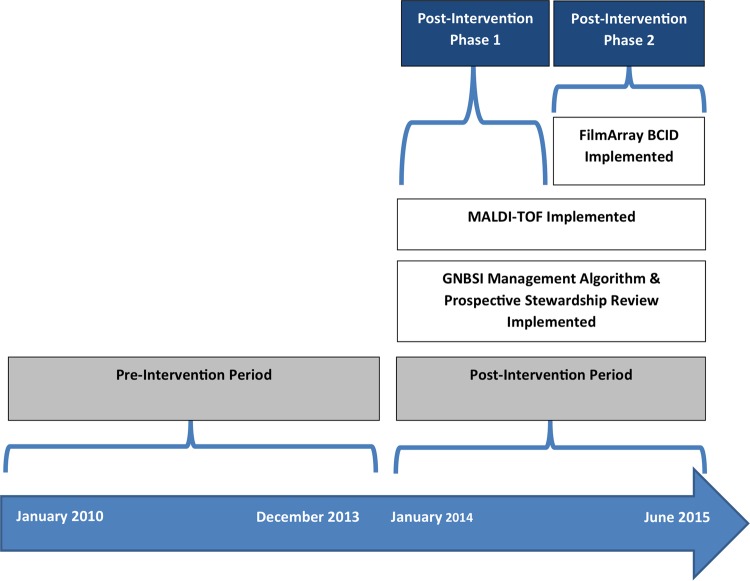
The use of rapid diagnostic tests (RDTs) enhances antimicrobial stewardship program (ASP) interventions in optimization of antimicrobial therapy. This quasi-experimental cohort study evaluated the combined impact of an ASP/RDT bundle on the appropriateness of empirical antimicrobial therapy (EAT) and time to de-escalation of broad-spectrum antimicrobial agents (BSAA) in Gram-negative bloodstream infections (GNBSI). The ASP/RDT bundle consisted of system-wide GNBSI treatment guidelines, prospective stewardship monitoring, and sequential introduction of two RDTs, matrix-assisted laser desorption ionization-time of flight mass spectrometry (MALDI-TOF MS) and the FilmArray blood culture identification (BCID) panel. The preintervention period was January 2010 through December 2013, and the postintervention period followed from January 2014 through June 2015. The postintervention period was conducted in two phases; phase 1 followed the introduction of MALDI-TOF MS, and phase 2 followed the introduction of the FilmArray BCID panel. The interventions resulted in significantly improved appropriateness of EAT (95% versus 91%; P = 0.02). Significant reductions in median time to de-escalation from combination antimicrobial therapy (2.8 versus 1.5 days), antipseudomonal beta-lactams (4.0 versus 2.5 days), and carbapenems (4.0 versus 2.5 days) were observed in the postintervention compared to the preintervention period (P < 0.001 for all). The reduction in median time to de-escalation from combination therapy (1.0 versus 2.0 days; P = 0.03) and antipseudomonal beta-lactams (2.2 versus 2.7 days; P = 0.04) was further augmented during phase 2 compared to phase 1 of the postintervention period. Implementation of an antimicrobial stewardship program and RDT intervention bundle in a multihospital health care system is associated with improved appropriateness of EAT for GNBSI and decreased utilization of BSAA through early de-escalation.
Keywords: antimicrobial stewardship; bloodstream infection; rapid diagnostics.
Copyright © 2017 American Society for Microbiology.
Figures

References
-
- Kumar A, Roberts D, Wood KE, Light B, Parrillo JE, Sharma S, Suppes R, Feinstein D, Zanotti S, Taiberg L, Gurka D, Kumar A, Cheang M. 2006. Duration of hypotension before initiation of effective antimicrobial therapy is the critical determinant of survival in human septic shock. Crit Care Med 34:1589–1596. doi: 10.1097/01.CCM.0000217961.75225.E9. - DOI - PubMed
-
- Kumar A, Ellis P, Arabi Y, Roberts D, Light B, Parrillo JE, Dodek P, Wood G, Kumar A, Simon D, Peters C, Ahsan M, Chateau D, Cooperative Antimicrobial Therapy of Septic Shock Database Research Group. 2009. Initiation of inappropriate antimicrobial therapy results in a fivefold reduction of survival in human septic shock. Chest 136:1237–1248. doi: 10.1378/chest.09-0087. - DOI - PubMed
-
- McGregor JC, Rich SE, Harris AD, Perencevich EN, Osih R, Lodise TP Jr, Miller RR, Furuno JP. 2007. A systematic review of the methods used to assess the association between appropriate antibiotic therapy and mortality in bacteremic patients. Clin Infect Dis 45:329–337. doi: 10.1086/519283. - DOI - PubMed
Publication types
MeSH terms
Substances
LinkOut - more resources
Full Text Sources
Other Literature Sources
Medical
