Randomized Controlled Trial
. 2017 Jun 19;7(1):3772.
doi: 10.1038/s41598-017-04012-0.

Neurofeedback learning modifies the incidence rate of alpha spindles, but not their duration and amplitude

Affiliations
Randomized Controlled Trial

Neurofeedback learning modifies the incidence rate of alpha spindles, but not their duration and amplitude

Alexei Ossadtchi et al. Sci Rep. .

Abstract

Although the first experiments on alpha-neurofeedback date back nearly six decades ago, when Joseph Kamiya reported successful operant conditioning of alpha-rhythm in humans, the effectiveness of this paradigm in various experimental and clinical settings is still a matter of debate. Here, we investigated the changes in EEG patterns during a continuously administered neurofeedback of P4 alpha activity. Two days of neurofeedback training were sufficient for a significant increase in the alpha power to occur. A detailed analysis of these EEG changes showed that the alpha power rose because of an increase in the incidence rate of alpha episodes, whereas the amplitude and the duration of alpha oscillations remained unchanged. These findings suggest that neurofeedback facilitates volitional control of alpha activity onset, but alpha episodes themselves appear to be maintained automatically with no volitional control - a property overlooked by previous studies that employed continuous alpha-power neurofeedback. We propose that future research on alpha neurofeedback should explore reinforcement schedules based on detection of onsets and offsets of alpha waves, and employ these statistics for exploration and quantification of neurofeedback induced effects.


Conflict of interest statement

The authors declare that they have no competing interests.

Figures
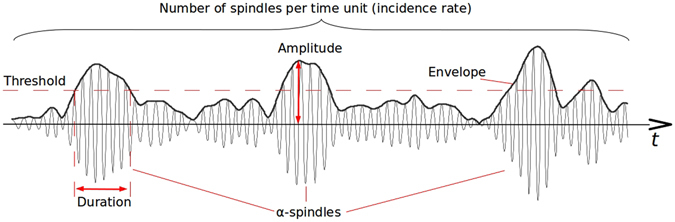
Figure 1
Figure 1
A representative EEG trace filtered in the 8–12 Hz band. Due to the inherent non-stationarity of the EEG time series, the average increase of the alpha-band power can be explained by changes in the duration of alpha spindles, the peak amplitude and the incidence rate of such spindles.
Figure 2
Figure 2
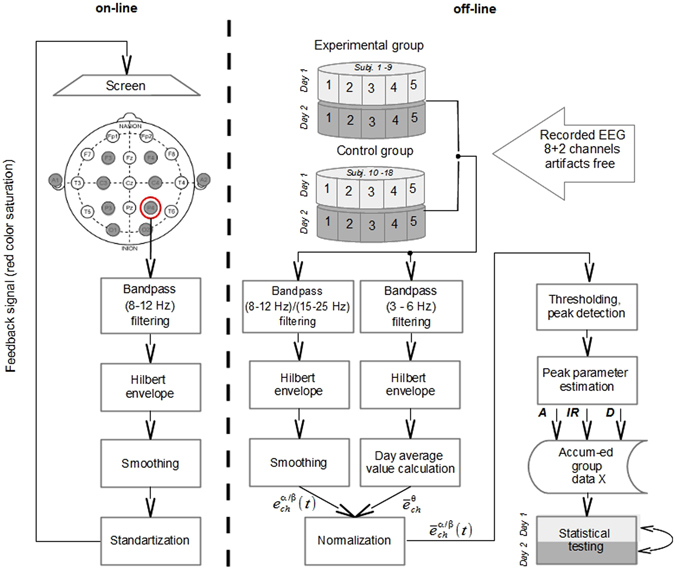
Schematic representation of the experimental procedure.
Figure 3
Figure 3
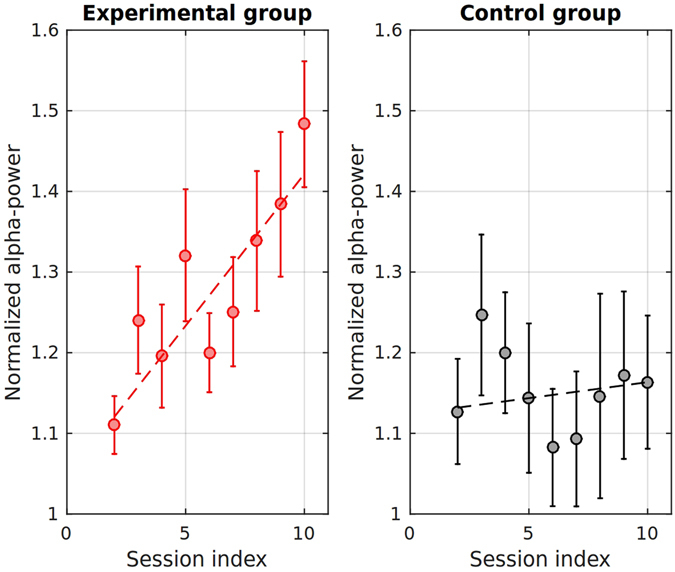
Average P4-alpha power dynamics in the experimental and the control groups during the two days of training. The points on the graph represent the mean alpha power during each 2-minute neurofeedback session relative to the first session of the first day. Since the first session of the first day was used as a reference point and is omitted from the graphs (baseline = 1), the effect of each individual 2-minute session can be estimated as a ratio of the observed value to that from the previous session.
Figure 4
Figure 4
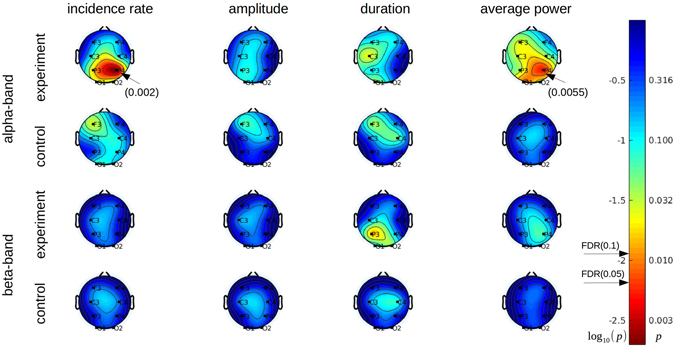
Statistical analysis of Q α(t) waveform morphology in terms of the incidence rate of alpha spindles (first column), their duration (second column), amplitude (third column) and average power (fourth column). The electrodes exhibiting significant changes are pointed by the arrows with the corresponding p–values specified in brackets. A linear colormap encodes the log10 p-values obtained from the permutation test of no difference between days 1 and 2. Non-logarithmic p-values are also shown on the outer side of the colorbar. Beta band changes are included in the analysis as a control for frequency band specificity. Significant differences that pass the FDR (0.1) correction for multiple comparisons are observed only for the spindles incidence rate parameter at P4 (p = 0.002) and for the average power at the same electrode (p = 0.0055). These differences correspond to a greater mean value observed on day 2, as compared to day 1. Note that changes in the incidence rate parameter are more spatially specific and better correspond to the goal of neurofeedback training of enhancing alpha rhythm power at P4 than the average power changes (top row, rightmost column).
Figure 5
Figure 5
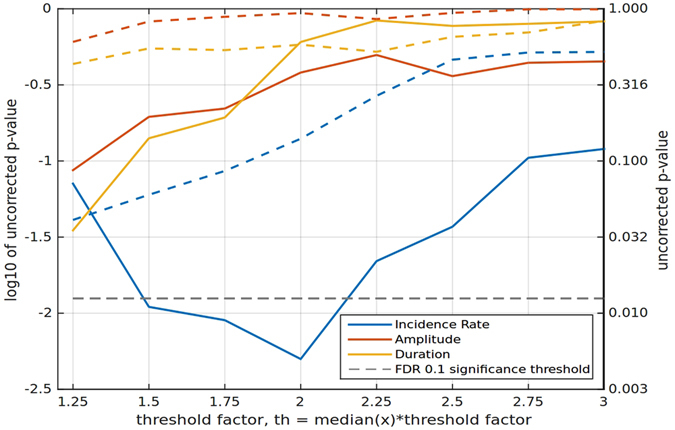
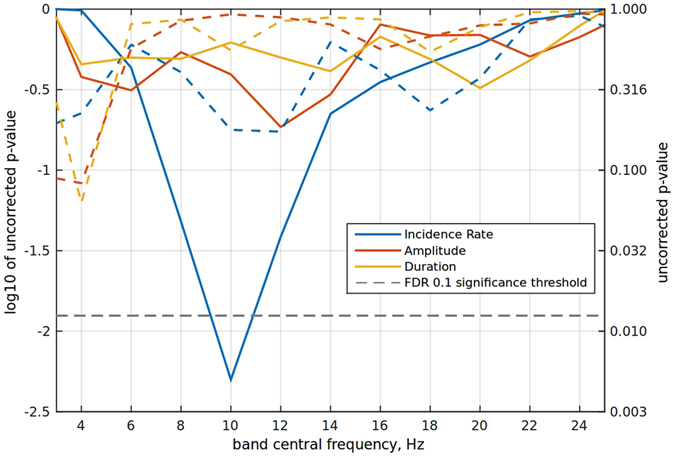
The effect of varying the spindle detection threshold. The p–value for the three parameters (spindle amplitude, incidence rate and duration) calculated from P4 electrode data for different threshold values is shown. The dashed lines correspond to the sham feedback group and the solid lines to the experimental group. The observed significance of alpha spindles incidence rate increase persists for a large range of threshold values.
Figure 6
Figure 6
Band specificity study. The plot shows dependence of the main effect’s p– value on the band. Solid lines correspond to the experimental group and the dashed lines to the control group. The significant difference between days in the incidence rate parameter is observed only in the alpha-band and only in the experimental group.
Figure 7
Figure 7
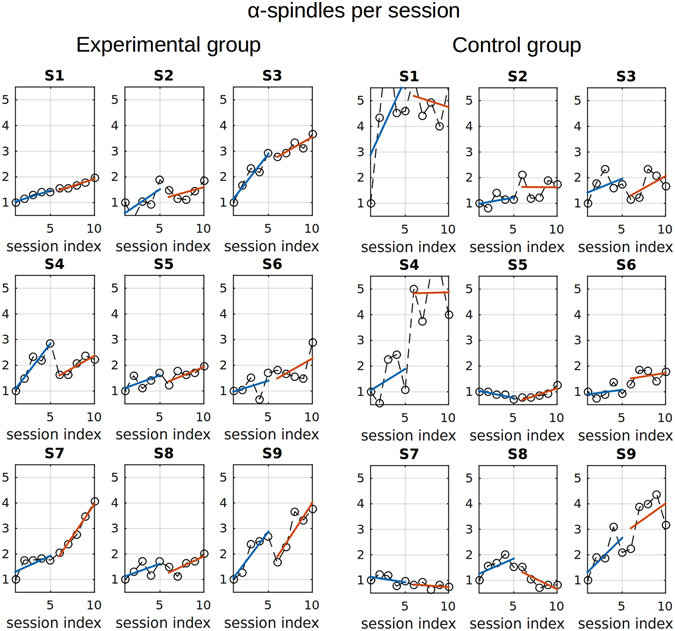
The dynamics of alpha-spindles incidence rate as a function of the training segment index (1–10) for all subjects (n = 9 experimental, n = 9 control) groups. The first five segments correspond to the the first day and the last five to the second day of training. For each subject, we normalized the spindles count by the number of events observed in the 1st segment (first day). The top panel corresponds to the experimental group and the bottom panel represents the data for the control group. All the subjects from the experimental group exhibit reliable positive correlation of within day training segment index. For quantification of the between group effects see Figure 8.
Figure 8
Figure 8
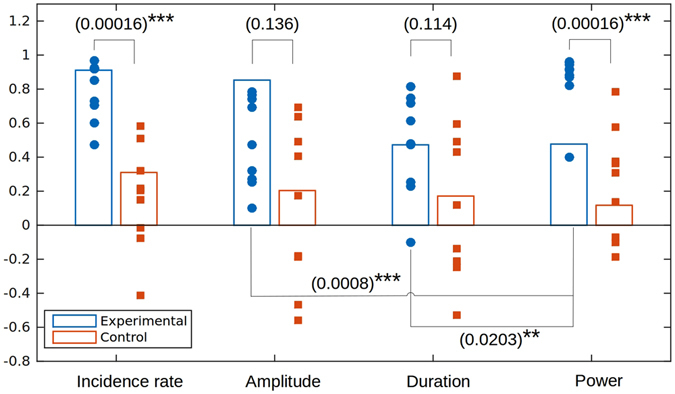
Summary of the results of the correlation analysis for different alpha-activity parameters for the experimental and control groups. For each subject, we plotted the points representing daily correlation coefficient for each of the four parameters of alpha activity: average power, spindles incidence rate, spindles amplitude and duration. Additionally, the bar plots represent average correlation coefficients for each group (blue for the experimental group; orange for the control group). Between group comparison shows that the experimental group data demonstrate high average correlation coefficients (p < 0.0001) for the power and spindles incidence rate parameters. No significant correlations are observed for the control group. Only the average power and spindles incidence rate features demonstrate highly significant differences between the experimental and control groups (Wilcoxon rank-sum test, p = 0.00016). No statistically significant differences are observed between the experimental and the control groups for spindle amplitude (p = 0.136) and spindle duration (p = 0.114) features. Only within the experimental group we observe a highly significant positive difference between the studied correlation coefficients for the spindle incidence rate and spindle amplitude parameter (p = 0.0008) as well as the spindle duration parameter (p = 0.0203).

References

    1. Kamiya, J. Conscious control of brain waves. Psychology Today (1968).
    1. Kamiya, J. Operant control of the EEG alpha rhythm and some of its reported effects on consciousness. Altered states of consciousness. New York: Wiley1069 (1969).
    1. Nowlis DP, Kamiya J. The control of electroencephalographic alpha rhythms through auditory feedback and the associated mental activity. Psychophysiology. 1970;6:476–484. doi: 10.1111/j.1469-8986.1970.tb01756.x. - DOI - PubMed
    1. Wyrwicka W, Sterman MB. Instrumental conditioning of sensorimotor cortex EEG spindles in the waking cat. Physiology & Behavior. 1968;3:703–707. doi: 10.1016/0031-9384(68)90139-X. - DOI
    1. Sterman M, LoPresti R, Fairchild M. Electroencephalographic and behavioral studies of monomethyl hydrazine toxicity in the cat. Journal of Neurotherapy. 2010;14:293–300. doi: 10.1080/10874208.2010.523367. - DOI

Publication types

LinkOut - more resources