


doi: 10.1038/s41598-017-02979-4.
Analytical solutions of the radiative transport equation for turbid and fluorescent layered media
Affiliations
- PMID: 28630496
- PMCID: PMC5476600
- DOI: 10.1038/s41598-017-02979-4
Item in Clipboard
Analytical solutions of the radiative transport equation for turbid and fluorescent layered media
Sci Rep.
.
Abstract
Accurate and efficient solutions of the three dimensional radiative transport equation were derived in all domains for the case of layered scattering media. Index mismatched boundary conditions based on Fresnel's equations were implemented. Arbitrary rotationally symmetric phase functions can be applied to characterize the scattering in the turbid media. Solutions were derived for an obliquely incident beam having arbitrary spatial profiles. The derived solutions were successfully validated with Monte Carlo simulations and partly compared with analytical solutions of the diffusion equation.
Conflict of interest statement
The authors declare that they have no competing interests.
Figures
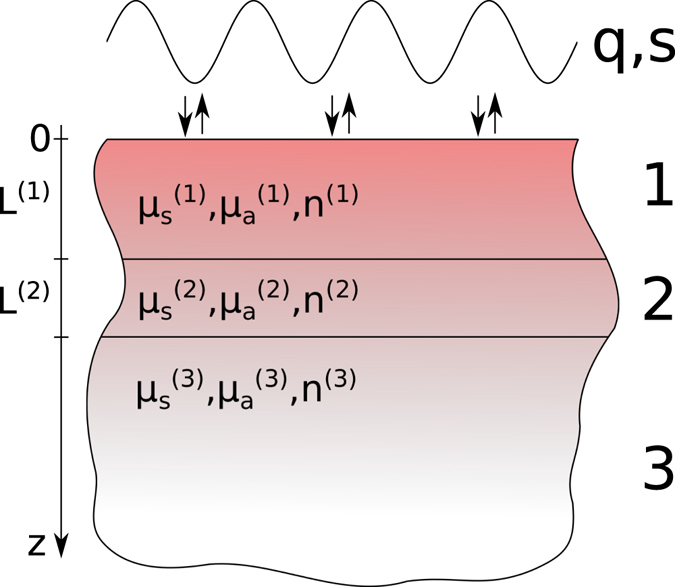
Schematic of the considered three-layered medium. The solution of the RTE is calculated in the Laplace and spatial frequency domains. By numerically inverting these transforms, solutions in the spatial domain and time domain can be obtained. For the fluorescence solution, an additional set of optical parameters for the fluorescence wavelength is assigned to each layer.
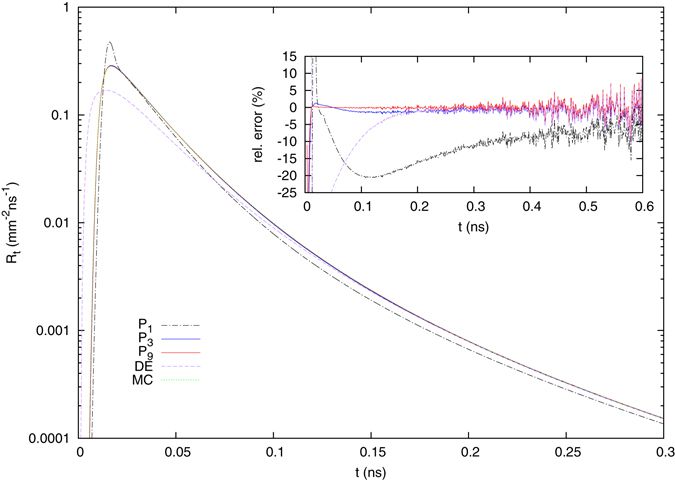
Time-resolved reflectance from the two-layered scattering medium with upper layer thickness of l = 2 mm and a refractive index of n
m = 1.4 due to an infinitely short, perpendicularly incident light pulse with a spatial Gaussian beam profile. The beam radius is ρ
w = 0.5 mm and the source-detector separation ρ = 2 mm. The refractive index of the surrounding medium is n
0 = 1.0. Already for N ≥ 3, a good agreement between the Monte Carlo simulation and the P
N solution is observed. For the Monte Carlo simulation 1011 photons were calculated.
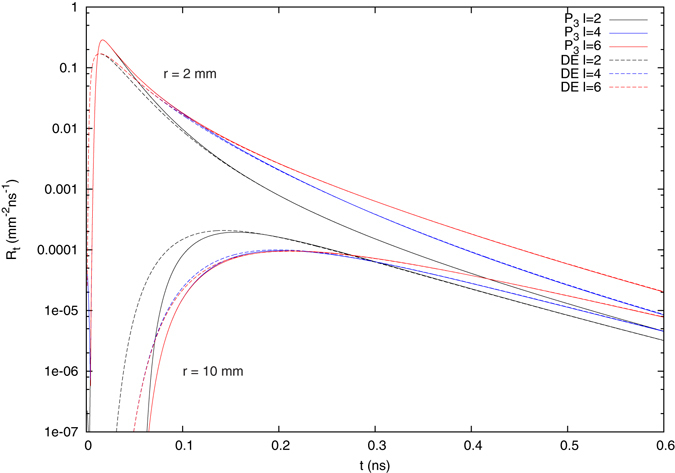
Comparison of time-resolved reflectance results produced by the P
3 approximation and diffusion theory for different upper layer thicknesses of the two-layered model with two source-detector distances r.
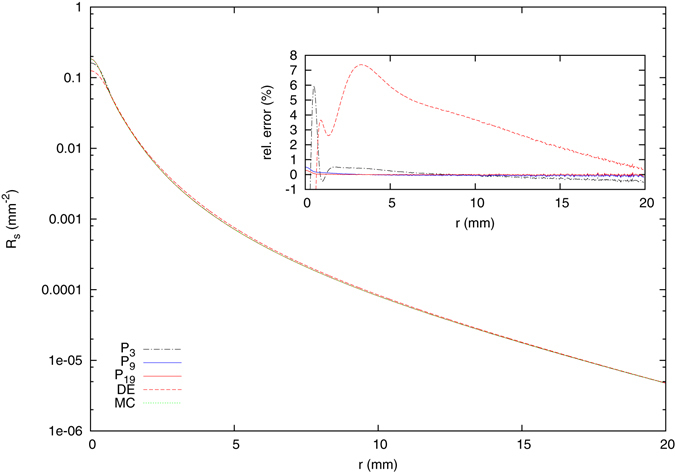
Steady-state spatially resolved reflectance from the three-layered scattering medium with an absorption coefficient of the lower semi-infinite layer of and a refractive index of n
m = 1.4 due to a perpendicularly incident Gaussian beam with a beam radius of ρ
w = 0.5 mm. The refractive index of the surrounding medium is n
0 = 1.0. For N ≥ 9, the Monte Carlo simulation and the P
N solution agree well. For the Monte Carlo simulation, 1011 Photons were calculated.
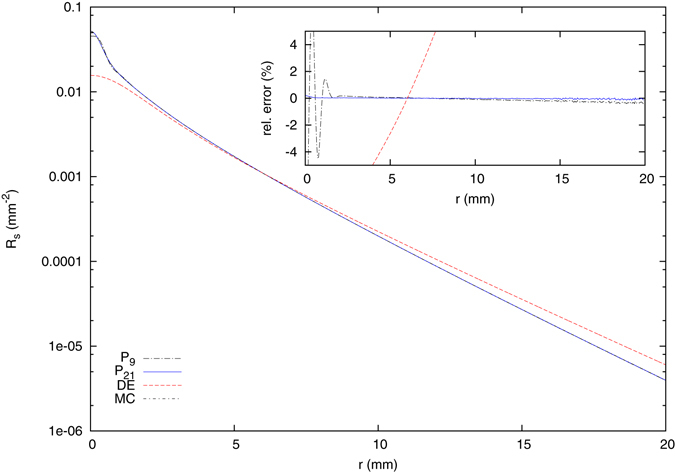
Steady-state spatially resolved reflectance from the three-layered scattering medium, but with interchanged scattering coefficients and . All other parameters are equal to those of Fig. 4. Due to the large transport length in the thin upper layer, the DE solution becomes unusable, whereas the multi-layer RTE solution still produces accurate results.
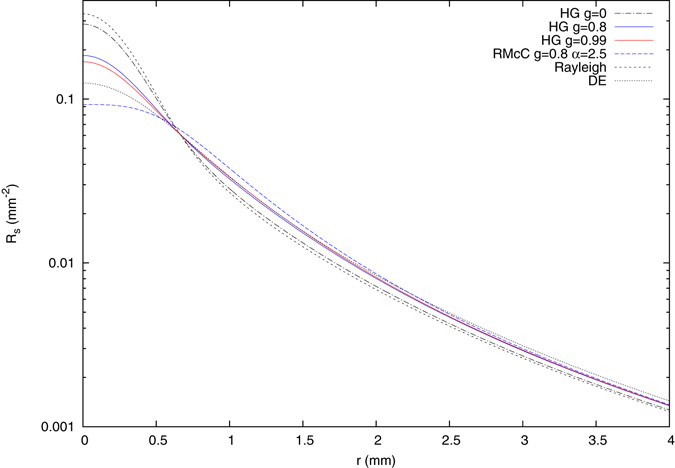
Steady-state spatially resolved reflectance from the three-layered scattering medium using the P
9 approximation with different phase functions.
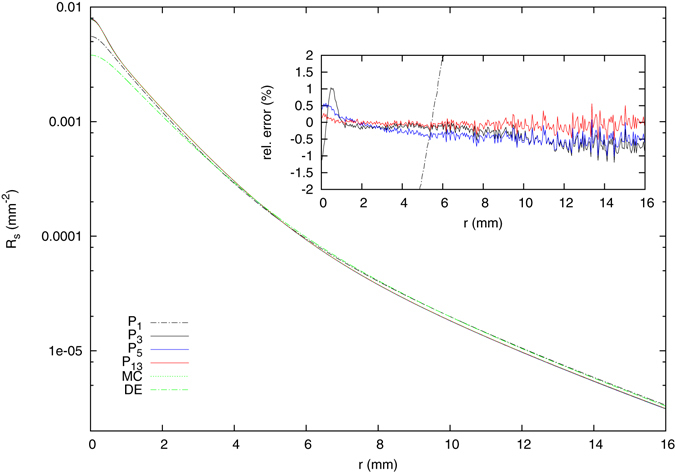
Steady-state spatially resolved fluorescence from the two-layered scattering medium with an upper layer thickness of l = 2 mm. Only the upper layer is fluorescent with a quantum yield of . The system is illuminated by a Gaussian beam with radius ρ
w = 0.5 mm. The optical properties of the layers were assigned to the excitation wavelength, whereas those of the fluorescence wavelength were chosen to be 20% below their respective excitation counterparts. The phase function and the boundary conditions are identical for both wavelengths. The P
3 solution already shows a very good agreement with the Monte Carlo simulation. For the Monte Carlo simulation, 8 · 109 Photons were calculated.
References
-
- J. J. Duderstadt & W. R. Martin. Transport theory (Wiley, Chichester, 1979).
-
- S. Chandrasekhar. Radiative transfer (Dover Publications, New York, 1960).
-
- A. Ishimaru. Wave Propagation and Scattering in Random Media (Academic Press, New York, 1978).
-
- Asllanaj F, Contassot-Vivier S, Liemert A, Kienle A. Radiative transfer equation for predicting light propagation in biological media: comparison of a modified finite volume method, the Monte Carlo technique, and an exact analytical solution. J. Biomed. Opt. 2014;19:015002. doi: 10.1117/1.JBO.19.1.015002. - DOI - PubMed
Publication types
LinkOut - more resources
Full Text Sources
Other Literature Sources
