


Effects of Exercise in the Fasted and Postprandial State on Interstitial Glucose in Hyperglycemic Individuals
- PMID: 28630579
- PMCID: PMC5465988
Effects of Exercise in the Fasted and Postprandial State on Interstitial Glucose in Hyperglycemic Individuals
Abstract
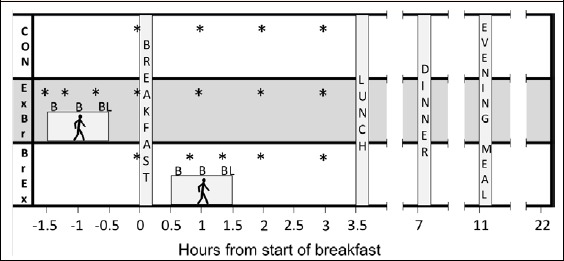
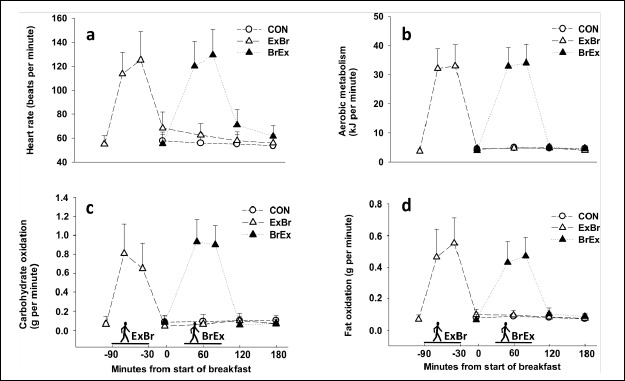
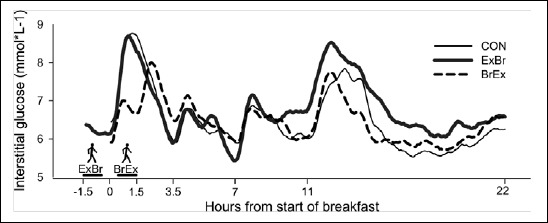
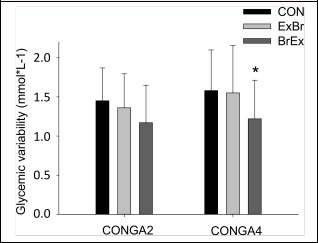
The purpose of the present study was to test if one bout of moderate exercise performed in either the fasted or the postprandial state affects glucose values measured over 22 hours. Twelve participants diagnosed with hyperglycemia not using antidiabetic medications underwent 3 test days in a randomized cross-over design encompassing one test day without exercise, one test day with 60 min of treadmill walking prior to breakfast, and one test day with an identical bout of exercise 30 min after the start of breakfast. Continuous glucose monitoring was performed until the next morning (>22 hours). There was no significant effect of type of test day on the area under the glucose curve for the entire 22 hours period (p = 0.111). None of the exercise interventions had a significant effect on the area under the glucose curve after breakfast, lunch or dinner. However, the postprandial exercise bout tended to decrease the area under the glucose curve after the evening meal compared to the fasted exercise bout (24.2 ± 6.2 vs. 27.6 ± 6.0 mmol·hour·L-1, p = 0.031). Furthermore, the postprandial exercise decreased the mean of the 10 highest glucose values measured in each individual (8.6 ± 1.9 mmol·L-1) over 22 hours compared to both the control day (9.3 ± 2.1 mmol.L-1) and the day with fasted exercise (9.6 ± 1.7 mmol·L-1, p = 0.012 and 0.009 respectively). Postprandial exercise also decreased the glycemic variability compared to the control day (1.22 ± 0.49 vs. 1.58 ± 0.52 mmol·L-1, p = 0.015). We conclude that performing moderate exercise in the postprandial state after breakfast, but not in the fasted state, decreases glucose excursions during the subsequent 22 hours period in hyperglycemic individuals not using antidiabetic medications.
Keywords: Blood glucose; carbohydrate; continuous glucose monitoring; physical activity; walking.
Figures
References
-
- Aadland E., Høstmark A.T. (2008) Very light Physical Activity after a Meal Blunts the Rise in Blood Glucose and Insulin. The Open Nutrition Journal 2, 94-99.
-
- Bailey D.P., Locke C.D. (2015) Breaking up prolonged sitting with light-intensity walking improves postprandial glycemia, but breaking up sitting with standing does not. Journal of Science and Medicine in Sport 18, 294-298. - PubMed
-
- Borer K.T., Wuorinen E.C., Lukos J.R., Denver J.W., Porges S.W., Burant C.F. (2009) Two bouts of exercise before meals, but not after meals, lower fasting blood glucose. Medicine & Science in Sports & Exercise 41, 1606-1614. - PubMed
-
- Borg G.A. (1982) Psychophysical bases of perceived exertion. Medicine & Science in Sports & Exercise 14, 377-381. - PubMed
-
- Caron D., Poussier P., Marliss E.B., Zinman B. (1982) The effect of postprandial exercise on meal-related glucose intolerance in insulin-dependent diabetic individuals. Diabetes Care 5, 364-369. - PubMed
LinkOut - more resources
Full Text Sources
Medical