. 2017 Jun 14;3(6):e1700731.
doi: 10.1126/sciadv.1700731. eCollection 2017 Jun.

Differential intron retention in Jumonji chromatin modifier genes is implicated in reptile temperature-dependent sex determination

Affiliations

Differential intron retention in Jumonji chromatin modifier genes is implicated in reptile temperature-dependent sex determination

Ira W Deveson et al. Sci Adv. .

Abstract

In many vertebrates, sex of offspring is determined by external environmental cues rather than by sex chromosomes. In reptiles, for instance, temperature-dependent sex determination (TSD) is common. Despite decades of work, the mechanism by which temperature is converted into a sex-determining signal remains mysterious. This is partly because it is difficult to distinguish the primary molecular events of TSD from the confounding downstream signatures of sexual differentiation. We use the Australian central bearded dragon, in which chromosomal sex determination is overridden at high temperatures to produce sex-reversed female offspring, as a unique model to identify TSD-specific features of the transcriptome. We show that an intron is retained in mature transcripts from each of two Jumonji family genes, JARID2 and JMJD3, in female dragons that have been sex-reversed by temperature but not in normal chromosomal females or males. JARID2 is a component of the master chromatin modifier Polycomb Repressive Complex 2, and the mammalian sex-determining factor SRY is directly regulated by an independent but closely related Jumonji family member. We propose that the perturbation of JARID2/JMJD3 function by intron retention alters the epigenetic landscape to override chromosomal sex-determining cues, triggering sex reversal at extreme temperatures. Sex reversal may then facilitate a transition from genetic sex determination to TSD, with JARID2/JMJD3 intron retention preserved as the decisive regulatory signal. Significantly, we also observe sex-associated differential retention of the equivalent introns in JARID2/JMJD3 transcripts expressed in embryonic gonads from TSD alligators and turtles, indicative of a reptile-wide mechanism controlling TSD.

Keywords: JARID2; JMJD3; POMC-mediated stress; PRC2 complex; retained intron; sex reversal.


Figures
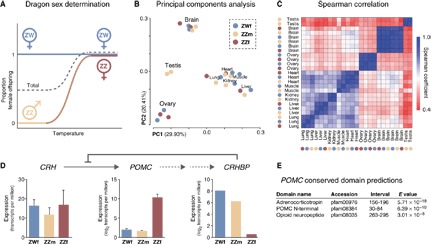
Fig. 1
Fig. 1. Comparison of global gene expression profiles for normal and sex-reversed dragons.
(A) In dragons, ZW embryos develop as female (ZWf; blue) regardless of environmental temperature. ZZ embryos develop as male (ZZm; yellow) at low temperatures and as sex-reversed females (ZZf; red) at high temperatures. Because female development can be specified independently by temperature or sex chromosome complement, it is possible to distinguish the effects of temperature and genotype on sex determination. (B) Principal components analysis and (C) Spearman ranked correlation clustering of global gene expression profiles for adult tissues from ZWf, ZZm, and ZZf individuals. (D) Top: Expression of POMC is activated by CRH (13), and CRH is inhibited by CRHBP (15). Bottom: Normalized expression (transcripts per million; mean ± SD; n = 2) for CRH (brain), POMC (brain), and CRHBP (liver) in ZWf, ZZm, and ZZf tissues. (E) Conserved domain prediction (protein BLAST) for the expressed sequence of POMC in dragon.
Fig. 2
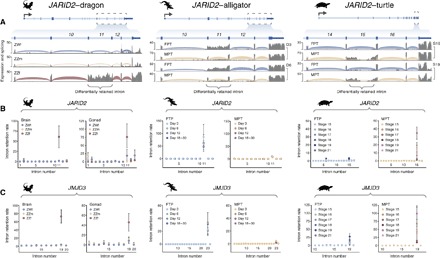
Fig. 2. Association of JARID2/JMJD3 differential IR with temperature-dependent sex.
(A) Annotated gene models for the predicted ortholog of JARID2 in dragon (left), alligator (middle), and turtle (right). For dragon, normalized coverage by mapped RNA sequencing reads (gray) and density of spliced read junctions spanning annotated introns are shown for a single replicate of ZWf (blue), ZZm (yellow), and ZZf brain (red). For alligator, a single replicate of embryonic gonad after 3 and 6 days of incubation at FPT (blue) or MPT (yellow) is shown. For turtle, a single replicate of embryonic gonad at developmental stages 16 and 19 at FPT (blue) or MPT (yellow) is shown. Note that the section of zero coverage in the center of the retained intron for turtle is a string of undefined (N) bases in the genome, to which reads cannot be mapped. (B and C) Normalized rates of IR (retained transcript fragments/kilobase (kb)/spliced intron junctions; mean ± SD) are shown for individual introns in JARID2 (B) and JMJD3 (C) in ZWf, ZZm, and ZWf dragons (brain and gonad; n = 2), alligator embryonic gonad (FPT and MPT; days 3, 6, 12, and 18 to 30; n = 3), and turtle embryonic gonad (FPT and MPT; stages 15 to 19 and 21; n = 2).
Fig. 3
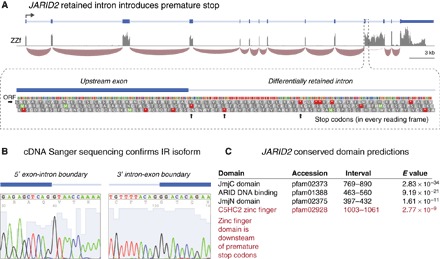
Fig. 3. JARID2 retained intron creates premature stop.
(A) Differential IR may regulate gene expression/function via the inclusion of premature stop codons within the retained intron sequence. The browser graphic shows multiple stop codons (in every reading frame) encoded within the sequence of JARID2 intron 11, which is retained in ZZf but not ZWf or ZZm dragons. ORF, open reading frame. (B) Intron-retaining isoform was validated by Sanger sequencing on complementary DNA (cDNA) using primer pairs that spanned each exon-intron boundary. (C) Conserved domain predictions (BLASTp) for the expressed JARID2 transcript from dragon included JmjN, JmjC histone demethylase, and ARID domains that characterize Jumonji family genes. The predicted zinc finger DNA binding domain is encoded downstream of intron 11 and will be deleted from a possible protein product.
Fig. 4
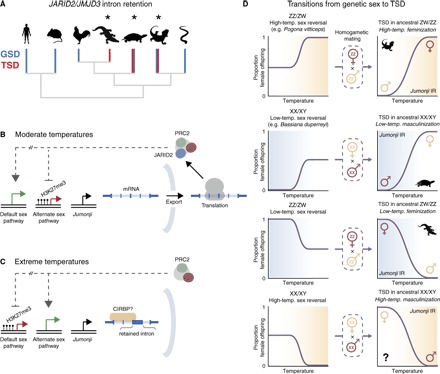
Fig. 4. Model for role of JARID2/JMJD3 differential IR in temperature-dependent sex.
(A) Phylogenetic relationships of reptile lineages, coded for genetic sex determination (GSD; blue) and/or TSD (red), and occurrence of sex-associated JARID2/JMJD3 IR (asterisk). (B to D) The sex-determining action of JARID2/JMJD3 IR is to divert sexual differentiation from the ancestral homogametic state (the default path) to the alternate developmental pathway. (B) At moderate temperatures, JARID2/JMJD3 mRNA is spliced, exported, and translated. JARID2 facilitates recruitment of PRC2 to target genes, which are repressed via H3K27 trimethylation (–28). JARID2 and/or JMJD3 may also directly activate genes via histone demethylation (14). (C) At extreme temperatures, introns are retained in JARID2/JMJD3 mRNA. IR may be induced by binding of CIRBP (6, 37) to JARID2/JMJD3 transcripts. IR isoforms are not exported or translated (24, 25). JARID2 is depleted from PRC2, reducing recruitment to target genes. Direct activation of genes by JARID2/JMJD3-catalyzed histone demethylation is also perturbed. The epigenetic landscape is thereby altered, repressing genes that maintain the default sex pathway and/or activating sex reversal genes. This can lead to feminization or masculinization, depending on the ancestral GSD system in a given species (8, 31, 32). (D) Four possible sex-associated patterns of IR may occur. Left: Ancestral GSD states (ZZ/ZW or XX/XY), with sex reversal at either high (beige) or low (blue) temperatures. Mating of sex-reversed and wild-type homogametic individuals causes transition to TSD (9, 30), with JARID2/JMJD3 IR maintained as the regulatory signal controlling differentiation. Right: Four TSD patterns emerge: female-specific IR at high temperatures, male-specific IR at low temperatures, female-specific IR at low temperatures, and male-specific IR at high temperatures.

References

    1. Charnier M., Action of temperature on the sex ratio in the Agama agama (Agamidae, Lacertilia) embryo. C. R. Seances Soc. Biol. Fil. 160, 620–622 (1966). - PubMed
    1. Bull J. J., Vogt R. C., Temperature-dependent sex determination in turtles. Science 206, 1186–1188 (1979). - PubMed
    1. Ferguson M. W., Joanen T., Temperature of egg incubation determines sex in Alligator mississippiensis. Nature 296, 850–853 (1982). - PubMed
    1. Yatsu R., Miyagawa S., Kohno S., Parrott B. B., Yamaguchi K., Ogino Y., Miyakawa H., Lowers R. H., Shigenobu S., Guillette L. J. Jr., Iguchi T., RNA-seq analysis of the gonadal transcriptome during Alligator mississippiensis temperature-dependent sex determination and differentiation. BMC Genomics 17, 77 (2016). - PMC - PubMed
    1. Czerwinski M., Natarajan A., Barske L., Looger L. L., Capel B., A timecourse analysis of systemic and gonadal effects of temperature on sexual development of the red-eared slider turtle Trachemys scripta elegans. Dev. Biol. 421, 166–177 (2016). - PubMed

Publication types

LinkOut - more resources