Comment
doi: 10.1126/sciadv.1701233.
eCollection 2017 Jun.
Response to Hohenlohe et al
Affiliations
- PMID: 28630935
- PMCID: PMC5462503
- DOI: 10.1126/sciadv.1701233
Item in Clipboard
Comment
Response to Hohenlohe et al
Sci Adv.
.
Abstract
A response to Hohenlohe et al.
Figures
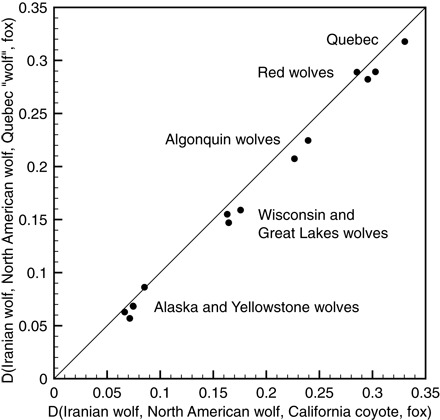
The allopatric gray wolf from Iran is used as a baseline for comparison because of the genome’s complete lack of coyote introgression. Consistent with a two-lineage model but contrary to a three-lineage model, the California coyote and the Quebec canid produce nearly equal D statistic values.
Comment on
-
Comment on "Whole-genome sequence analysis shows two endemic species of North American wolf are admixtures of the coyote and gray wolf".Sci Adv. 2017 Jun 7;3(6):e1602250. doi: 10.1126/sciadv.1602250. eCollection 2017 Jun. Sci Adv. 2017. PMID: 28630899 Free PMC article.
References
-
- Wilson P. J., Grewal S., Lawford I. D., Heal J. N. M., Granacki A. G., Pennock D., Theberge J. B., Theberge M. T., Voigt D. R., Waddell W., Chambers R. E., Paquet P. C., Goulet G., Cluff D., White B. N., DNA profiles of the eastern Canadian wolf and the red wolf provide evidence for a common evolutionary history independent of the gray wolf. Can. J. Zool. 78, 2156–2166 (2000).
-
- Wayne R. K., Jenks S. M., Mitochondrial DNA analysis implying extensive hybridization of the endangered red wolf Canis rufus. Nature 351, 565–568 (1991).
-
- Roy M. S., Geffen E., Smith D., Ostrander E. A., Wayne R. K., Patterns of differentiation and hybridization in North American wolflike canids, revealed by analysis of microsatellite loci. Mol. Biol. Evol. 11, 553–570 (1994). - PubMed
-
- Roy M. S., Geffen E., Smith D., Wayne R. K., Molecular genetics of pre-1940 red wolves. Conserv. Biol. 10, 1413–1424 (1996).
-
- Reich D. E., Wayne R. K., Goldstein D. B., Genetic evidence for a recent origin by hybridization of red wolves. Mol. Ecol. 8, 139–144 (1999). - PubMed
Publication types
MeSH terms
LinkOut - more resources
Full Text Sources
Other Literature Sources