


Advance care planning for patients with amyotrophic lateral sclerosis
- PMID: 28631959
- PMCID: PMC5943705
- DOI: 10.1080/21678421.2017.1285317
Advance care planning for patients with amyotrophic lateral sclerosis
Abstract
Purpose: To determine whether an advance care planning (ACP) decision-aid could improve communication about end-of-life treatment wishes between patients with amyotrophic lateral sclerosis (ALS) and their clinicians.
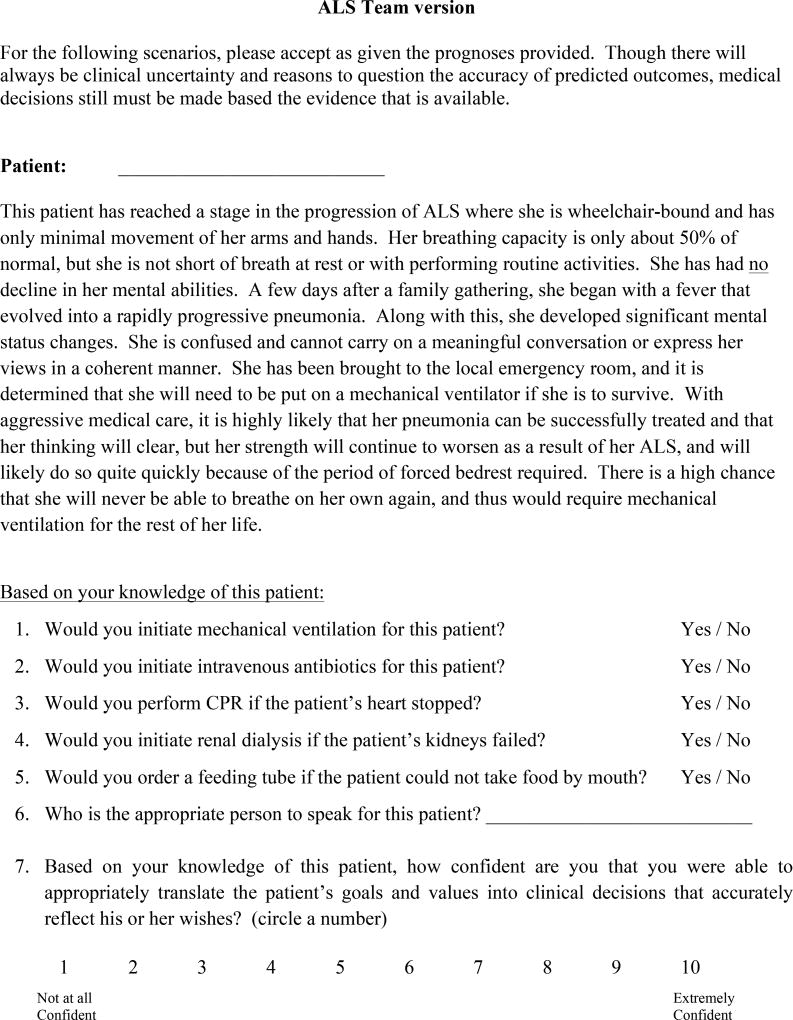
Methods: Forty-four patients with ALS (>21, English-speaking, without dementia) engaged in ACP using an interactive computer based decision-aid. Before participants completed the intervention, and again three months later, their clinicians reviewed three clinical vignettes, and made treatment decisions (n = 18) for patients. After patients indicated their agreement with the team's decisions, concordance was calculated.
Results: The mean concordance between patient wishes and the clinical team decisions was significantly higher post-intervention (post = 91.9%, 95% CI = 87.8, 96.1, vs. pre = 52.4%, 95% CI = 41.9, 62.9; p <0.001). Clinical team members reported greater confidence that their decisions accurately represented each patient's wishes post-intervention (mean = 6.5) compared to pre-intervention (mean = 3.3, 1 = low, 10 = high, p <0.001). Patients reported high satisfaction (mean = 26.4, SD = 3.2; 6 = low, 30 = high) and low decisional conflict (mean = 28.8, SD = 8.2; 20 = low, 80 = high) with decisions about end-of-life care, and high satisfaction with the decision-aid (mean = 52.7, SD = 5.7, 20 = low, 60 = high). Patient knowledge regarding ACP increased post-intervention (pre = 47.8% correct responses vs. post = 66.3%; p <0.001) without adversely affecting patient anxiety or self-determination.
Conclusion: A computer based ACP decision-aid can significantly improve clinicians' understanding of ALS patients' wishes with regard to end-of-life medical care.
Keywords: Advance care planning; advance directive; decision-aid; end of life; ethics; living will; surrogate decision-making.
References
-
- Ganzini L, Johnston WS, Silveira MJ. The final month of life in patients with ALS. Neurology. 2002;59(3):428–31. - PubMed
-
- Lechtzin N, Wiener CM, Clawson L, Chaudhry V, Diette GB. Hospitalization in amyotrophic lateral sclerosis - Causes, costs, and outcomes. Neurology. 2001;56(6):753–7. - PubMed
-
- Heritier B, Adler D, Iancu F, Ricou B, Gasche Y, Leuchter I, et al. Is tracheostomy still an option in amyotrophic lateral sclerosis? Reflections of a multidisciplinary work group. Swiss medical weekly. 2012;143:w13830-w. - PubMed
-
- Chochinov HM, Tataryn D, Clinch JJ, Dudgeon D. Will to live in the terminally ill. Lancet. 1999;354(9181):816–9. - PubMed
-
- Upadya A, Muralidharan V, Thorevska N, Amoateng-Adjepong Y, Manthous CA. Patient, physician, and family member understanding of living wills. Am J Respir Crit Care Med. 2002;166(11):1430–5. - PubMed
Publication types
MeSH terms
Grants and funding
LinkOut - more resources
Full Text Sources
Other Literature Sources
Medical
Miscellaneous
