


Changes in Eating Behaviors of Children with Obesity in Response to Carbohydrate-Modified and Portion-Controlled Diets
- PMID: 28632394
- PMCID: PMC5647499
- DOI: 10.1089/chi.2017.0020
Changes in Eating Behaviors of Children with Obesity in Response to Carbohydrate-Modified and Portion-Controlled Diets
Abstract
Objective: This study's objective was to determine whether two distinct carbohydrate (CHO)-modified diets and a standard portion-controlled (PC) diet differentially impacted children's eating behaviors and whether eating behavior scores predicted lower BMI among children with obesity.
Methods: Children (n = 102) aged 7-12 years with obesity were randomly assigned to a 12-month intervention of a low-carbohydrate (LC), reduced glycemic load (RGL), or standard PC diet. The Three-Factor Eating Questionnaire (TFEQ) was completed at baseline, 3, 6, and 12 months by parents to characterize their child's hunger (H), disinhibition (D), and cognitive restraint (CR). Baseline and follow-up TFEQ scores by diet were evaluated relative to BMI status over time.
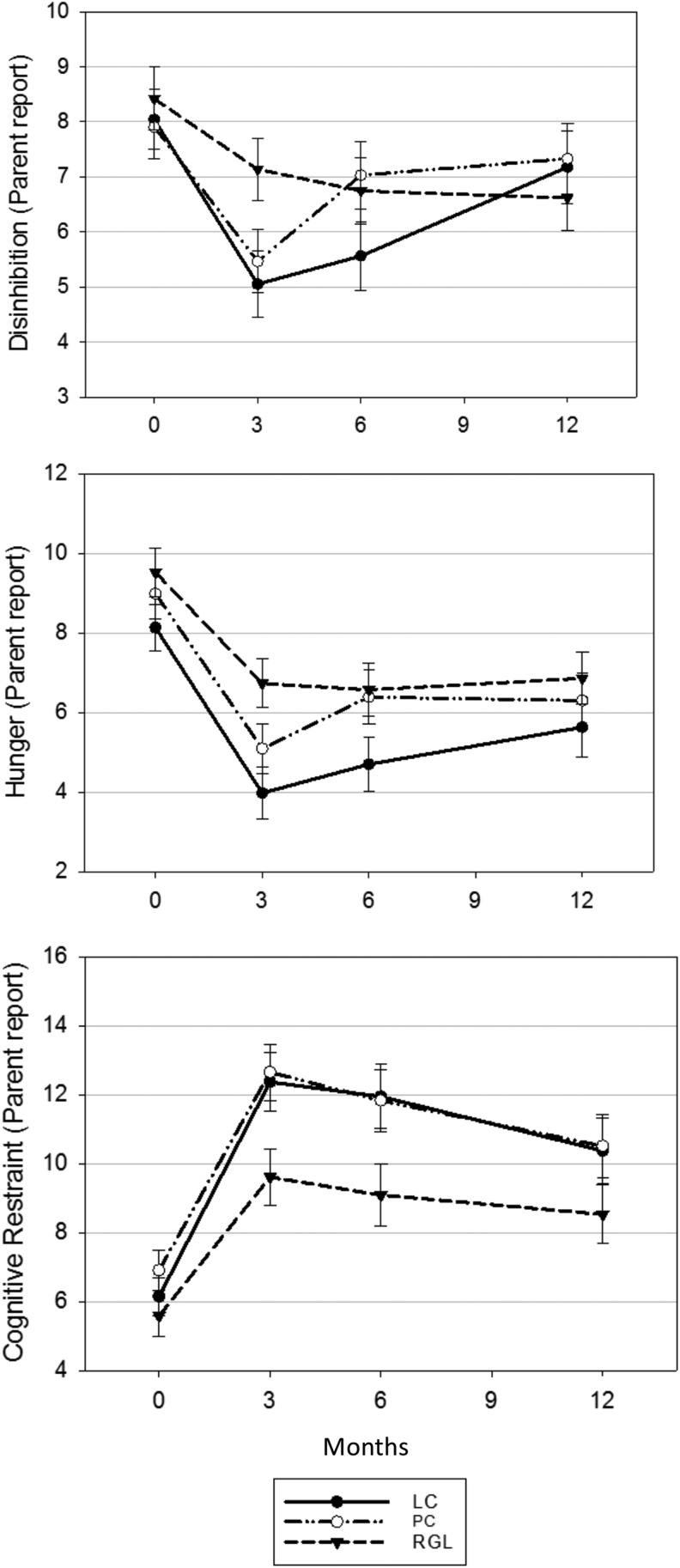
Results: All diet groups showed increased CR and decreased H and D from baseline to 3 months, with differences from baseline remaining at 12 months for CR and H. Lower BMI status during study follow-up was associated with different TFEQ scores by diet group (LC and RGL: higher CR; PC: lower H), adjusting for sex, age, and race. Higher CR at follow-up was predicted by race and higher baseline CR; only lower H at baseline predicted lower H at follow-up.
Conclusion: Eating behaviors improved significantly with all diets during the initial 3 months; higher CR and lower H were sustained at treatment's end. BMI outcomes were associated with different eating behaviors in CHO-modified diet groups compared with PC diets. Targeting diets of children with obesity with specific baseline characteristics may lead to improved outcomes.
Keywords: dietary intake; eating behaviors; pediatric obesity; weight management.
Conflict of interest statement
No competing financial interests exist.
Figures
References
-
- Whitlock EP, O'Conner EA, Williams SB, et al. Effectiveness of weight management interventions in children: A targeted systematic review for the USPSTF. Pediatrics 2010;125:e396–e418 - PubMed
-
- Stunkard AJ, Messick S. The three-factor eating questionnaire to measure dietary restraint, disinhibition and hunger. J Psychosom Res 1985;29:71–83 - PubMed
Publication types
MeSH terms
Grants and funding
LinkOut - more resources
Full Text Sources
Other Literature Sources
Medical
