


Men, women…who cares? A population-based study on sex differences and gender roles in empathy and moral cognition
- PMID: 28632770
- PMCID: PMC5478130
- DOI: 10.1371/journal.pone.0179336
Men, women…who cares? A population-based study on sex differences and gender roles in empathy and moral cognition
Abstract
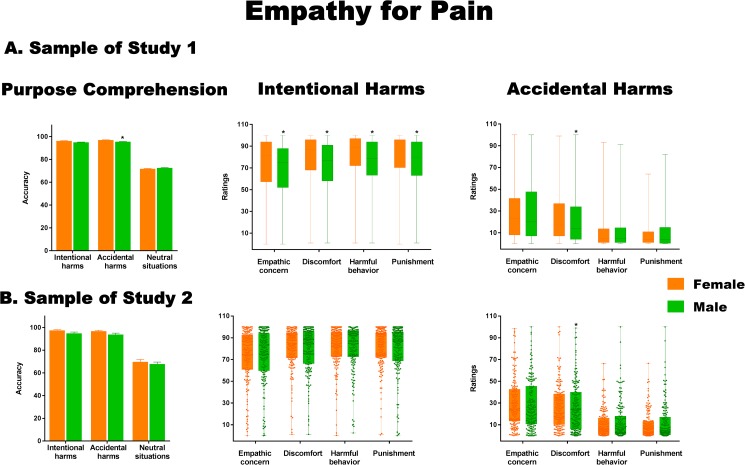
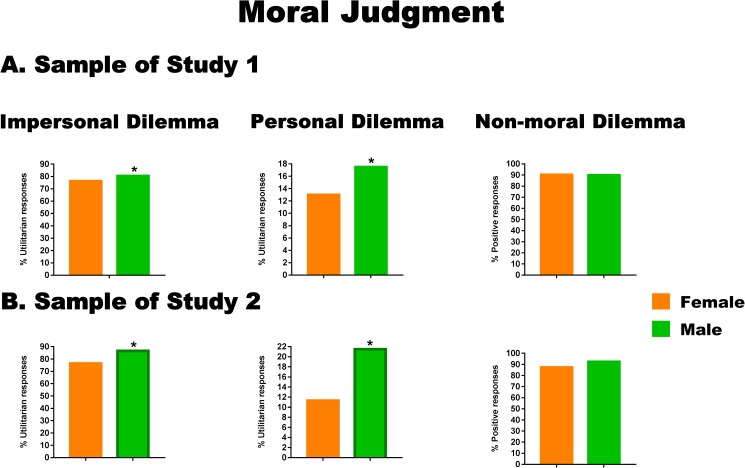
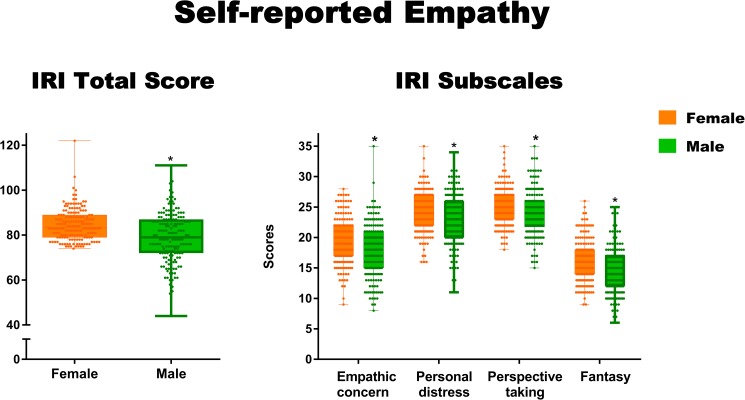
Research on sex differences in empathy has revealed mixed findings. Whereas experimental and neuropsychological measures show no consistent sex effect, self-report data consistently indicates greater empathy in women. However, available results mainly come from separate populations with relatively small samples, which may inflate effect sizes and hinder comparability between both empirical corpora. To elucidate the issue, we conducted two large-scale studies. First, we examined whether sex differences emerge in a large population-based sample (n = 10,802) when empathy is measured with an experimental empathy-for-pain paradigm. Moreover, we investigated the relationship between empathy and moral judgment. In the second study, a subsample (n = 334) completed a self-report empathy questionnaire. Results showed some sex differences in the experimental paradigm, but with minuscule effect sizes. Conversely, women did portray themselves as more empathic through self-reports. In addition, utilitarian responses to moral dilemmas were less frequent in women, although these differences also had small effect sizes. These findings suggest that sex differences in empathy are highly driven by the assessment measure. In particular, self-reports may induce biases leading individuals to assume gender-role stereotypes. Awareness of the role of measurement instruments in this field may hone our understanding of the links between empathy, sex differences, and gender roles.
Conflict of interest statement
Figures
References
-
- Guidelines for psychological practice with lesbian, gay, and bisexual clients. Am Psychol. 2012;67:10–42. doi: 10.1037/a0024659 - DOI - PubMed
-
- Baron-Cohen S, Wheelwright S. The empathy quotient: an investigation of adults with Asperger syndrome or high functioning autism, and normal sex differences. J Autism Dev Disord. 2004;34:163–75. - PubMed
-
- Toussaint L, Webb JR. Gender differences in the relationship between empathy and forgiveness. J Soc Psychol. 2005;145:673–85. doi: 10.3200/SOCP.145.6.673-686 - DOI - PMC - PubMed
-
- Derntl B, Finkelmeyer A, Eickhoff S, Kellermann T, Falkenberg DI, Schneider F, et al. Multidimensional assessment of empathic abilities: neural correlates and gender differences. Psychoneuroendocrinology. 2010;35:67–82. doi: 10.1016/j.psyneuen.2009.10.006 - DOI - PubMed
-
- Davis MH, Franzoi SL. Stability and change in adolescent selfconsciousness and empathy. Journal of Research in Personality. 1991;25:70–87.
MeSH terms
LinkOut - more resources
Full Text Sources
Other Literature Sources
