


Low Alanine Aminotransferase Levels in the Elderly Population: Frailty, Disability, Sarcopenia, and Reduced Survival
- PMID: 28633440
- PMCID: PMC6001897
- DOI: 10.1093/gerona/glx126
Low Alanine Aminotransferase Levels in the Elderly Population: Frailty, Disability, Sarcopenia, and Reduced Survival
Abstract
Background: Although low alanine aminotransferase (ALT) levels have been associated with poor outcomes in the elderly population, the determinants subtending this association have been poorly explored. To gain insight into this topic, we analyzed data from a prospective population-based database (InCHIANTI study) in which frailty, disability, sarcopenia, and pyridoxine levels were systematically assessed.
Methods: Data are from 765 participants aged more than 65 years (mean age 75.3 years, women 61.8%), without chronic liver disease, malignancies, or alcohol abuse. Frailty was defined according to Fried criteria, sarcopenia through peripheral Quantitative-Computed-Tomography (lowest gender-specific tertile of the residuals of a linear regression of muscle mass from height and fat mass), and disability as self-reported need for help in at least one basic daily living activity. Associations of ALT with overall and cardiovascular mortality were assessed by Cox-models with time-dependent covariates.
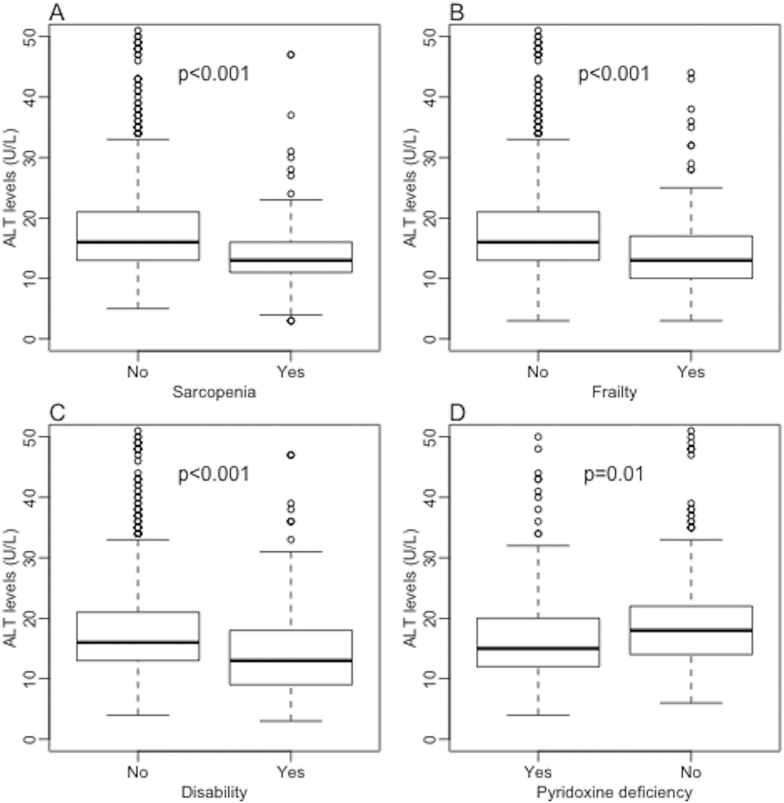
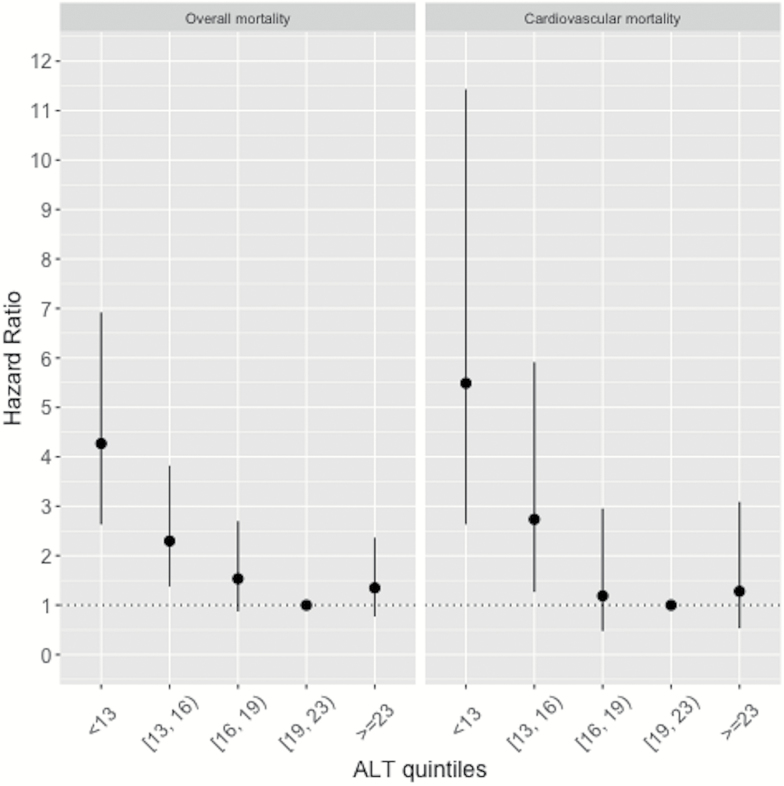
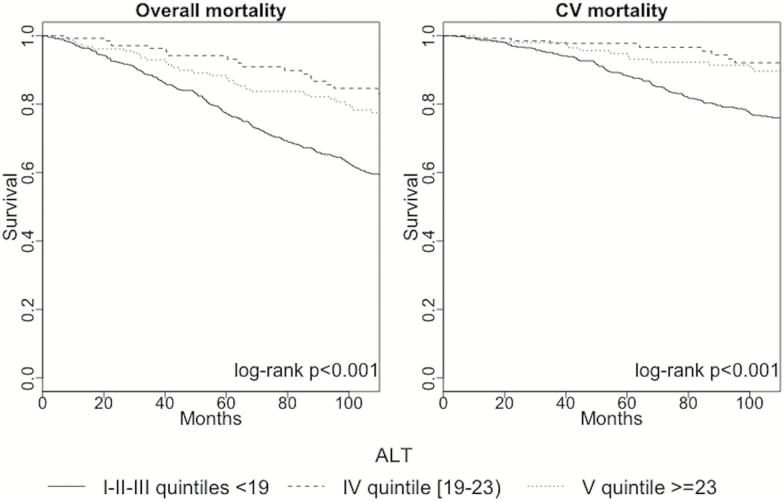
Results: ALT activity was inversely associated with frailty, sarcopenia, disability, and pyridoxine deficiency; however, higher ALT was confirmed to be protective with respect of overall and cardiovascular mortality even in multiple-adjusted models including all these covariates (overall: hazard ratio [HR] 0.98 [0.96-1], p = .02; cardiovascular: 0.94 [0.9-0.98], p < .01). The association between ALT activity and mortality was nonlinear (J-shaped), and subjects in the lower quintiles of ALT levels showed a sharply increased overall and cardiovascular mortality.
Conclusions: These results suggest that reduced ALT levels in older individuals can be considered as a marker of frailty, disability, and sarcopenia, and as an independent predictor of adverse outcomes. The possible relationship between reduced ALT and impaired hepatic metabolic functions should be explored.
Figures
References
-
- Fried LP, Kronmal RA, Newman AB, et al. Risk factors for 5-year mortality in older adults: the Cardiovascular Health Study. JAMA. 1998;279:585–592. - PubMed
-
- Psaty BM, Furberg CD, Kuller LH, et al. Traditional risk factors and subclinical disease measures as predictors of first myocardial infarction in older adults: the Cardiovascular Health Study. Arch Intern Med. 1999;159:1339–1347. - PubMed
-
- Volpato S, Leveille SG, Corti MC, Harris TB, Guralnik JM. The value of serum albumin and high-density lipoprotein cholesterol in defining mortality risk in older persons with low serum cholesterol. J Am Geriatr Soc. 2001;49:1142–1147. - PubMed
-
- Schatz IJ, Masaki K, Yano K, Chen R, Rodriguez BL, Curb JD. Cholesterol and all-cause mortality in elderly people from the Honolulu Heart Program: a cohort study. Lancet. 2001;358:351–355. doi:10.1016/S0140-6736(01)05553-2 - PubMed
Publication types
MeSH terms
Substances
Grants and funding
LinkOut - more resources
Full Text Sources
Other Literature Sources
Medical
