Outcomes after observation stays among older adult Medicare beneficiaries in the USA: retrospective cohort study
- PMID: 28634181
- PMCID: PMC5476173
- DOI: 10.1136/bmj.j2616
Outcomes after observation stays among older adult Medicare beneficiaries in the USA: retrospective cohort study
Abstract
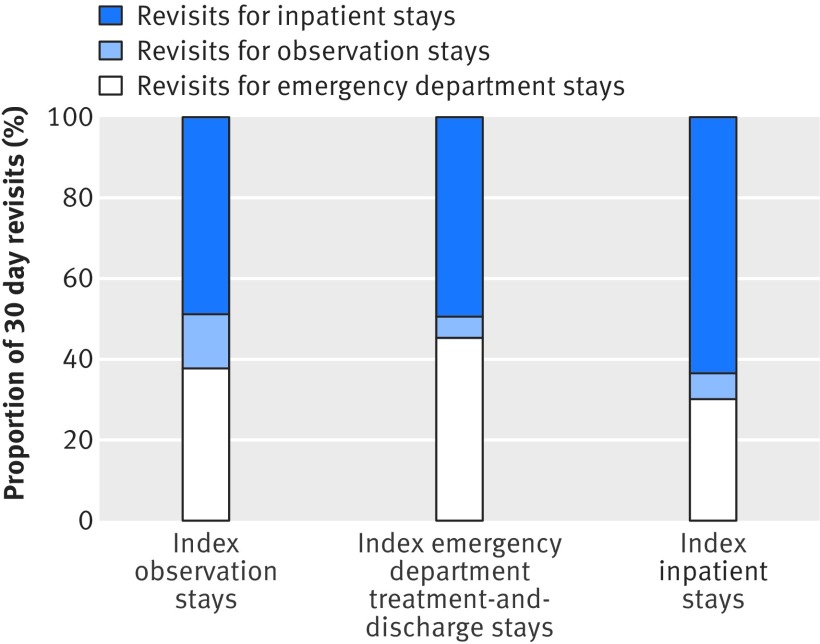
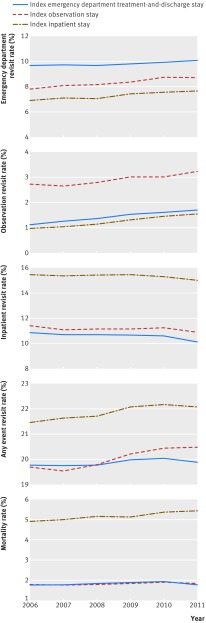
Objective To characterize rates and trends over time of emergency department treatment-and-discharge stays, repeat observation stays, inpatient stays, any hospital revisit, and death within 30 days of discharge from observation stays.Design Retrospective cohort study.Setting 4750 hospitals in the USA.Participants Nationally representative sample of Medicare fee for service beneficiaries aged 65 or over discharged after 363 037 index observation stays, 2 540 000 index emergency department treatment-and-discharge stays, and 2 667 525 index inpatient stays from 2006-11.Main outcome measures Rates of emergency department treatment-and-discharge stays, observation stays, inpatient stays, any hospital revisit, and death within 30 days of discharge from index observation stays. Rates were compared with corresponding outcomes within 30 days of discharge from both index emergency department treatment-and-discharge stays and index inpatient stays.Results Among 363 037 index observation stays resulting in discharge from 2006-11, 30 day rates of emergency department treatment-and-discharge stays were 8.4%, repeat observation stays were 2.9%, inpatient stays were 11.2%, any hospital revisit was 20.1%, and death was 1.8%. Of all revisits, 49.7% were for inpatient stays. Revisit rates for emergency department treatment-and-discharge stays, repeat observation stays, and any hospital revisit increased from 2006-11 (P<0.001 for trend), while 30 day rates of inpatient stays (P=0.054 for trend) and 30 day mortality (P=0.091 for trend) were both unchanged. Averaged over the study period, 30 day rates of any hospital revisit were similar after discharge from index emergency department treatment-and-discharge stays (19.9%) and index observation stays (20.1%), as was 30 day mortality (1.8% for both). Rates of any hospital revisit (21.8%) and death (5.2%) were highest after discharge from index inpatient stays.Conclusions Hospital revisits are common after discharge from observation stays, frequently result in inpatient hospitalizations, and have increased over time among Medicare beneficiaries. As revisit rates are similar after emergency department and observation stays, strategies shown to enhance emergency department transitional care may be reasonable starting points to improve post-observation outcomes.
Published by the BMJ Publishing Group Limited. For permission to use (where not already granted under a licence) please go to http://group.bmj.com/group/rights-licensing/permissions.
Conflict of interest statement
Competing interests: All authors have completed the ICMJE uniform disclosure form at www.icmje.org/coi_disclosure.pdf and declare: KD, LQ, ZL, NRD, ESS, HMK, and AKV work under contract with the Centers for Medicare & Medicaid Services to develop and maintain performance measures, as did MB at the time this research was performed. KD is a consultant for and member of a scientific advisory board for Clover Health, a Medicare preferred provider organization. He is also a member of the Standing Cardiovascular Committee of the National Quality Forum. HMK is chair of a cardiac scientific advisory board for UnitedHealth and is the recipient of research grants from Medtronic and Johnson & Johnson through Yale University. AKV is a member of the Standing Health and Well Being Committee of the National Quality Forum.
Figures
References
-
- Department of Health & Human Services. CMS Manual System Pub 100-02 Medicare Benefit Policy, Transmittal 42, December 16, 2005. https://www.cms.gov/Regulations-and-Guidance/Guidance/Transmittals/downl....
-
- Office of Inspector General, United States Department of Health and Human Services. Hospitals’ use of observation stays and short inpatient stays for Medicare beneficiaries, OEI-02-12-00040. http://oig.hhs.gov/oei/reports/oei-02-12-00040.pdf.
-
- Robin DW, Gershwin RJ. RAC attack--Medicare Recovery Audit Contractors: what geriatricians need to know. J Am Geriatr Soc 2010;58:1576-8. 10.1111/j.1532-5415.2010.02974.x pmid:20662954. - DOI - PubMed
-
- Harrison JP, Barksdale RM. The impact of RAC audits on US hospitals. J Health Care Finance 2013;39:1-14.pmid:24003757. - PubMed
-
- Centers for Medicare & Medicaid Services. Recovery Audit Program. https://www.cms.gov/research-statistics-data-and-systems/monitoring-prog....
MeSH terms
Grants and funding
LinkOut - more resources
Full Text Sources
Other Literature Sources
Medical