. 2017 Jul 3;114(27):7025-7030.
doi: 10.1073/pnas.1705016114. Epub 2017 Jun 20.

Biosynthesis of isonitrile lipopeptides by conserved nonribosomal peptide synthetase gene clusters in Actinobacteria

Affiliations

Biosynthesis of isonitrile lipopeptides by conserved nonribosomal peptide synthetase gene clusters in Actinobacteria

Nicholas C Harris et al. Proc Natl Acad Sci U S A. .

Abstract

A putative lipopeptide biosynthetic gene cluster is conserved in many species of Actinobacteria, including Mycobacterium tuberculosis and M. marinum, but the specific function of the encoding proteins has been elusive. Using both in vivo heterologous reconstitution and in vitro biochemical analyses, we have revealed that the five encoding biosynthetic enzymes are capable of synthesizing a family of isonitrile lipopeptides (INLPs) through a thio-template mechanism. The biosynthesis features the generation of isonitrile from a single precursor Gly promoted by a thioesterase and a nonheme iron(II)-dependent oxidase homolog and the acylation of both amino groups of Lys by the same isonitrile acyl chain facilitated by a single condensation domain of a nonribosomal peptide synthetase. In addition, the deletion of INLP biosynthetic genes in M. marinum has decreased the intracellular metal concentration, suggesting the role of this biosynthetic gene cluster in metal transport.

Keywords: biosynthetic enzymes; metal transport; mycobacteria.


Conflict of interest statement

The authors declare no conflict of interest.

Figures
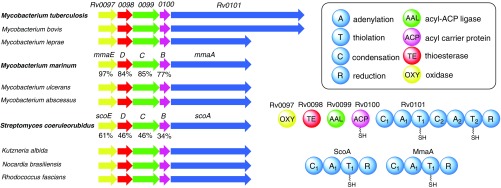
Fig. 1.
Fig. 1.
Schematic of the selected conserved biosynthetic gene clusters and their encoding protein products. Thousands of homologous gene clusters have been identified from published genomes. The similarity of protein homologs from M. marinum and S. coeruleorubidus to M. tuberculosis is shown below the gene clusters. A1 in Rv0101, MmaA, and ScoA was predicted to activate Lys based on the 10-residue specificity sequence (DIEDVGSVVK, DIEDVGSVVK, and DTEDVGTVVK, respectively). A2 in Rv0101 was predicted to activate Phe (DAWTVAAICK).
Fig. 2.
Fig. 2.
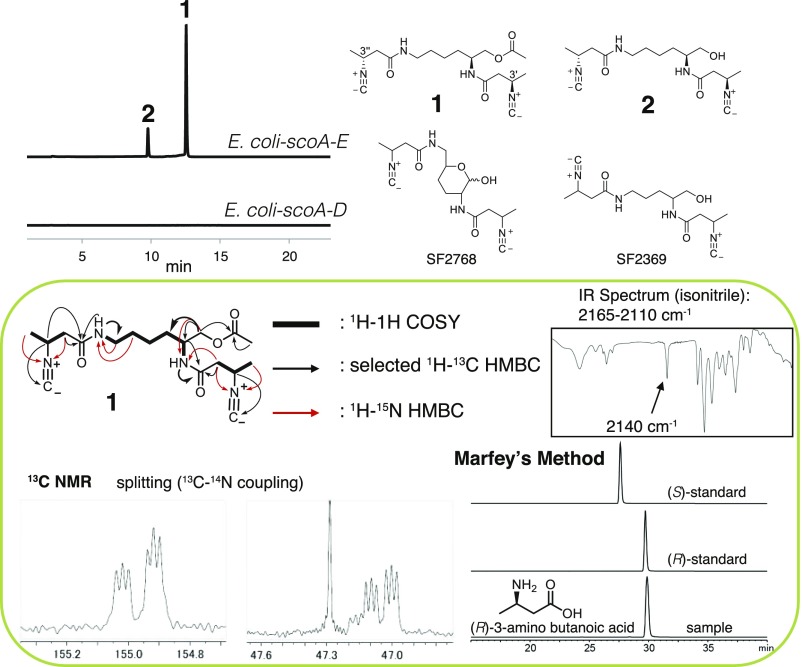
Biosynthesis of INLPs (INLP 1 and 2) by ScoA-E in E. coli. Extracted ion chromatograms show production of INLP 1 and 2 by E. coli-scoA-E. The calculated masses for INLP 1 and 2 with 10-ppm mass error tolerance were used for each trace. The negative control strain with empty vectors and strains containing any of the four gene combinations did not produce INLP 1 and 2, and only one representative trace is shown here for simplicity. The structural determination of INLP 1 is boxed. Structures of two known Actinomycetes metabolites are also shown here.
Fig. 3.
Fig. 3.
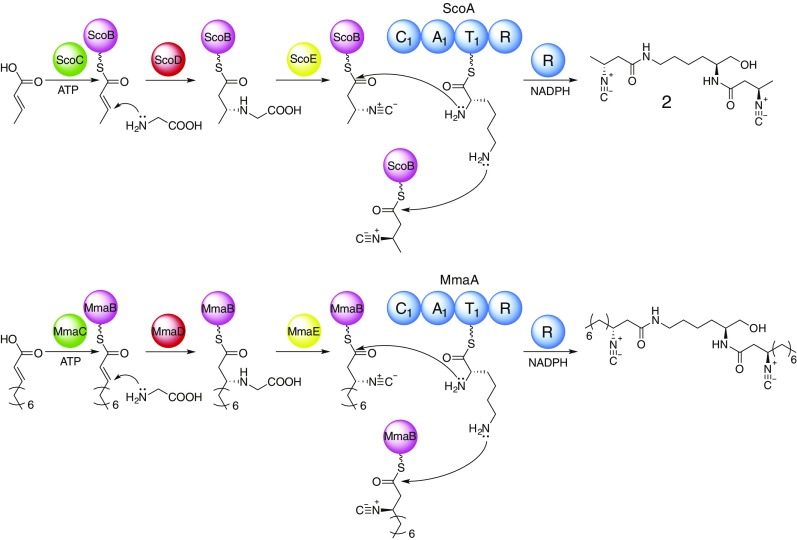
Proposed function of ScoA-E and MmaA-E in INLP biosynthesis.
Fig. 4.
Fig. 4.
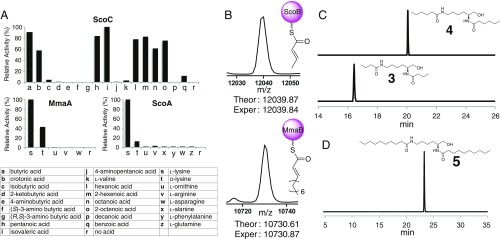
Biochemical analysis of AALs and NRPSs. (A) Substrate specificity of ScoA, MmaA, and ScoC determined by ATP-[32P]PPi exchange assays. (B) Detection of crotonyl-S-ScoB and decenoyl-S-MmaB by MS with maximum entropy deconvolution. (C) Extracted ion chromatograms showing the production of LP 3 and 4 in ScoA-C assays using butyric acid and hexanoic acid as a substrate, respectively. (D) Extracted ion chromatogram showing the production of LP 5 in the MmaA-C assay using decanoic acid as a substrate. The calculated masses for LP 3–5 with 10-ppm mass error tolerance were used for each trace.
Fig. 5.
Fig. 5.
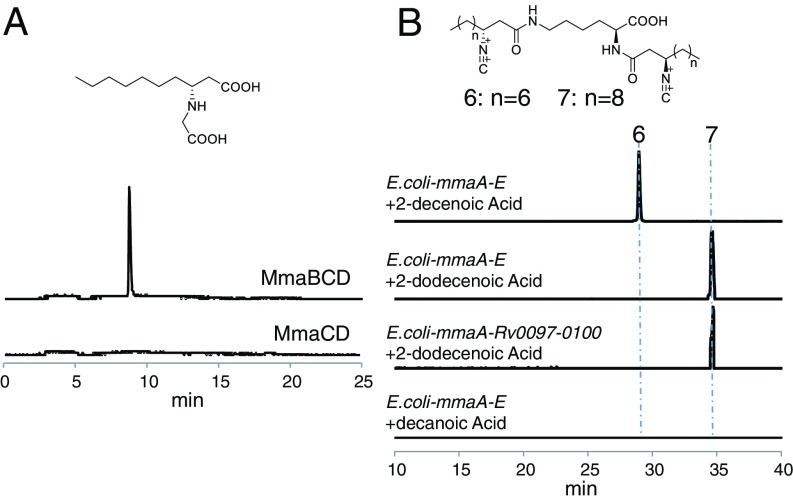
In vitro and in vivo analysis of isonitrile formation. (A) Extracted ion chromatogram showing the production of Gly adduct in the MmaB-D assay. The calculated mass with 10-ppm mass error tolerance was used for each trace. Control assays missing any of the protein or substrate (ATP, 2-decenoic acid, and Gly) abolished the production of Gly adduct, and only one representative trace with no MmaB is shown for simplicity. (B) Extracted ion chromatograms showing the E. coli-based production of INLP 6 and 7 after feeding of 2-decenoic acid and 2-dodecenoic acid, respectively. The calculated masses for INLP 6 and 7 with 10-ppm mass error tolerance were used for each trace. Strains containing any of the four gene combinations, or feeding of decanoic acid and dodecanoic acid, did not produce INLP 6 and 7, and only one representative trace with the feeding of decanoic acid to E. coli-mmaA-E is shown here for simplicity.
Fig. 6.
Fig. 6.
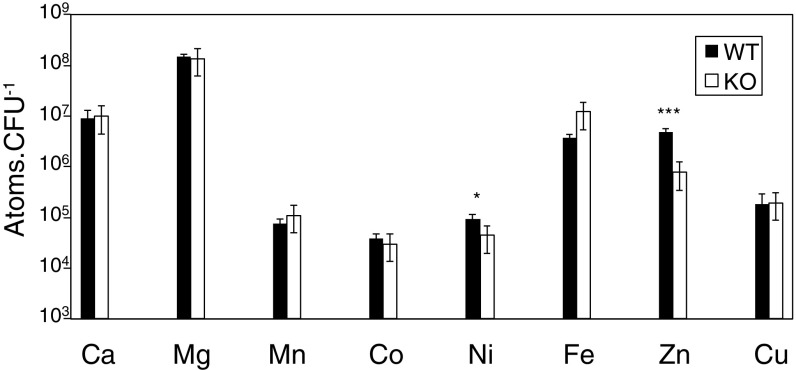
Effect of mmaA-E mutation in metal content. Intracellular metal content of the M. marinum wild-type (Left) and ΔmmaA-E (Right) strains grown in Sauton’s medium was determined by ICP-OES. Error bars, mean ± SD. *P ≤ 0.05 and ***P ≤ 0.001.

References

    1. Romero D, Traxler MF, López D, Kolter R. Antibiotics as signal molecules. Chem Rev. 2011;111:5492–5505. - PMC - PubMed
    1. O’Brien J, Wright GD. An ecological perspective of microbial secondary metabolism. Curr Opin Biotechnol. 2011;22:552–558. - PubMed
    1. Camilli A, Bassler BL. Bacterial small-molecule signaling pathways. Science. 2006;311:1113–1116. - PMC - PubMed
    1. Hur GH, Vickery CR, Burkart MD. Explorations of catalytic domains in non-ribosomal peptide synthetase enzymology. Nat Prod Rep. 2012;29:1074–1098. - PMC - PubMed
    1. Quadri LEN, Sello J, Keating TA, Weinreb PH, Walsh CT. Identification of a Mycobacterium tuberculosis gene cluster encoding the biosynthetic enzymes for assembly of the virulence-conferring siderophore mycobactin. Chem Biol. 1998;5:631–645. - PubMed

Publication types

MeSH terms