. 2017 Jun 20;7(1):3870.
doi: 10.1038/s41598-017-04209-3.

Enhancing KCC2 function counteracts morphine-induced hyperalgesia

Affiliations

Enhancing KCC2 function counteracts morphine-induced hyperalgesia

Francesco Ferrini et al. Sci Rep. .

Abstract

Morphine-induced hyperalgesia (MIH) is a severe adverse effect accompanying repeated morphine treatment, causing a paradoxical decrease in nociceptive threshold. Previous reports associated MIH with a decreased expression of the Cl- extruder KCC2 in the superficial dorsal horn (SDH) of the spinal cord, weakening spinal GABAA/glycine-mediated postsynaptic inhibition. Here, we tested whether the administration of small molecules enhancing KCC2, CLP257 and its pro-drug CLP290, may counteract MIH. MIH was typically expressed within 6-8 days of morphine treatment. Morphine-treated rats exhibited decreased withdrawal threshold to mechanical stimulation and increased vocalizing behavior to subcutaneous injections. Chloride extrusion was impaired in SDH neurons measured as a depolarizing shift in E GABA under Cl- load. Delivering CLP257 to spinal cord slices obtained from morphine-treated rats was sufficient to restore Cl- extrusion capacity in SDH neurons. In vivo co-treatment with morphine and oral CLP290 prevented membrane KCC2 downregulation in SDH neurons. Concurrently, co-treatment with CLP290 significantly mitigated MIH and acute administration of CLP257 in established MIH restored normal nociceptive behavior. Our data indicate that enhancing KCC2 activity is a viable therapeutic approach for counteracting MIH. Chloride extrusion enhancers may represent an effective co-adjuvant therapy to improve morphine analgesia by preventing and reversing MIH.


Conflict of interest statement

The authors declare that they have no competing interests.

Figures
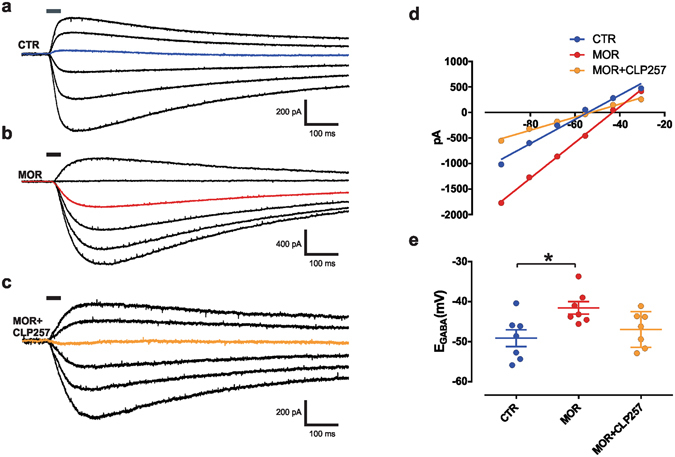
Figure 1
Figure 1
Acute CLP257 restores Cl extrusion in SDH neurons of morphine-treated rats. (ac) Voltage clamp responses at different holding potentials to 30-ms muscimol puffs (solid line) in SDH neurons following saline (a) or morphine (b) treatments in the presence of a Cl load (29 mM) to measure Cl extrusion capacity. In (c), muscimol response in a SDH neuron from a morphine-treated rat obtained after slice pre-incubation with CLP257 (100 µM) for 1 hour. The colored line indicates the response at −55.5 mV (note the change in polarity). (d) I-V relationships for GABAA currents obtained from neurons in (ac). (e) Pooled E GABA in controls (n = 7 cells, blue), in morphine-treated rats (n = 7 cells, red) and following CLP257 treatment (n = 7 cells, orange). E GABA is significantly more depolarized following morphine treatment as compared to control rats (one-way ANOVA, P = 0.02, Tukey post-hoc *P = 0.02), but not after CLP257 pre-incubation (P = 0.7); MOR vs. MOR + CLP (P = 0.1). Abbreviations: CTR = control; MOR = morphine; SDH = superficial dorsal horn.
Figure 2
Figure 2
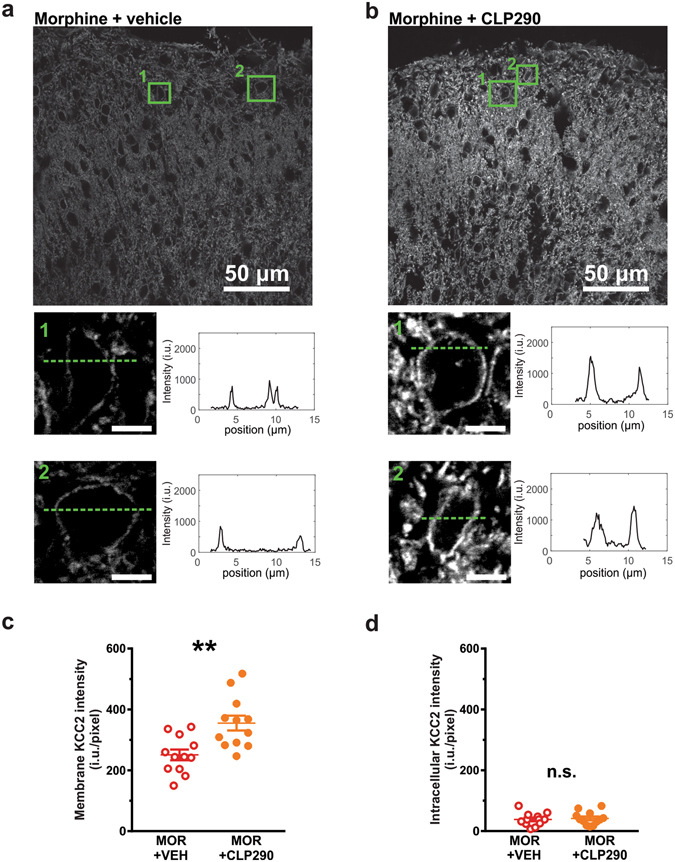
Effect of repeated morphine and CLP290 co-treatment on KCC2 expression. (a,b) KCC2 expression in the SDH of MOR + VEH and MOR + CLP290 treated rats. The enlargements below show the main membrane localization of KCC2 staining in representative cell bodies of the SDH. (c,d) Expression of membrane KCC2 (intensity per pixel) was significantly higher in MOR + CLP290 rats (n = 12) as compared to MOR + VEH rats (n = 12, t-test, **P = 0.003). The difference in intensity per pixel was significant for the membrane compartment (c; t-test, **P = 0.002) but not the intracellular compartment (d, t-test, P = 0.4). Abbreviations: VEH = vehicle (20% HPβCD); MOR = morphine; SDH = superficial dorsal horn; n.s. = not significant.
Figure 3
Figure 3
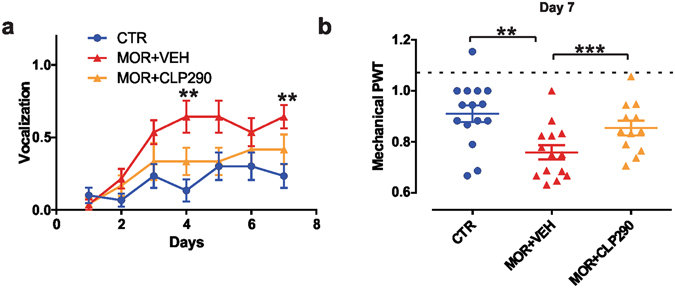
Effect of systemic CLP290 co-treatment on the development of MIH. (a) Effect of CLP290 on injection syringe puncture-induced vocalization in CTR (n = 15), MOR + VEH (n = 14) and MOR + CLP290 (n = 12; Kruskall-Wallis test; day 7: P = 0.009; CTR vs. MOR + VEH, **P < 0.01). (b) Effect of CLP290 (100 mg/kg) on paw withdrawal threshold (PWT) in rats treated with morphine for 7 days. CLP290 (n = 12) or VEH (n = 14) was orally administered every day, twice a day, together with s.c. morphine injection for 7 days; data are compared with saline-treated controls (one-way ANOVA, ***P < 0.001). All PWT values are normalized to the baseline. Abbreviations: CTR = control; VEH = vehicle (20% HPβCD); MOR = morphine; PWT = paw withdrawal threshold.
Figure 4
Figure 4
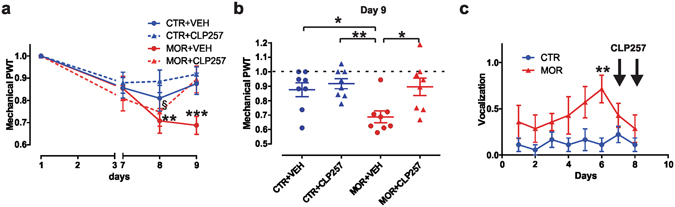
Effect of CLP257 on established MIH. (a) Effect of CLP257 on PWT in saline- (blue) and morphine-treated (red) rats (n = 8 per group). A single dose of CLP257 (100 mg/kg) or VEH were administered i.p. at day 9. Morphine-treated rats developed mechanical sensitivity at day 8 (repeated measure ANOVA; Bonferroni’s post-hoc day 8 vs. day 1: MOR + VEH **P < 0.01; MOR + CLP257, § P < 0.05) which was reversed by CLP257 injection at day 9 (Bonferroni’s post-hoc day 9 vs. day 1: MOR + VEH ***P < 0.001; MOR + CLP257, P > 0.05). (b) Between-group comparison of PWT estimates at day 9 of treatments; one-way ANOVA, P = 0.002; Tukey post-hoc: **P < 0.01; *P < 0.05. All threshold values are normalized to baseline. (c) Effect of CLP257 on injection-induced vocalization in saline- (n = 9) vs. morphine-treated rats (n = 7). Morphine treatment induced a significant increase in vocalizing behavior at day 6 (Mann-Whitney test, P = 0.008). Following CLP257 injection (i.p., 100 mg/kg; black arrows at day 7 and day 8), no differences were observed (day 7, P = 0.299; day 8, P = 0.47). Abbreviations: CTR = control; VEH = vehicle (20% HPβCD); MOR = morphine; PWT = paw withdrawal threshold.

References

    1. Crofford LJ. Adverse effects of chronic opioid therapy for chronic musculoskeletal pain. Nature reviews. Rheumatology. 2010;6:191–197. doi: 10.1038/nrrheum.2010.24. - DOI - PubMed
    1. Lee M, Silverman SM, Hansen H, Patel VB, Manchikanti L. A comprehensive review of opioid-induced hyperalgesia. Pain physician. 2011;14:145–161. - PubMed
    1. Arout CA, Edens E, Petrakis IL, Sofuoglu M. Targeting Opioid-Induced Hyperalgesia in Clinical Treatment: Neurobiological Considerations. CNS drugs. 2015;29:465–486. doi: 10.1007/s40263-015-0255-x. - DOI - PubMed
    1. Chu LF, Clark DJ, Angst MS. Opioid tolerance and hyperalgesia in chronic pain patients after one month of oral morphine therapy: a preliminary prospective study. The journal of pain: official journal of the American Pain Society. 2006;7:43–48. doi: 10.1016/j.jpain.2005.08.001. - DOI - PubMed
    1. Benyamin R, et al. Opioid complications and side effects. Pain physician. 2008;11:S105–120. - PubMed

Publication types

Grants and funding

LinkOut - more resources