


Review
doi: 10.1038/nrgastro.2017.71.
Epub 2017 Jun 21.
Extracellular vesicles in liver disease and potential as biomarkers and therapeutic targets
Affiliations
- PMID: 28634412
- PMCID: PMC6380505
- DOI: 10.1038/nrgastro.2017.71
Item in Clipboard
Review
Extracellular vesicles in liver disease and potential as biomarkers and therapeutic targets
Nat Rev Gastroenterol Hepatol.
2017 Aug.
Abstract
Extracellular vesicles (EVs) are membranous vesicles originating from different cells in the liver. The pathophysiological role of EVs is increasingly recognized in liver diseases, including alcoholic liver disease, NAFLD, viral hepatitis and hepatocellular carcinoma. EVs, via their cargo, can provide communication between different cell types in the liver and between organs. EVs are explored as biomarkers of disease and could also represent therapeutic targets and vehicles for treatment delivery. Here, we review advances in understanding the role of EVs in liver diseases and discuss their utility in biomarker discovery and therapeutics.
Conflict of interest statement
Competing interests statement: the authors declare no competing interests
Figures
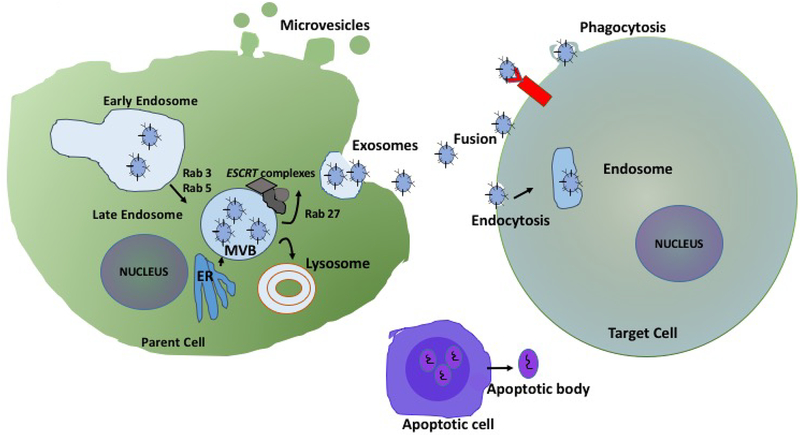
Early endosomes are formed as a result of endocytosis at the plasma membrane (1). Rab5 and Rab3 mediate formation of early endosomes. Early endosomes maturate to multivesicular bodies (MVB) (2), which lead to formation of exosomes. The components of the endosomal sorting complex required for transport (ESCRT) complexes are involved in MVB and exosome biogenesis. Rab27 proteins facilitate MVB trafficking and docking on the plasma membrane, leading to MVB exocytosis and exosomes release (3). Microvesicles forms as a result of blebbing of plasma membrane. Extensive plasma membrane blebbing occurs at the plasma membrane of apoptotic cells and leads to the formation of apoptotic bodies. ER, endoplasmic reticulum; ESCRT, endosomal sorting complexes required for transport; MVB, Multivesicular bodies.

Schematic representation of exosomes and example of their molecular cargos. Ago2, Argonaute 2; ALIX, ALG-2-interacting protein × (also known as programmed cell death 6-interacting protein); GAPDH, glyceraldehyde-3-phosphate dehydrogenase; HSP90, heat shock protein 90; lncRNA, long non-coding RNA; MHC1, major histocompatibility complex class 1; MHC2, major histocompatibility complex class 2; RABs, Ras-related proteins; TSG101, tumor susceptibility gene 101.

Biliary EVs can exert functional effects in various signaling pathways including protein kinase activation and decreased cholangiocyte proliferation. Exosomes secreted by hepatocytes induce proliferative function in liver regeneration and play a role in spread of infections in viral hepatitis. In alcoholic hepatitis, hepatocyte derived exosomes contain different miRNAs which induces hyperinflammatory phenotype. In hepatocellular carcinoma exosomes showed pro-tumorigenic activity associated with tumor progression CEACAM1, Carcinoembryonic antigen-related cell adhesion molecule 1; CEACAM6, Carcinoembryonic antigen-related cell adhesion molecule 6; EPK, Eukaryotic protein kinase; ESCRT, Endosomal sorting complexes required for transport; miR, microRNA; S1P, Sphingosine-1-phosphate. SEC, sinusoidal endothelial cells; SK2, sphingosine kinase 2

Ethanol induces increased hepatocyte secretion of extracellular vesicles (EVs) harboring elevated levels of microRNA (miR)-122, miR-192 and miR-30a. Alcohol can activate cell regulatory networks controlling inflammation and cell death including caspases which can lead to activation of apoptosis pathways and increase in exosome production. miR-122 sensitizes macrophages to lipopolysaccharide (LPS) stimulation and induces an augmented pro-inflammatory profile. Alcohol increases secretion of EVs, which are taken up by naive monocytes and induce an M2 macrophage phenotype, as indicated by M2 surface markers (CD68, CD163 and CD206) and increased levels of IL-10 and transforming growth factor β (TGFβ). EVs derived from hepatocytes contain CD40L, and after being taken up by monocytes these EVs promote macrophage activation, contributing to inflammation in alcoholic hepatitis. ER, endoplasmic reticulum; MVB, multivesicular body; TLR4, Toll-like receptor 4.

a | Synthetic RNAi can be introduced to the exosomes by electroporation. The protocol for loading of exosomes should be optimized for the special target, cargo and model. After loading, exosomes should be re-isolated and the loading efficacy of RNAi should be established and be optimized if necessary b |Exosomes are injected and can be taken up by different liver cells by clathrin-mediated endocytosis. Introduction of targeting moieties (such as introduction of the APOE to the exosomal lipid bilayer for more rapid and targeted delivery to the hepatocytes) can facilitate the uptake of exosomes by specific liver cells. EVs/Exosomes can deliver their cargo after cellular uptake. c | EVs/Exosomes deliver synthetic RNAi cargo to the cells. Transferred RNAi can use the host cell RISC complex or exosome- delivered RISC complex. RISC complex to induce degradation of cleavage of target mRNA. AP2, adaptor protein complex 2; RISC, RNA-induced silencing complex
References
-
- Stoorvogel W, Kleijmeer MJ, Geuze HJ & Raposo G The biogenesis and functions of exosomes. Traffic 3, 321–330 (2002). - PubMed
Publication types
MeSH terms
Substances
Grants and funding
LinkOut - more resources
Full Text Sources
Other Literature Sources
Medical
