


Views of general practice staff about the use of a patient-oriented treatment decision aid in shared decision making for patients with type 2 diabetes: A mixed-methods study
- PMID: 28636186
- PMCID: PMC5750736
- DOI: 10.1111/hex.12586
Views of general practice staff about the use of a patient-oriented treatment decision aid in shared decision making for patients with type 2 diabetes: A mixed-methods study
Abstract
Background: Decision aids can be used to support shared decision making (SDM). A patient-oriented treatment decision aid (DA) was developed for type 2 diabetes but its use by general practice staff appeared to be limited.
Objectives: To explore views of practice staff towards SDM and the DA.
Design: A mixed-methods study within the Dutch PORTDA-diab trial.
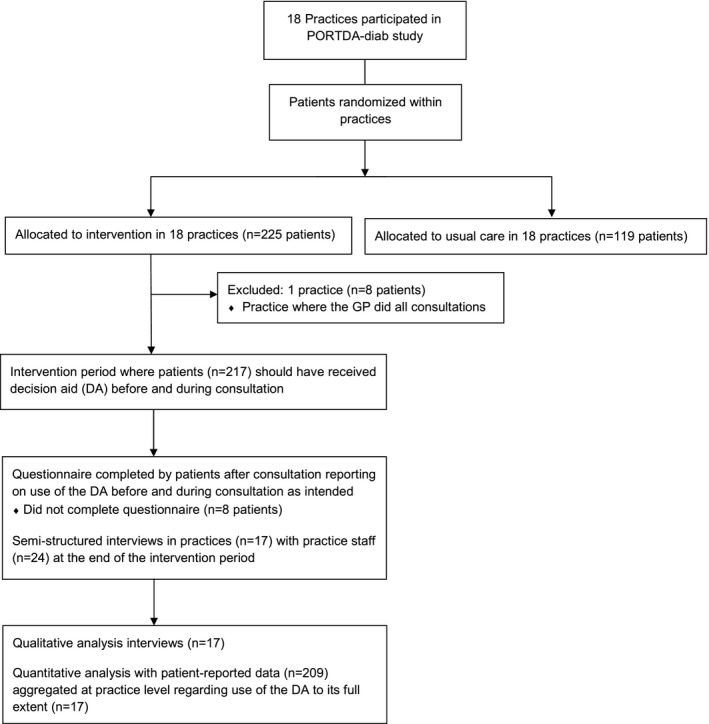
Setting and participants: Included were 17 practices with staff members who were responsible for routine diabetes care and had worked with the DA, and 209 of their patients.
Methods: Interviews were conducted focusing on applicability, usefulness and feasibility of the DA. Interviews were tape-recorded, transcribed verbatim and subjected to content analysis for identifying and classifying views. Patient-reported data about the use of the DA were collected. Associations between specific views and use of the DA were tested using Pearson point-biserial correlation.
Results: The majority of practice staff expressed positive views towards SDM, which was associated with making more use of the DA. Most of the staff expressed that the DA stimulated a two-way conversation. By using the DA, several became aware of their paternalistic approach. Some staff experienced a conflict with the content of the DA, which was associated with making less use of the DA.
Conclusions: The DA was considered useful by practice staff to support SDM. A positive view towards SDM was a facilitator, whereas experiencing a conflict with the content of the DA was a barrier for making use of the DA.
Keywords: decision aids; diabetes mellitus type 2; patient-centered care; primary health care; qualitative research; shared decision making.
© 2017 The Authors Health Expectations Published by John Wiley & Sons Ltd.
Figures
References
-
- Powers MA, Bardsley J, Cypress M, et al. Diabetes self‐management education and support in type 2 diabetes: a joint position statement of the american diabetes association, the american association of diabetes educators, and the academy of nutrition and dietetics. Clin Diabetes. 2016;34:70‐80. - PMC - PubMed
-
- Inzucchi SE, Bergenstal RM, Buse JB, et al. Management of hyperglycaemia in type 2 diabetes, 2015: a patient‐centred approach. update to a position statement of the american diabetes association and the european association for the study of diabetes. Diabetologia. 2015;58:429‐442. - PubMed
-
- Wagner EH, Austin BT, Davis C, Hindmarsh M, Schaefer J, Bonomi A. Improving chronic illness care: translating evidence into action. Health Aff (Millwood). 2001;20:64‐78. - PubMed
-
- Charles C, Gafni A, Whelan T. Decision‐making in the physician‐patient encounter: revisiting the shared treatment decision‐making model. Soc Sci Med. 1999;49:651‐661. - PubMed
-
- Stiggelbout AM, Van der Weijden T, De Wit MP, et al. Shared decision making: really putting patients at the centre of healthcare. BMJ. 2012;344:e256. - PubMed
Publication types
MeSH terms
LinkOut - more resources
Full Text Sources
Other Literature Sources
Medical
