Observational Study
. 2017 Jun 21;6(6):e006081.
doi: 10.1161/JAHA.117.006081.

Breastfeeding and the Risk of Maternal Cardiovascular Disease: A Prospective Study of 300 000 Chinese Women

Affiliations
Observational Study

Breastfeeding and the Risk of Maternal Cardiovascular Disease: A Prospective Study of 300 000 Chinese Women

Sanne A E Peters et al. J Am Heart Assoc. .

Abstract

Background: Breastfeeding confers substantial benefits to child health and has also been associated with lower risk of maternal cardiovascular diseases (CVDs) in later life. However, the evidence on the effects of CVD is still inconsistent, especially in East Asians, in whom the frequency and duration of breastfeeding significantly differ from those in the West.

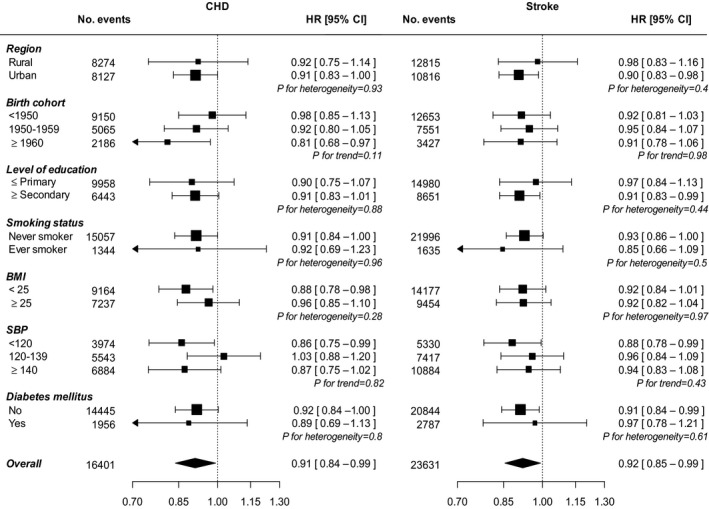
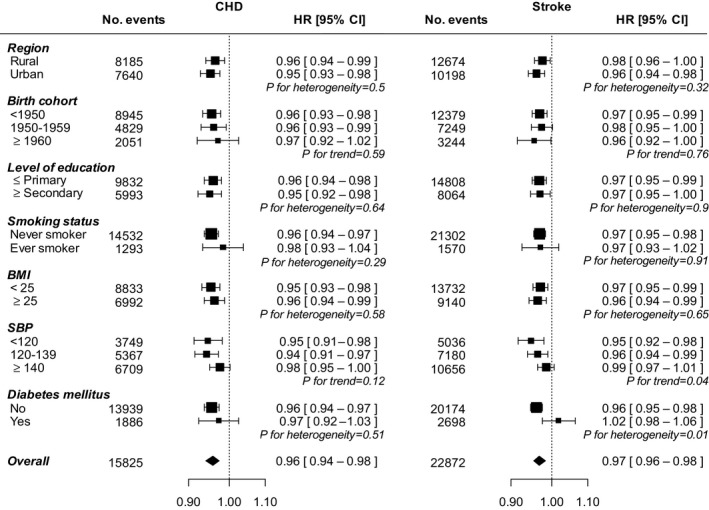
Methods and results: In 2004-2008, the nationwide China Kadoorie Biobank recruited 0.5 million individuals aged 30 to 79 years from 10 diverse regions across China. During 8 years of follow-up, 16 671 incident cases of coronary heart disease and 23 983 cases of stroke were recorded among 289 573 women without prior CVD at baseline. Cox regression yielded adjusted hazard ratios (HRs) and 95% CIs for incident CVD by breastfeeding. Overall, ≈99% of women had given birth, among whom 97% reported a history of breastfeeding, with a median duration of 12 months per child. Compared with parous women who had never breastfed, ever breastfeeding was associated with a significantly lower risk of CVD, with adjusted HRs of 0.91 (95% CI, 0.84-0.99) for coronary heart disease and 0.92 (95% CI, 0.85-0.99) for stroke. Women who had breastfed for ≥24 months had an 18% (HR, 0.82; 0.77-0.87) lower risk of coronary heart disease and a 17% (HR, 0.83; 0.79-0.87) lower risk of stroke compared with women who had never breastfed. Among women who ever breastfed, each additional 6 months of breastfeeding per child was associated with an adjusted HR of 0.96 (95% CI, 0.94-0.98) for coronary heart disease and 0.97 (95% CI, 0.96-0.98) for stroke.

Conclusions: Among Chinese women, a history of breastfeeding was associated with an ≈10% lower risk of CVD in later life and the magnitude of the inverse association was stronger among those with a longer duration of breastfeeding.

Keywords: China; breastfeeding; cardiovascular disease; epidemiology; risk factor; women.


Figures

Figure 1
Figure 1
Adjusted* hazard ratios (HRs) and 95% CIs for incident coronary heart disease (CHD) and stroke comparing parous women who ever breastfed with parous women who never breastfed, by baseline characteristics. *Analyses are stratified by age at risk and study area, and, where appropriate, adjusted for level of attained education, household income, smoking status, alcohol use, systolic blood pressure (SBP), history of hypertension, physical activity, body mass index (BMI), and history of diabetes mellitus. Each square represents the HR. Horizontal lines indicate the corresponding 95% CIs. The diamond indicates the overall estimate and its 95% CI. Nulliparous women are excluded.
Figure 2
Figure 2
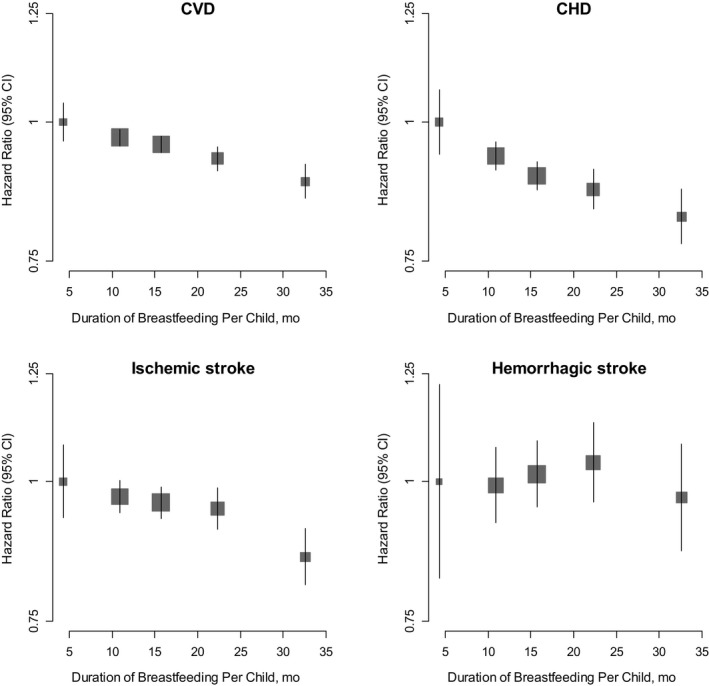
Adjusted* hazard ratios and 95% CIs for incident cardiovascular disease (CVD), coronary heart disease (CHD), ischemic stroke, and hemorrhagic stroke associated with duration of breastfeeding per child among parous women who ever breastfed. *Analyses are stratified by age at risk and study area, and adjusted for level of attained education, household income, smoking status, alcohol use, systolic blood pressure, history of hypertension, physical activity, body mass index, and history of diabetes mellitus. The hazard ratios are plotted on a floating absolute scale. Each square has an area inversely proportional to the SE of the log risk. Vertical lines indicate the corresponding 95% CIs.
Figure 3
Figure 3
Adjusted* hazard ratios (HRs) and 95% CIs for incident coronary heart disease (CHD) and stroke associated with each additional 6 months of breastfeeding per child, by baseline characteristics. Analyses are restricted to parous women who ever breastfed. *Analyses are stratified by age at risk and study area, and, where appropriate, adjusted for level of attained education, household income, smoking status, alcohol use, systolic blood pressure, history of hypertension, physical activity, body mass index, and history of diabetes mellitus. Each square represents the HR. Horizontal lines indicate the corresponding 95% CIs. The diamond indicates the overall estimate and its 95% CI. Nulliparous women are excluded.

References

    1. Lain KY, Catalano PM. Metabolic changes in pregnancy. Clin Obstet Gynecol. 2007;50:938–948. - PubMed
    1. Sanghavi M, Rutherford JD. Cardiovascular physiology of pregnancy. Circulation. 2014;130:1003–1008. - PubMed
    1. Stuebe AM, Rich‐Edwards JW. The reset hypothesis: lactation and maternal metabolism. Am J Perinatol. 2009;26:81–88. - PMC - PubMed
    1. Gunderson EP, Lewis CE, Wei GS, Whitmer RA, Quesenberry CP, Sidney S. Lactation and changes in maternal metabolic risk factors. Obstet Gynecol. 2007;109:729–738. - PMC - PubMed
    1. Schwarz EB, Ray RM, Stuebe AM, Allison MA, Ness RB, Freiberg MS, Cauley JA. Duration of lactation and risk factors for maternal cardiovascular disease. Obstet Gynecol. 2009;113:974–982. - PMC - PubMed

Publication types