


Heritability of resting heart rate and association with mortality in middle-aged and elderly twins
- PMID: 28637897
- PMCID: PMC5831408
- DOI: 10.1136/heartjnl-2016-310986
Heritability of resting heart rate and association with mortality in middle-aged and elderly twins
Abstract
Objective: Resting heart rate (RHR) possibly has a hereditary component and is associated with longevity. We used the classical biometric twin study design to investigate the heritability of RHR in a population of middle-aged and elderly twins and, furthermore, studied the association between RHR and mortality.
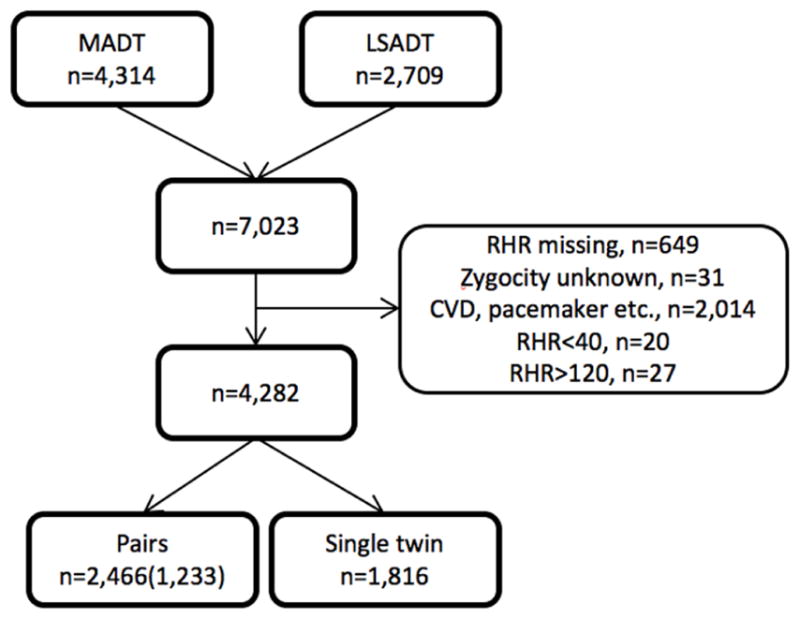
Methods: In total, 4282 twins without cardiovascular disease were included from the Danish Twin Registry, hereof 1233 twin pairs and 1816 'single twins' (twins with a non-participating co-twin); mean age 61.7 (SD 11.1) years; 1334 (31.2%) twins died during median 16.3 (IQR 13.8-16.5) years of follow-up assessed through Danish national registers. RHR was assessed by palpating radial pulse.
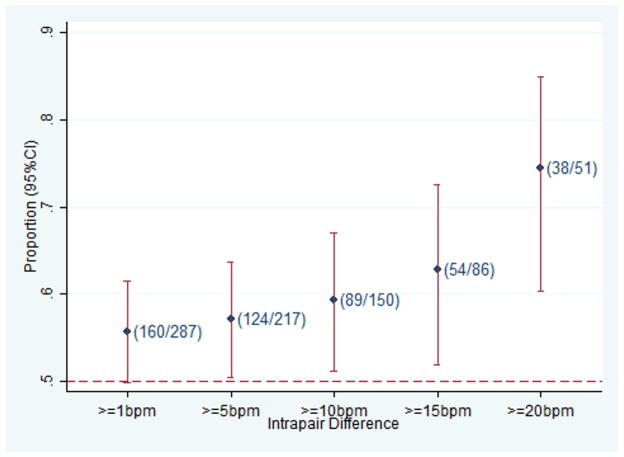
Results: Within pair correlations for RHR adjusted for sex and age were 0.23 (95% CI 0.14 to 0.32) and 0.10 (0.03 to 0.17) for RHR in monozygotic (MZ) and dizygotic (DZ) twin pairs, respectively. Overall, heritability estimates were 0.23 (95% CI 0.15 to 0.30); 0.27 (0.15 to 0.38) for males and 0.17 (0.06 to 0.28) for females. In multivariable models adjusting for age, gender, body mass index, diabetes, hypertension, pulmonary function, smoking, physical activity and zygosity, RHR was significantly associated with mortality (eg, RHR >90 vs 61-70 beats per min: all-cause HR 1.56 (95% CI 1.21 to 2.03); cardiovascular 2.19 (1.30 to 3.67). Intrapair twin comparison revealed that the twin with the higher RHR was significantly more likely to die first and the probability increased with increase in intrapair difference in RHR.
Conclusions: RHR is a trait with a genetic influence in middle-aged and elderly twins free of cardiovascular disease. RHR is independently associated with longevity even when familial factors are controlled for in a twin design.
Keywords: Resting heart rate; cardiovascular; heritability; longevity; mortality; twin study.
© Article author(s) (or their employer(s) unless otherwise stated in the text of the article) 2018. All rights reserved. No commercial use is permitted unless otherwise expressly granted.
Conflict of interest statement
Competing interests: None declared.
Figures
Comment in
-
Heritability of resting heart rate and association with mortality in middle-aged and elderly twins.Heart. 2018 Jan;104(1):6-7. doi: 10.1136/heartjnl-2017-311657. Epub 2017 Jun 28. Heart. 2018. PMID: 28659304 No abstract available.
References
-
- Eppinga RN, Hagemeijer Y, Burgess S, et al. Identification of genomic loci associated with resting heart rate and shared genetic predictors with all-cause mortality. Nat Genet. 2016;48:1557–63. - PubMed
-
- Van Hulle CA, Corley R, Zahn-Waxler C, et al. An exploration of the genetic and environmental etiology of heart rate in infancy and middle childhood. Twin Res. 2000;3:259–65. - PubMed
-
- De Geus EJ, Kupper N, Boomsma DI, et al. Bivariate genetic modeling of cardiovascular stress reactivity: does stress uncover genetic variance? Psychosom Med. 2007;69:356–64. - PubMed
-
- Havlik RJ, Garrison RJ, Fabsitz R, et al. Variability of heart rate, P-R, QRS and Q-T durations in twins. J Electrocardiol. 1980;13:45–8. - PubMed
-
- Greenland P, Daviglus ML, Dyer AR, et al. Resting heart rate is a risk factor for cardiovascular and noncardiovascular mortality: the Chicago Heart Association detection project in industry. Am J Epidemiol. 1999;149:853–62. - PubMed
Publication types
MeSH terms
Grants and funding
LinkOut - more resources
Full Text Sources
Other Literature Sources
