


Passing a Technical Skills Examination in the First Year of Surgical Residency Can Predict Future Performance
- PMID: 28638511
- PMCID: PMC5476382
- DOI: 10.4300/JGME-D-16-00517.1
Passing a Technical Skills Examination in the First Year of Surgical Residency Can Predict Future Performance
Abstract
Background: The ability of an assessment to predict performance would be of major benefit to residency programs, allowing for early identification of residents at risk.
Objective: We sought to establish whether passing the Objective Structured Assessment of Technical Skills (OSATS) examination in postgraduate year 1 (PGY-1) predicts future performance.
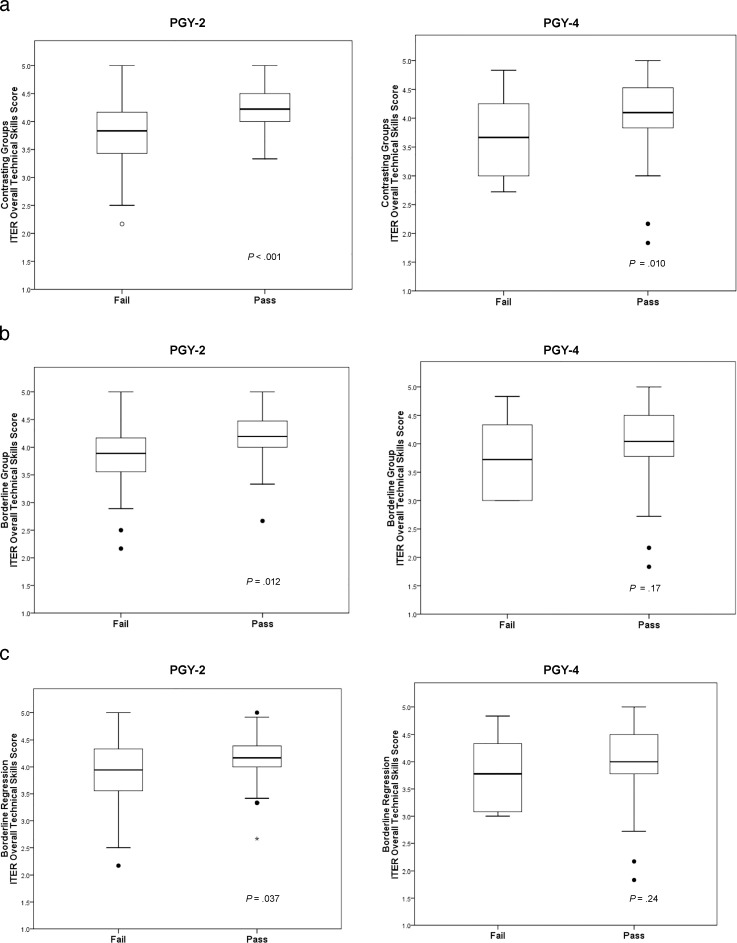
Methods: Between 2002 and 2012, 133 PGY-1 surgery residents at the University of Toronto (Toronto, Ontario, Canada) completed an 8-station, simulated OSATS examination as a component of training. With recently set passing scores, residents were assigned a pass/fail status using 3 standards setting methods (contrasting groups, borderline group, and borderline regression). Future in-training performance was compared between residents who had passed and those who failed the OSATS, using in-training evaluation reports from resident files. A Mann-Whitney U test compared performance among groups at PGY-2 and PGY-4 levels.
Results: Residents who passed the OSATS examination outperformed those who failed, when compared during PGY-2 across all 3 standard setting methodologies (P < .05). During PGY-4, only the contrasting groups method showed a significant difference (P < .05).
Conclusions: We found that PGY-1 surgical resident pass/fail status on a technical skills examination was associated with future performance on in-training evaluation reports in later years. This provides validity evidence for the current PGY-1 pass/fail score, and suggests that this technical skills examination may be used to predict performance and to identify residents who require remediation.
Conflict of interest statement
Conflict of interest: The authors declare they have no competing interests.
Figures
References
-
- Sonnadara RR, Mui C, McQueen S, et al. Reflections on competency-based education and training for surgical residents. J Surg Ed. 2014; 71 1: 151– 158. - PubMed
-
- Alman BA, Ferguson P, Kraemer W, et al. Competency-based education: a new model for teaching orthopaedics. Instr Course Lect. 2013; 62: 565– 569. - PubMed
-
- Royal College of Physicians and Surgeons of Canada. Competence by design: the rationale for change. http://www.royalcollege.ca/rcsite/cbd/rationale-why-cbd-e. Accessed April 24, 2017.
-
- Accreditation Council for Graduate Medical Education. Milestones. http://www.acgme.org/acgmeweb/tabid/430/ProgramandInstitutionalAccredita.... Accessed March 30, 2017.
-
- Southgate L, Hays RB, Norcini J, et al. Setting performance standards for medical practice: a theoretical framework. Med Educ. 2001; 35 5: 474– 481. - PubMed
MeSH terms
LinkOut - more resources
Full Text Sources
Other Literature Sources
