


Cellular immunotherapies for cancer
- PMID: 28638729
- PMCID: PMC5467985
- DOI: 10.1080/2162402X.2017.1306619
Cellular immunotherapies for cancer
Abstract
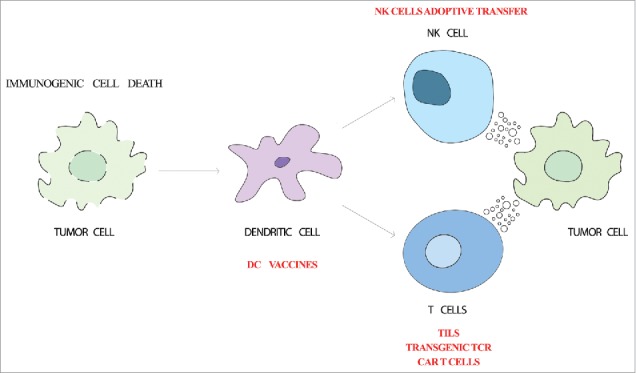
Lessons learned over decades on the use of gene and cell therapies have found clinical applicability in the field of cancer immunotherapy. On December 16th, 2016 a symposium was held in Pamplona (Spain) to analyze and discuss the critical points for the clinical success of adoptive cell transfer strategies in cancer immunotherapy. Cellular immunotherapy is being currently exploited for the development of new cancer vaccines using ex vivo manipulated dendritic cells or to enhance the number of effector cells, transferring reinvigorated NK cells or T cells. In this meeting report, we summarize the main topics covered and provide an overview of the field of cellular immunotherapy.
Keywords: Chimeric antigen receptor; NK cells; Tumor-infiltrating lymphocytes; dendritic cells.
Figures
References
-
- Hodi FS, O'Day SJ, McDermott DF, Weber RW, Sosman JA, Haanen JB, Gonzalez R, Robert C, Schadendorf D, Hassel JC et al.. Improved survival with ipilimumab in patients with metastatic melanoma. N Engl J Med 2010; 363:711-23; PMID: 20525992; https://doi.org/10.1056/NEJMoa1003466 - DOI - PMC - PubMed
-
- Robert C, Long GV, Brady B, Dutriaux C, Maio M, Mortier L, Hassel JC, Rutkowski P, McNeil C, Kalinka-Warzocha E et al.. Nivolumab in previously untreated melanoma without BRAF mutation. N Engl J Med 2015; 372:320-30; PMID: 25399552; https://doi.org/10.1056/NEJMoa1412082 - DOI - PubMed
-
- Wolchok JD, Kluger H, Callahan MK, Postow MA, Rizvi NA, Lesokhin AM, Segal NH, Ariyan CE, Gordon RA, Reed K et al.. Nivolumab plus ipilimumab in advanced melanoma. N Engl J Med 2013; 369:122-33; PMID: 23724867; https://doi.org/10.1056/NEJMoa1302369 - DOI - PMC - PubMed
-
- Bertrand F, Muller S, Roh KH, Laurent C, Dupre L, Valitutti S. An initial and rapid step of lytic granule secretion precedes microtubule organizing center polarization at the cytotoxic T lymphocyte/target cell synapse. Proc Natl Acad Sci USA 2013; 110:6073-8; PMID: 23536289; https://doi.org/10.1073/pnas.1218640110 - DOI - PMC - PubMed
-
- Vasconcelos Z, Muller S, Guipouy D, Yu W, Christophe C, Gadat S, Valitutti S, Dupré L. Individual human cytotoxic T Lymphocytes exhibit intraclonal heterogeneity during sustained killing. Cell Rep 2015; 11:1474-85; PMID: 26027932; https://doi.org/10.1016/j.celrep.2015.05.002 - DOI - PubMed
Publication types
LinkOut - more resources
Full Text Sources
Other Literature Sources
