


The Pandemic H 30 Subclone of Sequence Type 131 (ST131) as the Leading Cause of Multidrug-Resistant Escherichia coli Infections in the United States (2011-2012)
- PMID: 28638846
- PMCID: PMC5473367
- DOI: 10.1093/ofid/ofx089
The Pandemic H 30 Subclone of Sequence Type 131 (ST131) as the Leading Cause of Multidrug-Resistant Escherichia coli Infections in the United States (2011-2012)
Abstract
Background: Extraintestinal Escherichia coli infections are increasingly challenging due to emerging antimicrobial resistance, including resistance to extended-spectrum beta-lactams and fluoroquinolones. Sequence type 131 (ST131) is a leading contributor.
Methods: Three hundred sixty E. coli clinical isolates from across the United States (2011-2012), selected randomly from the SENTRY collection within 3 resistance categories (extended-spectrum cephalosporin [ECS]-reduced susceptibility [RS]; fluoroquinolone-resistant, ESC-susceptible; and fluoroquinolone-susceptible, ESC-susceptible) were typed for phylogroup, sequence type complex (STc), subsets thereof, virulence genotype, O type, and beta-lactamase genes. Molecular results were compared with susceptibility profile, specimen type, age, and sex.
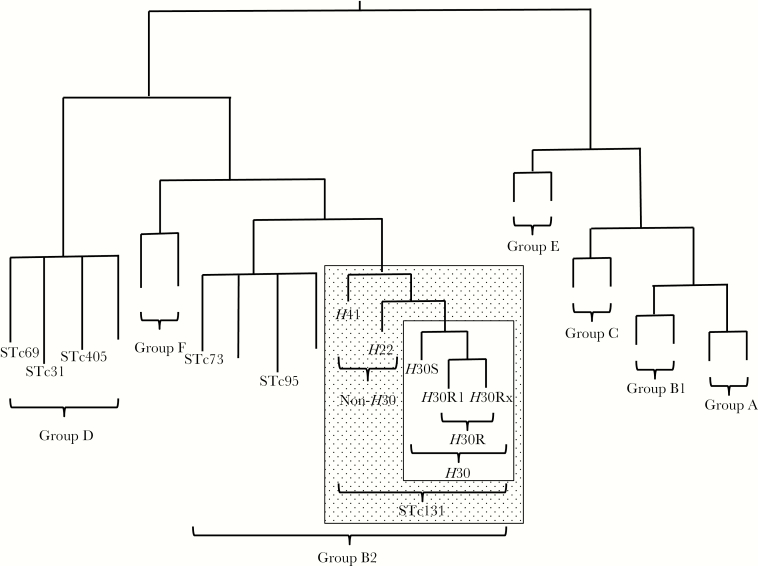
Results: Phylogroup B2 accounted for most isolates, especially fluoroquinolone-resistant isolates (83%). Group B2-derived ST131 and its H30 subclone (divided between H30Rx and H30R1) predominated, especially among ESC-RS and fluoroquinolone-resistant isolates. In contrast, among fluoroquinolone-susceptible isolates, group B2-derived STc73 and STc95 predominated. Within each resistance category, ST131 isolates exhibited more extensive resistance and/or virulence profiles than non-ST131 isolates. ST131-H30 was distributed broadly by geographical region, age, and specimen type and exhibited distinctive beta-lactamase genes. Back-calculations indicated that within the source population ST131 accounted for 26.4% of isolates overall (vs 17% in 2007), including 19.8% ST131-H30, 13.2% ST131-H30R1, and 6.6% each ST131-H30Rx and non-H30 ST131.
Conclusions: ST131-H30, with its ESC resistance-associated H30Rx subset, caused most antimicrobial-resistant E. coli infections across the United States in 2011-2012 and, since 2007, increased in relative prevalence by >50%. Focused attention to this strain could help combat the current E. coli resistance epidemic.
Keywords: Escherichia coli infections; ST131.; antimicrobial resistance; extended-spectrum beta-lactamases; fluoroquinolone resistance.
Published by Oxford University Press on behalf of Infectious Diseases Society of America 2017. This work is written by (a) US Government employee(s) and is in the public domain in the US.
Figures
References
-
- Russo TA, Johnson JR. Medical and economic impact of extraintestinal infections due to Escherichia coli: focus on an increasingly important endemic problem. Microbes Infect. 2003;5:449–56. - PubMed
-
- Gupta K, Hooton TM, Naber KG et al. International clinical practice guidelines for the treatment of acute uncomplicated cystitis and pyelonephritis in women: a 2010 update by the Infectious Diseases Society of America and the European Society for Microbiology and Infectious Diseases. Clin Infect Dis. 2011;52:e103–e20. - PubMed
Grants and funding
LinkOut - more resources
Full Text Sources
Other Literature Sources
