


WHOLE BODY VIBRATION IMPROVES ATTENTION AND MOTOR PERFORMANCE IN MICE DEPENDING ON THE DURATION OF THE WHOLE-BODY VIBRATION SESSION
- PMID: 28638875
- PMCID: PMC5471459
- DOI: 10.21010/ajtcam.v14i4.15
WHOLE BODY VIBRATION IMPROVES ATTENTION AND MOTOR PERFORMANCE IN MICE DEPENDING ON THE DURATION OF THE WHOLE-BODY VIBRATION SESSION
Abstract
Background: Whole body vibration (WBV) is a form of physical stimulation via mechanical vibrations transmitted to a subject. It is assumed that WBV induces sensory stimulation in cortical brain regions through the activation of skin and muscle receptors responding to the vibration. The effects of WBV on muscle strength are well described. However, little is known about the impact of WBV on the brain. Recently, it was shown in humans that WBV improves attention in an acute WBV protocol. Preclinical research is needed to unravel the underlying brain mechanism. As a first step, we examined whether chronic WBV improves attention in mice.
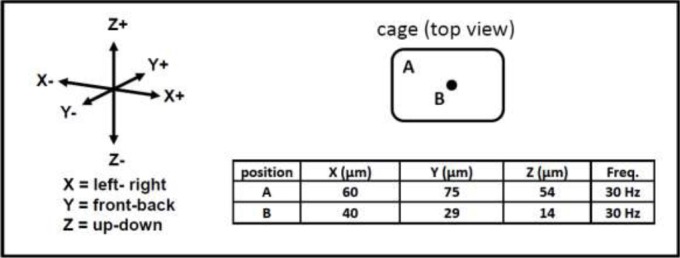
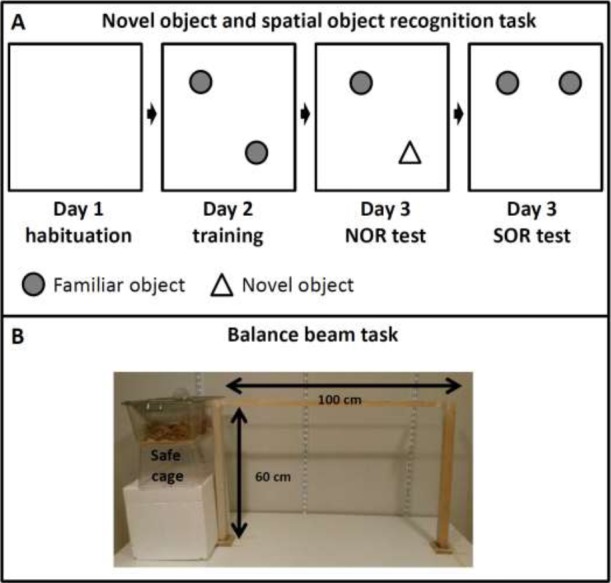
Material and methods: A custom made vibrating platform for mice with low intensity vibrations was used. Male CD1 mice (3 months of age) received five weeks WBV (30 Hz; 1.9 G), five days a week with sessions of five (n=12) or 30 (n=10) minutes. Control mice (pseudo-WBV; n=12 and 10 for the five and 30 minute sessions, respectively) were treated in a similar way, but did not receive the actual vibration. Object recognition tasks were used as an attention test (novel and spatial object recognition - the primary outcome measure). A Balance beam was used for motor performance, serving as a secondary outcome measure.
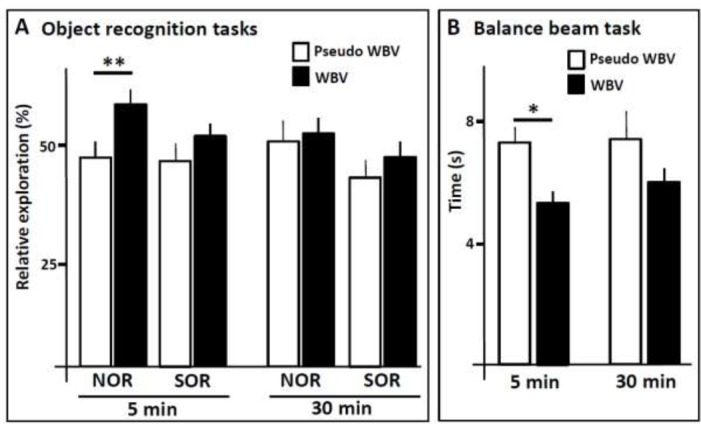
Results: WBV sessions of five (but not WBV sessions of 30 minutes) improved balance beam performance (mice gained 28% in time needed to cross the beam) and novel object recognition (mice paid significantly more attention to the novel object) as compared to pseudo WBV, but no change was found for spatial object performance (mice did not notice the relocation). Although 30 minutes WBV sessions were not beneficial, it did not impair either attention or motor performance.
Conclusion: These results show that brief sessions of WBV improve, next to motor performance, attention for object recognition, but not spatial cues of the objects. The selective improvement of attention in mice opens the avenue to unravel the underlying brain mechanisms.
Keywords: attention; balance beam; chronic treatment; motor performance; novel object recognition.
Figures
References
-
- Bosco C, Colli R, Introini E, Cardinale M, Tsarpela O, Madella A, Tihanvi J, Viru A. Adaptive responses of human skeletal muscle to vibration. Clin. Physiol. 1999;19:183–187. - PubMed
-
- Braida D, Donzelli A, Martucci R, Ponzoni L, Pauletti A, Langus A, Sala M. Mice discriminate between stationary and moving 2D shapes:Application to the object recognition task to increase attention. Behav. Brain Res. 2013;242:95–101. - PubMed
-
- Castilla-Ortega E, Pedraza C, Chun J, de Fonseca FR, Estivill-Torrus G, Santin LJ. Hippocampal c-fos activation in normal and LPA1-null mice after two object recognition tasks with different memory demands. Behav. Brain Res. 2012;232:400–405. - PubMed
MeSH terms
LinkOut - more resources
Full Text Sources
Other Literature Sources
Research Materials