


Geospatial Analysis of Drug Poisoning Deaths Involving Heroin in the USA, 2000-2014
- PMID: 28639058
- PMCID: PMC5533669
- DOI: 10.1007/s11524-017-0177-7
Geospatial Analysis of Drug Poisoning Deaths Involving Heroin in the USA, 2000-2014
Abstract
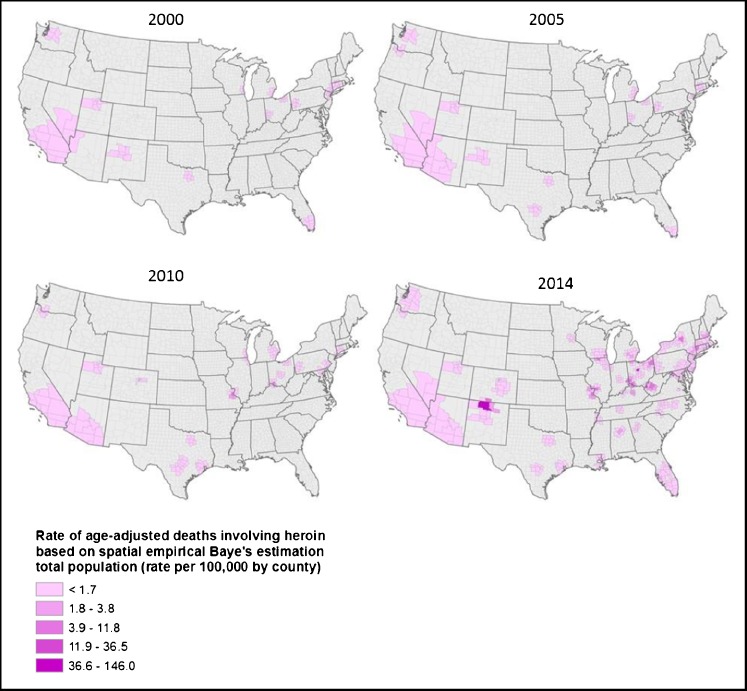
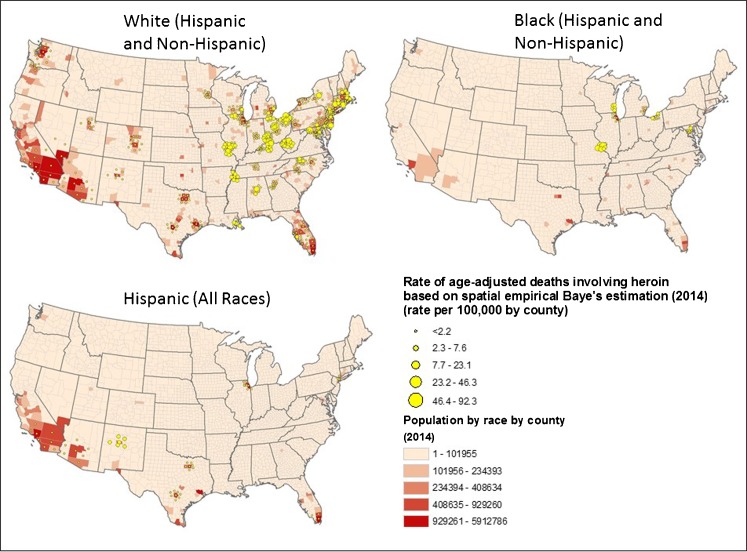
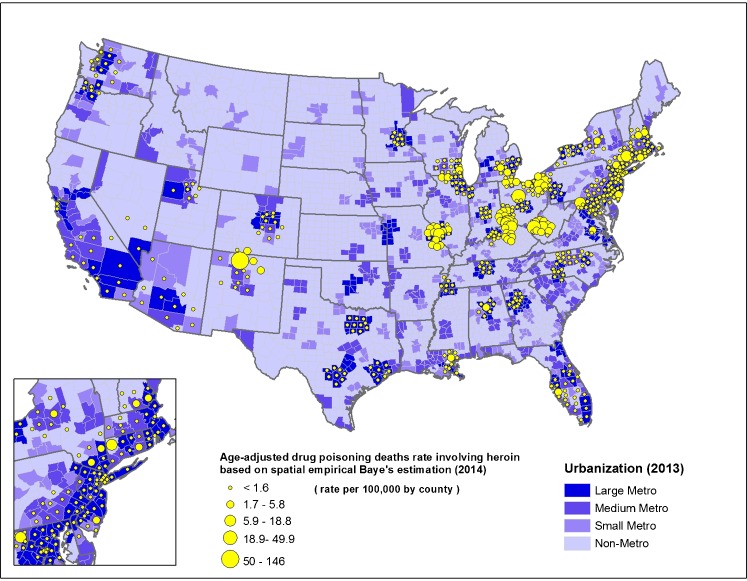
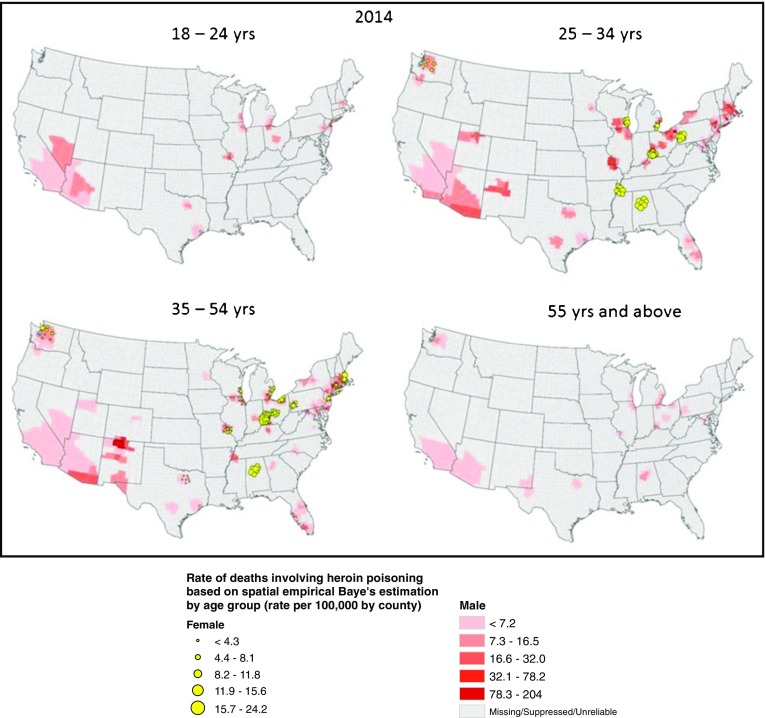
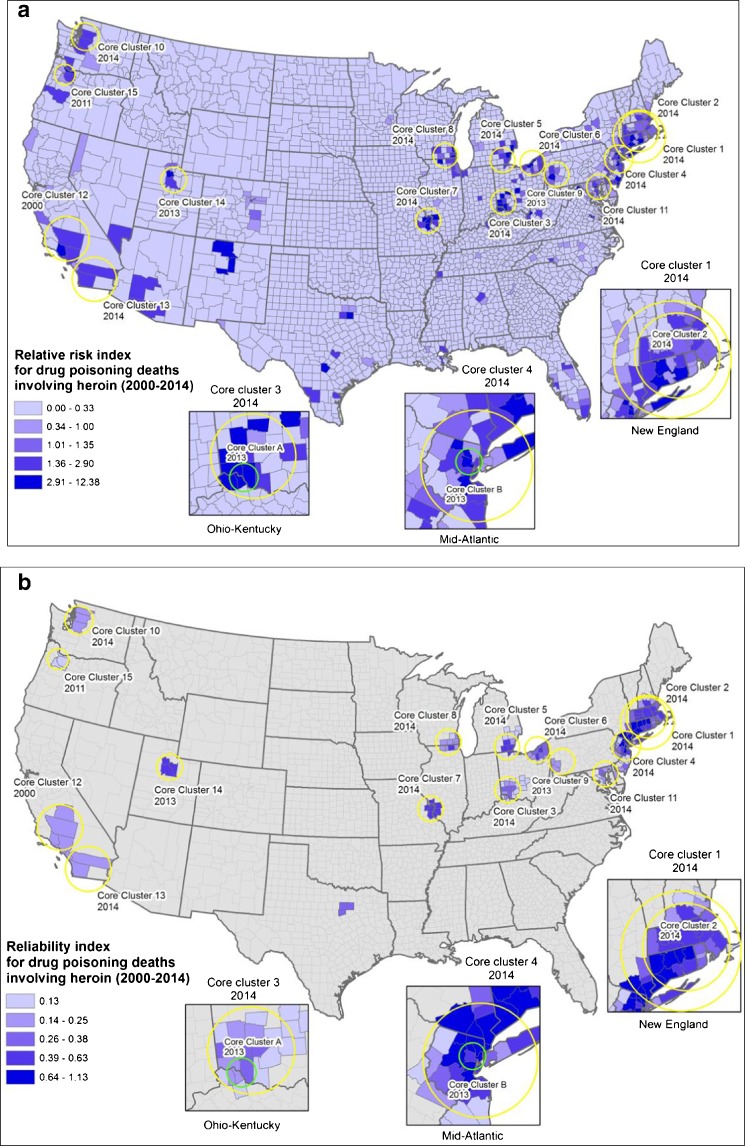
We investigate the geographic patterns of drug poisoning deaths involving heroin by county for the USA from 2000 to 2014. The county-level patterns of mortality are examined with respect to age-adjusted rates of death for different classes of urbanization and racial and ethnic groups, while rates based on raw counts of drug poisoning deaths involving heroin are estimated for different age groups and by gender. To account for possible underestimations in these rates due to small areas or small numbers, spatial empirical Baye's estimation techniques have been used to smooth the rates of death and alleviate underestimation when analyzing spatial patterns for these different groups. The geographic pattern of poisoning deaths involving heroin has shifted from the west coast of the USA in the year 2000 to New England, the Mid-Atlantic region, and the Great Lakes and central Ohio Valley by 2014. The evolution over space and time of clusters of drug poisoning deaths involving heroin is confirmed through the SaTScan analysis. For this period, White males were found to be the most impacted population group overall; however, Blacks and Hispanics are highly impacted in counties where significant populations of these two groups reside. Our results show that while 35-54-year-olds were the most highly impacted age group by county from 2000 to 2010, by 2014, the trend had changed with an increasing number of counties experiencing higher death rates for individuals 25-34 years. The percentage of counties across the USA classified as large metro with deaths involving heroin is estimated to have decreased from approximately 73% in 2010 to just fewer than 56% in 2014, with a shift to small metro and non-metro counties. Understanding the geographic variations in impact on different population groups in the USA has become particularly necessary in light of the extreme increase in the use and misuse of street drugs including heroin and the subsequent rise in opioid-related deaths in the USA.
Keywords: Drug poisoning deaths; Heroin; Spatiotemporal cluster analysis; Substance use.
Figures
References
-
- Substance Abuse and Mental Health Services Administration. Results from the 2011 National Survey on Drug Use and Health: Summary of National Findings, NSDUH Series H-48, HHS Publication No. (SMA) 14-4863. Rockville. 2012.
-
- Substance Abuse and Mental Health Services Administration. Results from the 2014 National Survey on Drug Use and Health: Summary of National Findings, NSDUH Series H-48, HHS Publication No. (SMA) 14-4863. Rockville. 2015.
-
- Ford M, Dulaney AR. Prescription drug overdose: data from Carolinas Poison Center. N C Med J. 2014;74(3):74316. http://www.cdc.gov/psr/prescriptiondrug/. Accessed Aug 2016 - PubMed
-
- Coplan PM, Kale H, Sandstrom L, Landau C, Chilcoat HD. Changes in oxycodone and heroin exposures in the National Poison Data System after introduction of extended-release oxycodone with abuse-deterrent characteristics. Pharmacoepidemiol Drug Saf. 2013;22:1274–1282. doi: 10.1002/pds.3522. - DOI - PMC - PubMed
MeSH terms
Substances
Grants and funding
LinkOut - more resources
Full Text Sources
Other Literature Sources
