


Bacterial genome sequencing in clinical microbiology: a pathogen-oriented review
- PMID: 28639162
- PMCID: PMC5653721
- DOI: 10.1007/s10096-017-3024-6
Bacterial genome sequencing in clinical microbiology: a pathogen-oriented review
Abstract
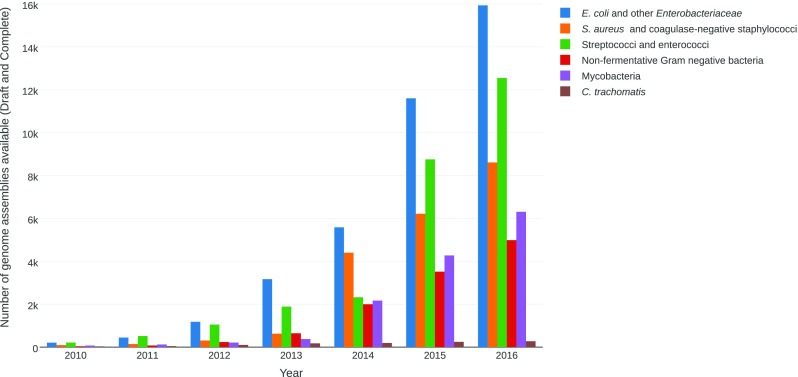
In recent years, whole-genome sequencing (WGS) has been perceived as a technology with the potential to revolutionise clinical microbiology. Herein, we reviewed the literature on the use of WGS for the most commonly encountered pathogens in clinical microbiology laboratories: Escherichia coli and other Enterobacteriaceae, Staphylococcus aureus and coagulase-negative staphylococci, streptococci and enterococci, mycobacteria and Chlamydia trachomatis. For each pathogen group, we focused on five different aspects: the genome characteristics, the most common genomic approaches and the clinical uses of WGS for (i) typing and outbreak analysis, (ii) virulence investigation and (iii) in silico antimicrobial susceptibility testing. Of all the clinical usages, the most frequent and straightforward usage was to type bacteria and to trace outbreaks back. A next step toward standardisation was made thanks to the development of several new genome-wide multi-locus sequence typing systems based on WGS data. Although virulence characterisation could help in various particular clinical settings, it was done mainly to describe outbreak strains. An increasing number of studies compared genotypic to phenotypic antibiotic susceptibility testing, with mostly promising results. However, routine implementation will preferentially be done in the workflow of particular pathogens, such as mycobacteria, rather than as a broadly applicable generic tool. Overall, concrete uses of WGS in routine clinical microbiology or infection control laboratories were done, but the next big challenges will be the standardisation and validation of the procedures and bioinformatics pipelines in order to reach clinical standards.
Keywords: Clinical microbiology; Genomics; Next-generation sequencing; Whole-genome sequencing.
Conflict of interest statement
The authors declare that they have no conflict of interest.
Figures
References
Publication types
MeSH terms
LinkOut - more resources
Full Text Sources
Other Literature Sources
