Review
. 2017 Jun 22;9(7):70.
doi: 10.3390/cancers9070070.

Phenotypic Plasticity and Cell Fate Decisions in Cancer: Insights from Dynamical Systems Theory

Affiliations
Review

Phenotypic Plasticity and Cell Fate Decisions in Cancer: Insights from Dynamical Systems Theory

Dongya Jia et al. Cancers (Basel). .

Abstract

Waddington's epigenetic landscape, a famous metaphor in developmental biology, depicts how a stem cell progresses from an undifferentiated phenotype to a differentiated one. The concept of "landscape" in the context of dynamical systems theory represents a high-dimensional space, in which each cell phenotype is considered as an "attractor" that is determined by interactions between multiple molecular players, and is buffered against environmental fluctuations. In addition, biological noise is thought to play an important role during these cell-fate decisions and in fact controls transitions between different phenotypes. Here, we discuss the phenotypic transitions in cancer from a dynamical systems perspective and invoke the concept of "cancer attractors"-hidden stable states of the underlying regulatory network that are not occupied by normal cells. Phenotypic transitions in cancer occur at varying levels depending on the context. Using epithelial-to-mesenchymal transition (EMT), cancer stem-like properties, metabolic reprogramming and the emergence of therapy resistance as examples, we illustrate how phenotypic plasticity in cancer cells enables them to acquire hybrid phenotypes (such as hybrid epithelial/mesenchymal and hybrid metabolic phenotypes) that tend to be more aggressive and notoriously resilient to therapies such as chemotherapy and androgen-deprivation therapy. Furthermore, we highlight multiple factors that may give rise to phenotypic plasticity in cancer cells, such as (a) multi-stability or oscillatory behaviors governed by underlying regulatory networks involved in cell-fate decisions in cancer cells, and (b) network rewiring due to conformational dynamics of intrinsically disordered proteins (IDPs) that are highly enriched in cancer cells. We conclude by discussing why a therapeutic approach that promotes "recanalization", i.e., the exit from "cancer attractors" and re-entry into "normal attractors", is more likely to succeed rather than a conventional approach that targets individual molecules/pathways.

Keywords: EMT; cancer attractors; cell fate decision; gene network dynamics; intrinsically disordered proteins; therapy resistance.


Conflict of interest statement

The authors declare that they have no conflict of interest.

Figures
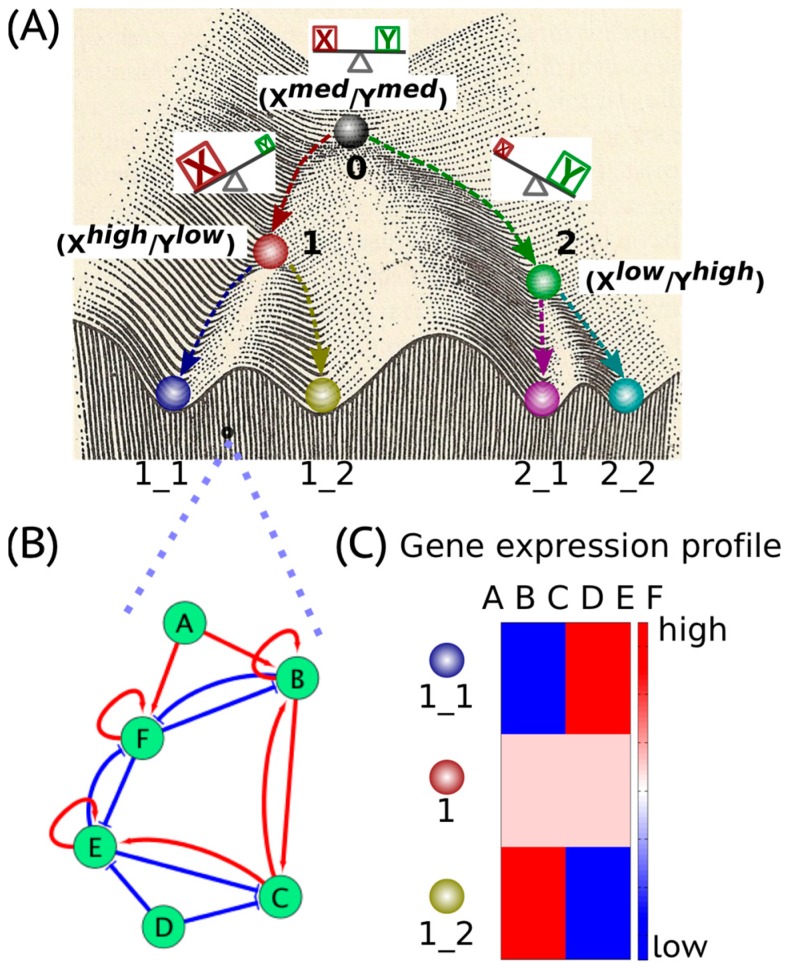
Figure 1
Figure 1
Schematic illustration of Waddington’s epigenetic landscape. (A) Waddington’s epigenetic landscape (adopted and revised from [1]). The balls with different colors on the landscape represent different cell phenotypes, each settles steadily in one of the sub-valleys at the foot of the hill. X and Y are the master regulators driving a cell to attain the phenotypes “1” and “2” respectively. The phenotype “0”, characterized by the co-expression of both X and Y at a medium level Xmed/Ymed, represents the progenitor state of the two differentiated states “1” and “2” which are characterized by Xhigh/Ylow and Xlow/Yhigh respectively. Due to inherent stochasticity in the progenitor cell “0”, the level of X (Y) becomes higher than that of Y (X). This asymmetry can trigger a cascade of events where the levels of X (Y) continually increase and those of Y (X) continually decrease, because X (Y) can progressively repress its repressor Y (X) strongly, rendering its own inhibition by Y (X) ineffective. Consequently, the cell attains the differentiated state Xhigh/Ylow (Xlow/Yhigh). (B) Schematic illustration of a gene regulatory network (GRN) governing the differentiation of “1” to two lineages “1_1” and “1_2”. The nodes A–F represent different genes whose regulatory behaviors usually can be approximated by the interplay between two master regulators X and Y as aforementioned. Various kinds of regulation can be found in the GRN, such as transcriptional activation, represented by red arrows, transcriptional inhibition, represented by blue bar-headed arrows, and self-activation, represented by circled arrows. (C) Schematic illustration of a heatmap that depicts the gene expression patterns of different cell phenotypes. The two sister lineages “1_1” and “1_2” are characterized by different gene expression patterns, i.e., relatively high expression of one gene set and low of another. The progenitor of “1_1” and “1_2”, i.e., “1”, usually co-expresses both sets of genes at some intermediate level.
Figure 2
Figure 2
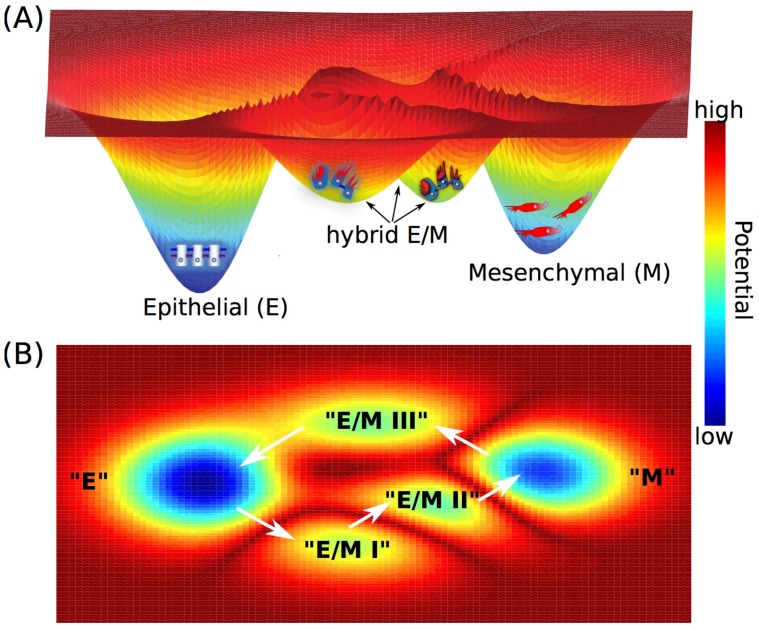
Schematic illustration of the quasi-potential landscape for epithelial-to-mesenchymal transition (EMT) in 3-dimensional space (A) and 2-dimensional projection (B). In (A), the basins of attraction depicting the attractors “E”, “E/M” and “M” are labeled respectively along with the cartoons representing the epithelial (tight cell-cell adhesion, cobblestone shaped), hybrid E/M (some cell-cell adhesion and invasive) and mesenchymal (no cell-cell adhesion, invasive and spindle-shaped) phenotypes. The quasi-potential of “attractors”, i.e., stability of “attractors”, is derived from the probability of finding cells in that “attractors”. Lower potential here represents more stable “attractor” in the landscape. The “potential well” depicted here is an analog of “valleys” in Waddington epigenetic landscape.
Figure 3
Figure 3
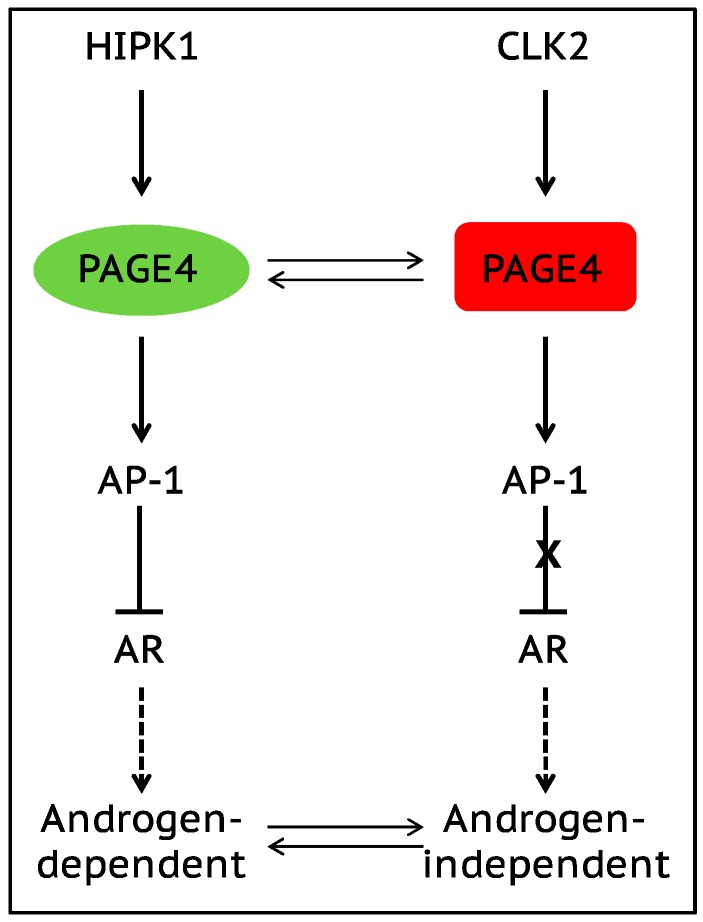
IDP conformational dynamics and phenotypic heterogeneity in prostate cancer cells. The stress-response kinase HIPK1 phosphorylates the IDP PAGE4 resulting in a relatively compact PAGE4 ensemble (HIPK1-PAGE4) that can potentiate AP-1 in androgen-dependent cells. In contrast, the dual-specificity kinase CLK2 hyperphosphorylates PAGE4 leading to a more random-like PAGE4 ensemble (CLK2-PAGE4) that attenuates AP-1 function. Mathematical modeling suggests that the oscillatory dynamics of HIPK1-PAGE4, CLK2-PAGE4, and CLK2 in the circuit enable the cells to transition from an androgen-dependent to an androgen-independent phenotype. This prediction is supported by the experimentally observed heterogeneity in a population of isogenic PCa cells (see [106] for details).

References

    1. Waddington C.H. The Strategy of the Genes. George Allen & Unwin; London, UK: 1957.
    1. Zhou J.X., Huang S. Understanding gene circuits at cell-fate branch points for rational cell reprogramming. Trends Genet. 2011;27:55–62. doi: 10.1016/j.tig.2010.11.002. - DOI - PubMed
    1. Takahashi K., Yamanaka S. Induction of pluripotent stem cells from mouse embryonic and adult fibroblast cultures by defined factors. Cell. 2006;126:663–676. doi: 10.1016/j.cell.2006.07.024. - DOI - PubMed
    1. Amson R., Karp J.E., Telerman A. Lessons from tumor reversion for cancer treatment. Curr. Opin. Oncol. 2013;25:59–65. doi: 10.1097/CCO.0b013e32835b7d21. - DOI - PubMed
    1. Giuliani A. Collective motions and specific effectors: A statistical mechanics perspective on biological regulation. BMC Genomics. 2010;11:S2. doi: 10.1186/1471-2164-11-S1-S2. - DOI - PMC - PubMed

LinkOut - more resources