Crash Fatality Rates After Recreational Marijuana Legalization in Washington and Colorado
- PMID: 28640679
- PMCID: PMC5508149
- DOI: 10.2105/AJPH.2017.303848
Crash Fatality Rates After Recreational Marijuana Legalization in Washington and Colorado
Abstract
Objectives: To evaluate motor vehicle crash fatality rates in the first 2 states with recreational marijuana legalization and compare them with motor vehicle crash fatality rates in similar states without recreational marijuana legalization.
Methods: We used the US Fatality Analysis Reporting System to determine the annual numbers of motor vehicle crash fatalities between 2009 and 2015 in Washington, Colorado, and 8 control states. We compared year-over-year changes in motor vehicle crash fatality rates (per billion vehicle miles traveled) before and after recreational marijuana legalization with a difference-in-differences approach that controlled for underlying time trends and state-specific population, economic, and traffic characteristics.
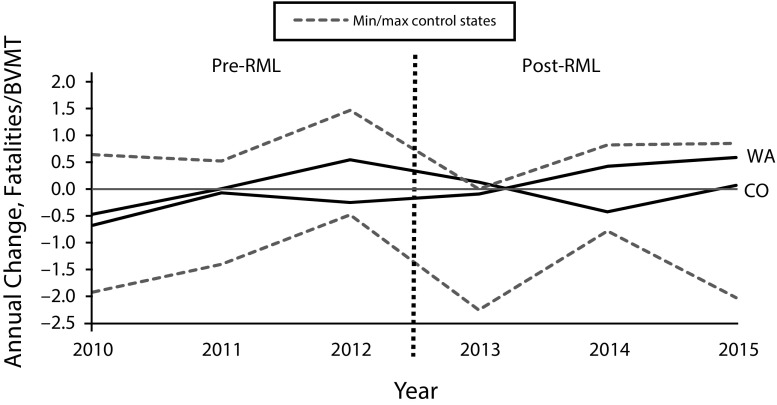
Results: Pre-recreational marijuana legalization annual changes in motor vehicle crash fatality rates for Washington and Colorado were similar to those for the control states. Post-recreational marijuana legalization changes in motor vehicle crash fatality rates for Washington and Colorado also did not significantly differ from those for the control states (adjusted difference-in-differences coefficient = +0.2 fatalities/billion vehicle miles traveled; 95% confidence interval = -0.4, +0.9).
Conclusions: Three years after recreational marijuana legalization, changes in motor vehicle crash fatality rates for Washington and Colorado were not statistically different from those in similar states without recreational marijuana legalization. Future studies over a longer time remain warranted.
Figures
References
-
- Pollini RA, Romano E, Johnson MB, Lacey JH. The impact of marijuana decriminalization on California drivers. Drug Alcohol Depend. 2015;150:135–140. - PubMed
-
- Masten SV, Guenzburger GV. Changes in driver cannabinoid prevalence in 12 U.S. states after implementing medical marijuana laws. J Safety Res. 2014;50:35–52. - PubMed
-
- Dubois S, Mullen N, Weaver B, Bédard M. The combined effects of alcohol and cannabis on driving: impact on crash risk. Forensic Sci Int. 2015;248:94–100. - PubMed
-
- Blows S, Ivers RQ, Connor J, Ameratunga S, Woodward M, Norton R. Marijuana use and car crash injury. Addiction. 2005;100:605–611. - PubMed
MeSH terms
LinkOut - more resources
Full Text Sources
Other Literature Sources
Medical