Prevalence of Financial Fraud and Scams Among Older Adults in the United States: A Systematic Review and Meta-Analysis
- PMID: 28640686
- PMCID: PMC5508139
- DOI: 10.2105/AJPH.2017.303821
Prevalence of Financial Fraud and Scams Among Older Adults in the United States: A Systematic Review and Meta-Analysis
Abstract
Background: The financial exploitation of older adults was recently recognized by the Centers for Disease Control and Prevention as a serious public health problem. Knowledge of the prevalence of elder financial exploitation is mostly limited to the category of financial abuse, which occurs in relationships involving an expectation of trust. Little is known about the other major category of elder financial exploitation-elder financial fraud and scams, which is perpetrated by strangers. A valid estimate of elder financial fraud-scam prevalence is necessary as a foundation for research and prevention efforts.
Objectives: To estimate the prevalence of elder financial fraud-scam victimization in the United States based on a systematic review and meta-analysis.
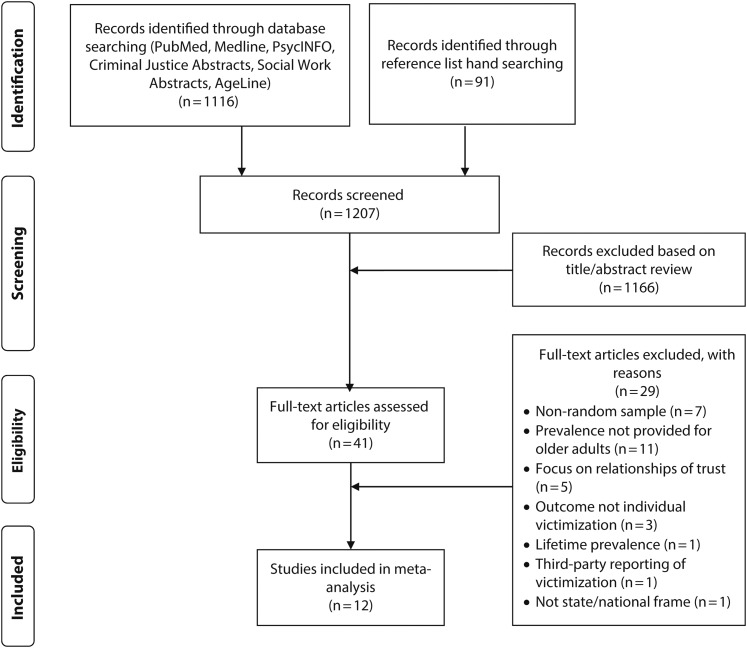
Search methods: Multiple investigators independently screened titles and abstracts and reviewed relevant full-text records from PubMed, Medline, PsycINFO, Criminal Justice Abstracts, Social Work Abstracts, and AgeLine databases.
Selection criteria: To maximize the validity and generalizability of prevalence estimation, we restricted eligibility to general population-based studies (English speaking, 1990 onward) using state- or national-level probability sampling and collecting data directly from older adults.
Data collection and analysis: Information on elder financial fraud-scam prevalence and study-level characteristics was extracted independently by 2 investigators. Meta-analysis of elder financial fraud-scam prevalence used generalized mixed models with individual studies as levels of a random classification factor.
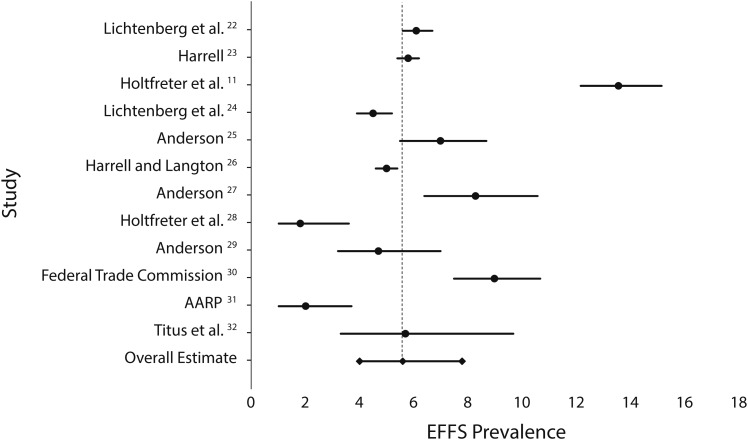
Main results: We included 12 studies involving a total of 41 711 individuals in the meta-analysis. Overall pooled elder financial fraud-scam prevalence (up to 5-year period) across studies was 5.6% (95% confidence interval [CI] = 4.0%, 7.8%), with a 1-year period prevalence of 5.4% (95% CI = 3.2%, 7.6%). Studies using a series of questions describing specific fraud-scam events to measure victimization found a significantly higher prevalence (7.1%; 95% CI = 4.8%, 9.4%) than studies using a single, general-question self-report assessment approach (3.6%; 95% CI = 1.8%, 5.4%).
Author's conclusions: Elder financial fraud and scams is a common problem, affecting approximately 1 of every 18 cognitively intact, community-dwelling older adults each year; it requires further attention from researchers, clinicians, and policymakers. Elder financial fraud-scam prevalence findings in this study likely underestimate the true population prevalence. We provide methodological recommendations to limit older adult participation and reporting bias in future population-based research. Public Health Implications. Elder financial exploitation victimization is associated with mortality, hospitalization, and poor physical and mental health. Health care professionals working with older adults likely routinely encounter patients who are fraud-scam victims. Validation of instruments to screen for elder financial fraud and scams in clinical settings is an important area of future research. Without effective primary prevention strategies, the absolute scope of this problem will escalate with the growing population of older adults.
Figures
References
-
- Hall JE, Karch DL, Crosby AE. Elder Abuse Surveillance: Uniform Definitions and Recommended Core Data Elements for Use in Elder Abuse Surveillance, Version 1.0. Atlanta, GA: National Center for Injury Prevention and Control, Centers for Disease Control and Prevention; 2016.
-
- 2015 White House Conference On Aging: Final Report. Washington, DC: White House Conference on Aging; 2015.
-
- Burnett J, Jackson SL, Sinha AK et al. Five-year all-cause mortality rates across five types of substantiated elder abuse occurring in the community. J Elder Abuse Negl. 2016;28(2):59–75. - PubMed
-
- Ganzini L, McFarland BH, Cutler D. Prevalence of mental disorders after catastrophic financial loss. J Nerv Ment Dis. 1990;178(11):680–685. - PubMed
Publication types
MeSH terms
Grants and funding
LinkOut - more resources
Full Text Sources
Other Literature Sources
Medical