Review
. 2017 Jul 20;35(21):2378-2385.
doi: 10.1200/JCO.2016.71.7199. Epub 2017 Jun 22.

CNS Tumors in Neurofibromatosis

Affiliations
Review

CNS Tumors in Neurofibromatosis

Jian Campian et al. J Clin Oncol. .

Abstract

Neurofibromatosis (NF) encompasses a group of distinct genetic disorders in which affected children and adults are prone to the development of benign and malignant tumors of the nervous system. The purpose of this review is to discuss the spectrum of CNS tumors arising in individuals with NF type 1 (NF1) and NF type 2 (NF2), their pathogenic etiologies, and the rational treatment options for people with these neoplasms. This article is a review of preclinical and clinical data focused on the treatment of the most common CNS tumors encountered in children and adults with NF1 and NF2. Although children with NF1 are at risk for developing low-grade gliomas of the optic pathway and brainstem, individuals with NF2 typically manifest low-grade tumors affecting the cranial nerves (vestibular schwannomas), meninges (meningiomas), and spinal cord (ependymomas). With the identification of the NF1 and NF2 genes, molecularly targeted therapies are beginning to emerge, as a result of a deeper understanding of the mechanisms underlying NF1 and NF2 protein function. As we enter into an era of precision oncology, a more comprehensive awareness of the factors that increase the risk of developing CNS cancers in affected individuals, coupled with a greater appreciation of the cellular and molecular determinants that maintain tumor growth, will undoubtedly yield more effective therapies for these cancer predisposition syndromes.


Figures
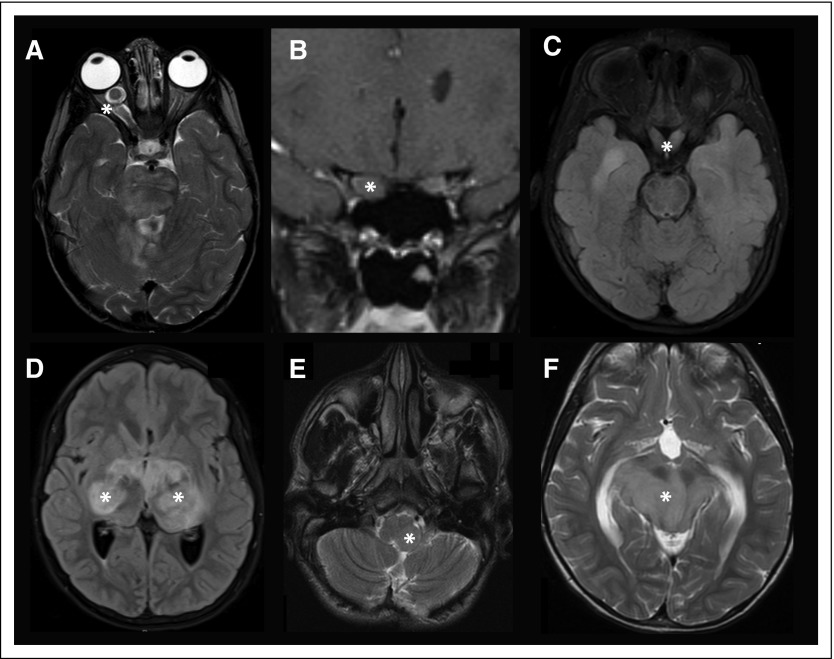
Fig 1.
Fig 1.
CNS tumors in neurofibromatosis type 1. (A) Right optic nerve glioma with contrast enhancement. (B) Right optic glioma in the coronal plane, revealing asymmetry in the sizes of the optic nerves. (C) Bilateral optic chiasm and tract glioma. (D) Bilateral optic radiation glioma. (E) Left pontine glioma extending into the medulla. (F) Bilateral midbrain glioma with associated obstructive hydrocephalus (note the enlarged posterior horns of the lateral ventricles). Asterisks denote the location of the tumors in all panels.
Fig 2.
Fig 2.
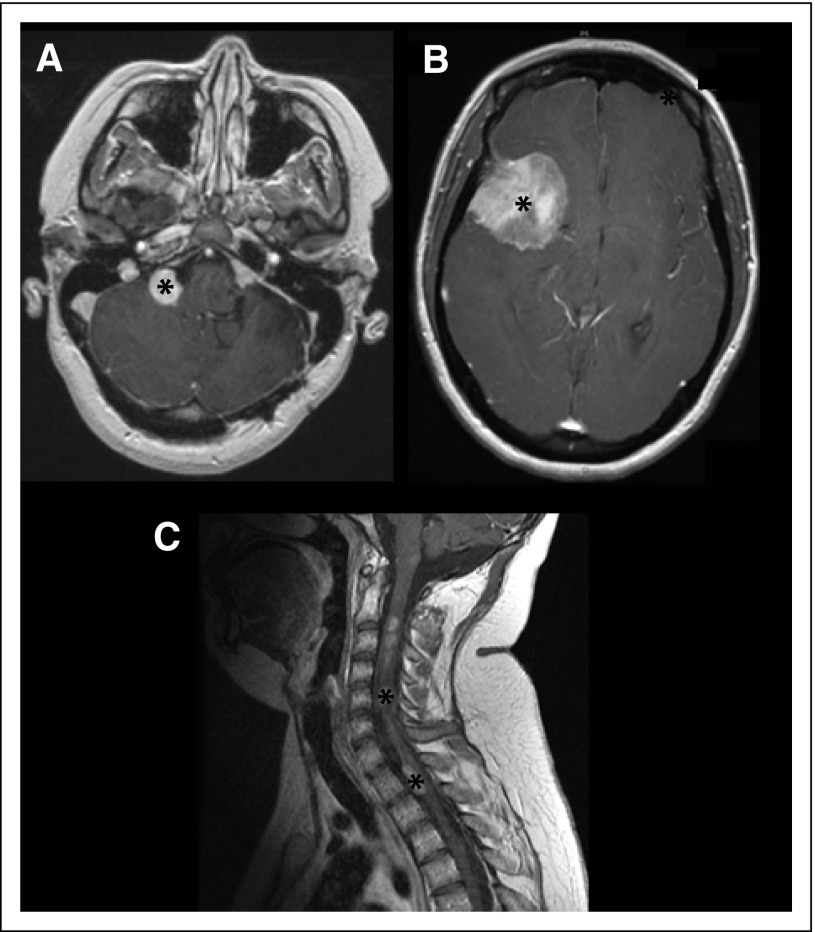
CNS tumors in neurofibromatosis type 2. (A) Bilateral vestibular schwannomas with gadolinium contrast enhancement (asterisk). (B) A large meningioma in the right anterior and middle cranial fossa in the axial plane (asterisk). (C) Multiple spinal cord ependymomas (string of pearls) in the sagittal T1-weighted contrast-enhanced magnetic resonance image of the cervical spine (asterisks).
Fig 3.
Fig 3.
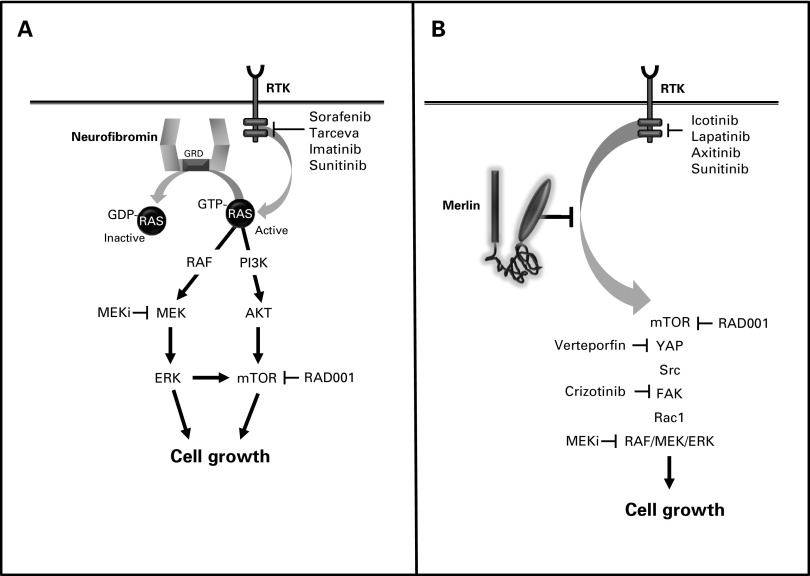
NF1 and NF2 genes/proteins. (A) The NF1 gene encodes a 2818 amino acid protein with a central RAS-GTPase-activating protein domain. Neurofibromin functions to accelerate the conversion of active GTP-bound RAS to its inactive GDP-bound conformation. Active RAS transmits its growth-promoting signal by activating MEK, AKT, and mechanistic target of rapamycin (mTOR). (B) The NF2 gene encodes a 595 amino acid protein with striking sequence similarity to molecules of the protein 4.1 (ezrin, radixin, and moesin) superfamily. Numerous mechanisms have been proposed for merlin growth regulation, including suppression of RAF/MEK, YAP, mechanistic target of rapamycin (mTOR), ErbB2, Src, FAK, and Rac1 activation. Molecularly targeted therapies that inhibit specific signaling intermediates and receptor tyrosine kinases have been evaluated in preclinical and clinical trials.

References

    1. Kresak JL, Walsh M: Neurofibromatosis: A review of NF1, NF2, and schwannomatosis. J Pediatr Genet 5:98-104, 2016 - PMC - PubMed
    1. Blakeley JO, Plotkin SR: Therapeutic advances for the tumors associated with neurofibromatosis type 1, type 2, and schwannomatosis. Neuro-oncol 18:624-638, 2016 - PMC - PubMed
    1. Anderson JL, Gutmann DH: Neurofibromatosis type 1. Handb Clin Neurol 132:75-86, 2015 - PubMed
    1. Ingham S, Huson SM, Moran A, et al. : Malignant peripheral nerve sheath tumours in NF1: Improved survival in women and in recent years. Eur J Cancer 47:2723-2728, 2011 - PubMed
    1. Evans DG, Huson SM, Birch JM: Malignant peripheral nerve sheath tumours in inherited disease. Clin Sarcoma Res 2:17, 2012 - PMC - PubMed

MeSH terms