. 2017 Jun 23;66(24):636-643.
doi: 10.15585/mmwr.mm6624a3.

Evaluation of Placental and Fetal Tissue Specimens for Zika Virus Infection - 50 States and District of Columbia, January-December, 2016

Collaborators, Affiliations

Evaluation of Placental and Fetal Tissue Specimens for Zika Virus Infection - 50 States and District of Columbia, January-December, 2016

Sarah Reagan-Steiner et al. MMWR Morb Mortal Wkly Rep. .

Abstract

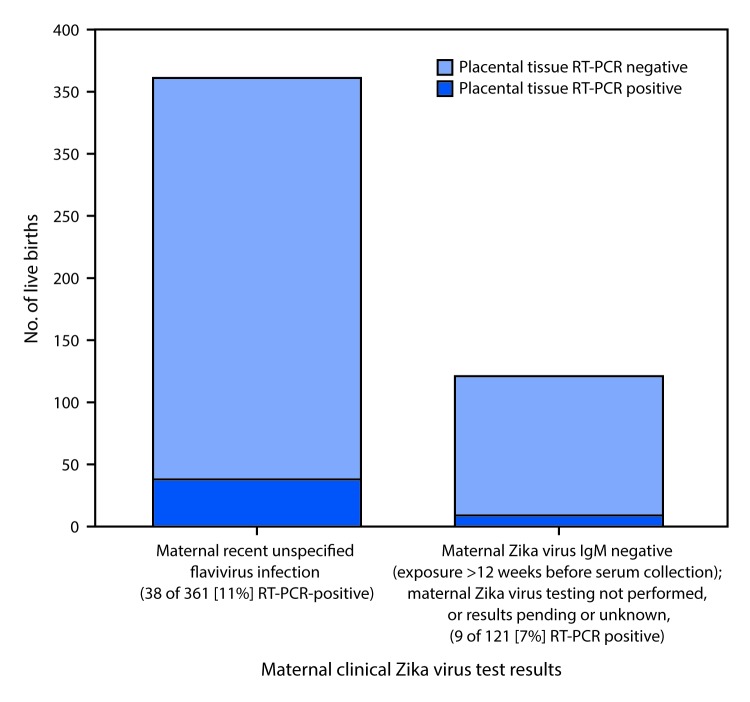
Zika virus infection during pregnancy can cause congenital microcephaly and brain abnormalities (1), and detection of Zika virus RNA in clinical and tissue specimens can provide definitive laboratory evidence of recent Zika virus infection. Whereas duration of viremia is typically short, prolonged detection of Zika virus RNA in placental, fetal, and neonatal brain tissue has been reported and can provide key diagnostic information by confirming recent Zika virus infection (2). In accordance with recent guidance (3,4), CDC provides Zika virus testing of placental and fetal tissues in clinical situations where this information could add diagnostic value. This report describes the evaluation of formalin-fixed paraffin-embedded (FFPE) tissue specimens tested for Zika virus infection in 2016 and the contribution of this testing to the public health response. Among 546 live births with possible maternal Zika virus exposure, for which placental tissues were submitted by the 50 states and District of Columbia (DC), 60 (11%) were positive by Zika virus reverse transcription-polymerase chain reaction (RT-PCR). Among 81 pregnancy losses for which placental and/or fetal tissues were submitted, 18 (22%) were positive by Zika virus RT-PCR. Zika virus RT-PCR was positive on placental tissues from 38/363 (10%) live births with maternal serologic evidence of recent unspecified flavivirus infection and from 9/86 (10%) with negative maternal Zika virus immunoglobulin M (IgM) where possible maternal exposure occurred >12 weeks before serum collection. These results demonstrate that Zika virus RT-PCR testing of tissue specimens can provide a confirmed diagnosis of recent maternal Zika virus infection.


Conflict of interest statement

Conflict of Interest: Kirsten St. George reports grants from Akonni Biosystems Inc., nonfinancial support from ThermoFisher, and a royalty generating collaborative agreement with Zeptometrix outside the submitted work. No other conflicts of interest were reported.

Figures

FIGURE
FIGURE
Zika virus placental tissue RT-PCR results, among live births with neither clinical laboratory evidence of confirmed recent Zika virus infection on maternal testing nor confirmed congenital Zika virus infection on infant testing (n = 482),,†,§ by maternal clinical Zika virus test results categories, — 50 U.S. states and the District of Columbia, January–December, 2016 Abbreviations: IgM = immunoglobulin M; PRNT= plaque-reduction neutralization test; RT-PCR = reverse transcription–polymerase chain reaction. * Excludes live births with confirmed recent maternal Zika virus infection (positive Zika virus RT-PCR, or Zika or dengue virus IgM-positive or equivocal with Zika virus PRNT titer ≥10 and dengue virus PRNT titer <10) or no evidence of Zika virus infection (Zika or dengue virus IgM positive or equivocal with Zika virus PRNT titer <10 regardless of dengue PRNT titer, or Zika virus IgM negative where all possible exposure occurred within 2–12 weeks of serum collection date), or confirmed congenital Zika virus infection based on infant testing (positive Zika virus RT-PCR or Zika virus IgM positive and Zika virus PRNT titer ≥10 with dengue virus PRNT titer <10). Includes 41 live births where infants had laboratory evidence of probable congenital Zika virus infection; 9/41 (22%) with placental tissue RT-PCR positive; and 441 live births where infants had negative Zika virus testing or no Zika virus testing reported; 38/441 (9%) with placental tissue RT-PCR positive. Positive placental tissue RT-PCR results provide evidence of confirmed recent maternal Zika virus infection. § Placental tissue RT-PCR positive = at least one placental tissue specimen was positive by Zika virus RT-PCR. Recent unspecified flavivirus infection = negative or no Zika virus RT-PCR performed, with Zika or dengue virus IgM positive, or equivocal with Zika and dengue virus PRNT titers ≥10. ** Maternal samples negative by Zika virus IgM, all or part of possible exposure occurred >12 weeks before serum collection date with negative or no Zika virus RT-PCR performed, maternal Zika virus testing not performed, or results pending or unknown.

References

    1. Rasmussen SA, Jamieson DJ, Honein MA, Petersen LR. Zika virus and birth defects—reviewing the evidence for causality. N Engl J Med 2016;374:1981–7. 10.1056/NEJMsr1604338 - DOI - PubMed
    1. Bhatnagar J, Rabeneck DB, Martines RB, et al. Zika virus RNA replication and persistence in brain and placental tissue. Emerg Infect Dis 2017;23:405–14. 10.3201/eid2303.161499 - DOI - PMC - PubMed
    1. Russell K, Oliver SE, Lewis L, et al. Update: interim guidance for the evaluation and management of infants with possible congenital Zika virus infection—United States, August 2016. MMWR Morb Mortal Wkly Rep 2016;65:870–8. 10.15585/mmwr.mm6533e2 - DOI - PubMed
    1. Oduyebo T, Igbinosa I, Petersen EE, et al. Update: interim guidance for health care providers caring for pregnant women with possible Zika virus exposure—United States, July 2016. MMWR Morb Mortal Wkly Rep 2016;65:739–44. 10.15585/mmwr.mm6529e1 - DOI - PubMed
    1. Rabe IB, Staples JE, Villanueva J, et al.; MTS. Interim guidance for interpretation of Zika virus antibody test results. MMWR Morb Mortal Wkly Rep 2016;65:543–6. 10.15585/mmwr.mm6521e1 - DOI - PubMed